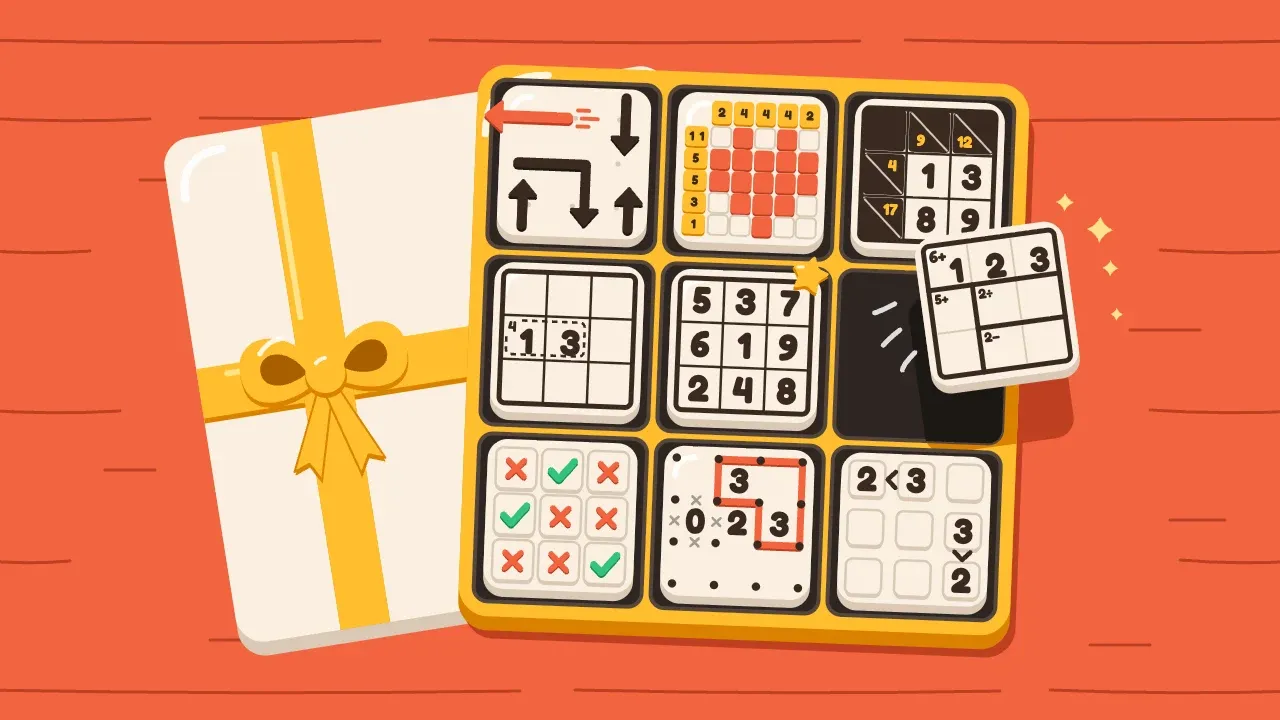
Puzzles like Sudoku keep what you already enjoy: a small set of rules, a grid, and an answer you reach by logic. These eight change the clues instead. Some use sums, some use pictures, and one has no numbers at all. They’re grouped by what you’d like to keep.
What makes Sudoku so satisfying (and what to look for next)
Sudoku is satisfying because a few rules lead to one answer. Nikoli gives the rules: fill a 9x9 grid so that every row, column and 3x3 box holds the digits 1 to 9 once each. A well-made puzzle has a single solution, and there’s no arithmetic involved, since Wikipedia notes the nine symbols could be anything. Even the emptiest puzzle needs clues: a 2012 computer search by McGuire, Tugemann and Civario showed that no 16-clue Sudoku with one solution exists, so 17 is the fewest.
It’s an American puzzle with a Japanese name. Dell’s magazine printed it as “Number Place” in 1979, and Nikoli introduced it in Japan in 1984, then shortened the name to Sudoku, according to Wikipedia and Nikoli.
When you look for the next puzzle, three things can change:
- The clues: numbers, pictures or shapes.
- The arithmetic: none, counting only, or small sums.
- What you draw: digits in cells, filled squares, or a line.
| If you want… | Try |
|---|---|
| The closest thing to Sudoku | KenKen or Killer Sudoku |
| Number puzzles with lots of sums | Kakuro |
| Numbers without arithmetic | Futoshiki or Hitori |
| A picture at the end | Nonograms |
| Clues written in words | Zebra puzzles |
| Something with no numbers | Arrow puzzles |
Number puzzles that feel closest to Sudoku
These four keep the digits. Three of them add sums, so they ask a little more of your arithmetic than Sudoku does. Don’t worry, the digits stay small (1 to 9 at most).
1. KenKen: a Sudoku grid with cages instead of boxes
KenKen keeps the rule that each digit appears once per row and column, and drops the 3x3 boxes. In their place are cages: heavy-outlined groups of cells with a target number and an operation (+, -, x or ÷) in the corner, says Wikipedia. Grids run from 3x3 to 9x9, according to KenKen’s makers, who say Japanese maths teacher Tetsuya Miyamoto developed it in 2004. The name comes from the Japanese ken, roughly wisdom or cleverness, so KenKen means cleverness twice over (Drexel University).
A tiny example: in a 3x3 grid, a three-cell cage marked 6+ can only hold 1, 2 and 3 in some order. Here’s one quirk that Sudoku doesn’t have: a cage may repeat a digit when the repeated cells share neither a row nor a column, as the Keen manual explains.
Want the closest feel to Sudoku, and don’t mind small sums? This is the one. Start with a 3x3 or 4x4: a small grid won’t overwhelm you. You’ll also see it as Calcudoku or Mathdoku, names used by publishers without the KenKen trademark.
2. Killer Sudoku: Sudoku plus cage totals
Killer Sudoku is a normal 9x9 Sudoku with cages added. According to Wikipedia, it starts with no digits, and the digits in each cage must add to that cage’s total. In the usual version no digit repeats inside a cage, and the row, column and box rules still apply. Check each puzzle’s own rules before you start.
A two-cell cage totalling 4 can only be 1 and 3, since 2 and 2 would repeat. That one deduction is the first new skill, and you already know the row, column and box rules. Killer Sudoku is usually credited to Tokyo puzzle setter Tetsuya Nishio and was called “sum number place” in Japan, per Wikipedia and Ed Pegg Jr.’s survey of Sudoku variations.
Good for anyone who knows Sudoku well and wants one new idea.
3. Kakuro: a crossword made of sums
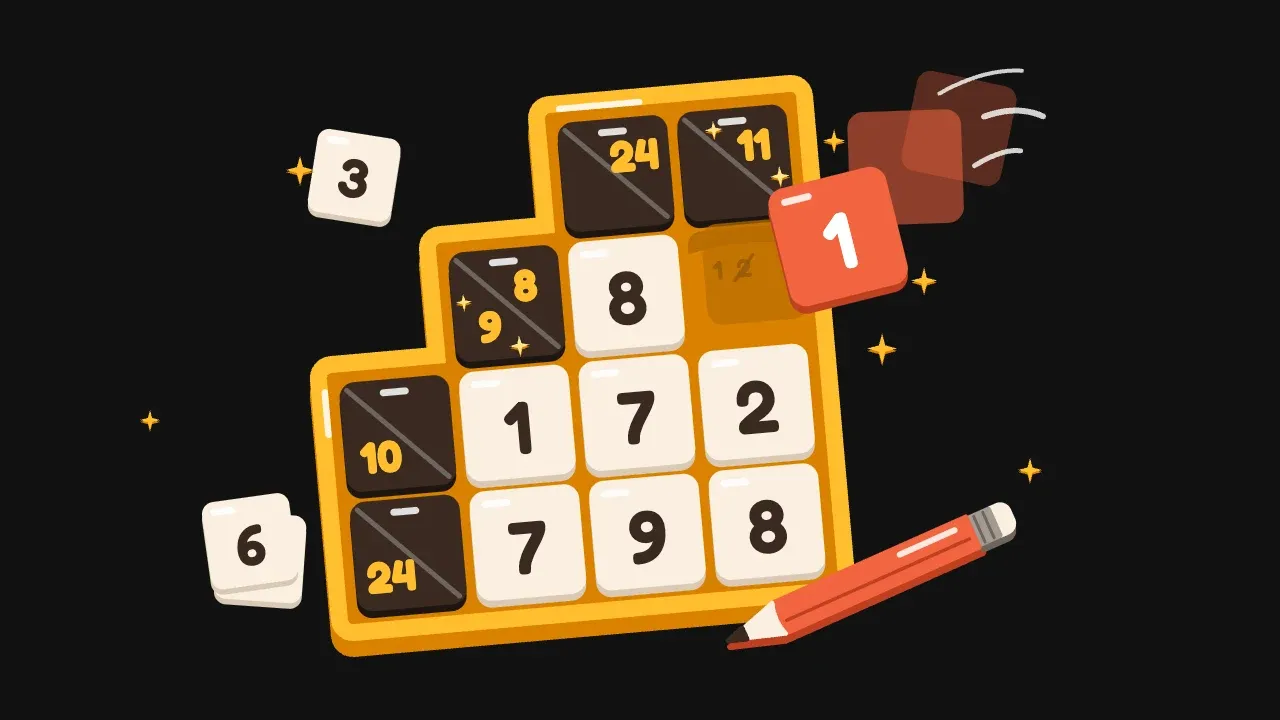
Kakuro swaps words for totals. You write digits 1 to 9 in the white cells, and each run of cells must add up to the clue in the black cell beside or above it, with no digit repeated inside a run (Nikoli). In English it began as “Cross Sums” at Dell Magazines, and “Kakuro” is short for the Japanese “kasan kurosu”, meaning “addition cross”, says Grandmaster Puzzles.
What makes it playable? Some totals can be made only one way. A 4 in two cells is 1 and 3. A 17 in two cells is 8 and 9. A 6 in three cells is 1, 2 and 3. Two clues that cross share one cell, so a 3 and a 4 in two cells each must share the digit 1, as Wikipedia shows. Learn a handful and the grid opens up, so you don’t need to memorise them all. You’ll find a longer cheat sheet in how to solve Kakuro.
Compared with Sudoku, there are no boxes and no starting digits, and sums do the work. A fit if you like crosswords or the sum side of Killer Sudoku.
4. Futoshiki: Sudoku with greater-than signs
Futoshiki, Japanese for “inequality”, is a square grid where each digit appears once per row and column, with no boxes. A few digits are given, and < or > signs sit between some cells (Wikipedia; the same puzzle appears as Unequal in Simon Tatham’s collection).
A small deduction shows the idea. In a 4x4 grid, if one cell has a < sign pointing at its right neighbour, the left cell can’t be 4 and the right cell can’t be 1. Nothing gets added; it’s all about comparing sizes.
Does Kakuro sound like homework? Start here instead: you only compare sizes, never add.
Logic puzzles with no sums at all
These swap digits for filled squares, a loop or a table of yes and no. You’ll still count, but there are no sum clues to meet.
5. Nonograms: numbers that draw a picture
Nonograms put numbers at the edges of a grid. They give the lengths of the runs of filled cells in that row or column, in order, with at least one empty cell between runs, and the filled cells reveal a picture (Wikipedia). Non Ishida, a Japanese graphics editor, won a Tokyo competition in 1987 with pictures made from the lit windows of a skyscraper. The Puzzle Museum adds that the professional puzzler Tetsuya Nishio independently published the same kind of puzzle at about the same time. You’ll also meet them as Griddlers, Hanjie or Picross, which is Nintendo’s trademarked name.
A tiny example: a clue of 3 1 in a five-cell row needs 3 + 1 + 1 empty gap = 5 cells, so it fits only one way. Fill three, leave one empty, fill one.
Nobody places a digit here. You fill and cross out cells, and the reasoning feels like Sudoku’s: find the line where only one thing fits. That click is what Sudoku fans play for, isn’t it? A good pick if you want a picture when you finish and no sum clues. Start with how to solve nonograms, then pick some nonogram puzzles to try.
6. Slitherlink: one loop, drawn from number clues
In Slitherlink you connect neighbouring dots with lines to make one single loop that never crosses or branches. Each number says how many of its cell’s four edges belong to the loop, and cells without a number can have any count (Nikoli). Nikoli considers it its original puzzle, and Grandmaster Puzzles says it first appeared in 1989.
A tiny example: a 0 means none of its four edges is in the loop, so you can cross all four out at once.
Compared with Sudoku, you draw a path instead of writing digits, but the clues still chain: each certain edge makes the next one visible. It suits you if you like shapes and a puzzle that ends in a single clean loop. Learn the opening moves in how to solve Slitherlink.
7. Zebra puzzles: logic written as sentences
Zebra puzzles give you clues in words and a grid of yes and no marks. In the classic, Wikipedia says, there are five houses, each with a different colour, nationality, pet, drink and cigarette brand. Fifteen clues lead to the question of who owns the zebra. A version appeared in Life International in 1962. Its link to Einstein or Lewis Carroll has no known evidence, Mensa International notes.
A tiny example: the clue “Ben eats the pear” gets a tick in one cell and a cross in the rest of that row and column. Then the next clue has less room.
Where Sudoku’s rules are fixed, here they’re hidden in the sentences, and there’s no arithmetic at all. It suits you if you like a puzzle that reads like a small story. Learn the grid in how to solve zebra puzzles, then test yourself with zebra puzzles with answers.
One more to try: Nikoli’s Hitori. It starts from a grid of numbers. You shade cells so no number repeats in a row or column, shaded cells never touch along an edge, and all the unshaded cells stay connected. It needs no arithmetic.
A Sudoku-feel puzzle you can play now
8. Arrow puzzles: no numbers at all
An arrow puzzle covers a board with arrows. You tap one, and it slides off the board in the direction it points, as long as nothing stands in front of its head. Clear every arrow and you’ve won. There’s no clue to read, and you don’t place a digit. Each move comes from spotting what’s certain: which arrow has a free path right now? That’s the Sudoku habit in a new shape. The rules are short, and how arrow puzzles work covers them in full.
Try it with Loopaway, a free arrow puzzle in your browser: tap an arrow to slide it off the board.
A calm pick if you’re tired of numbers. If you want more, the free puzzle games page has three, all playable in your browser.
Which puzzle like Sudoku should you try first?
Which one first? The one that matches what you’d like to keep from Sudoku.
| If you want… | Try first | Why |
|---|---|---|
| The closest thing to Sudoku | Killer Sudoku or KenKen | Same grid logic, plus cages |
| Less arithmetic | Futoshiki | It only compares sizes |
| No sum clues and a picture | Nonograms | You count cells, no sum clues |
| A story-like puzzle | Zebra puzzles | Clues come as sentences |
| Something calm, no numbers | Arrow puzzles | Nothing to read, only an order to find |
| More sums | Kakuro | The sum combinations do the work |
Like numbers but not grids? Then number sequence puzzles are another route. For the wider map, see the types of puzzle game. And the habits for logic puzzles, like noticing what’s certain, marking what’s ruled out and not guessing, carry over to every puzzle here.
Where to play them free, on screen or on paper
You don’t have to pay for any of these. Simon Tatham’s Portable Puzzle Collection is MIT-licensed and includes Keen (KenKen-like), Unequal (Futoshiki), Loopy (Slitherlink), Solo (Sudoku and Killer) and Pattern (nonograms). It has browser versions, Windows downloads and source code for Unix. Krazydad offers free printable Sudoku, Kakuro and nonograms, free to reproduce for personal and school use.
A printout needs no screen or connection, and a pencil’s enough for the number, picture and loop puzzles on this list.
Frequently asked questions
What puzzles are similar to Sudoku?
KenKen, Killer Sudoku, Kakuro and Futoshiki are the number puzzles closest to it. Nonograms, Slitherlink, zebra puzzles and arrow puzzles keep the step-by-step logic but drop the sums.
Are there free puzzles like Sudoku?
Yes. Simon Tatham's Portable Puzzle Collection is free and has KenKen-like, Futoshiki, Slitherlink and nonogram puzzles. Krazydad offers free printable Sudoku, Kakuro and nonograms, and EnjoGames has free puzzle games you play in your browser.
Do I need to be good at maths to play puzzles like Sudoku?
No. Sudoku itself uses no arithmetic, and Futoshiki, Hitori, nonograms, Slitherlink and zebra puzzles need only comparing or counting. KenKen, Killer Sudoku and Kakuro use basic arithmetic on small digits.
Can I play logic puzzles offline?
Yes. Pen and paper works for Sudoku-style number puzzles, Nonograms, Slitherlink and zebra puzzles, and Krazydad's printable Sudoku, Kakuro and nonograms need no screen. Simon Tatham's collection also has Windows downloads and source code for Unix.
Sources
- Sudoku (Nikoli)
- Kakuro (Nikoli)
- Hitori (Nikoli)
- Slitherlink (Nikoli)
- There is no 16-Clue Sudoku: Solving the Sudoku Minimum Number of Clues Problem (arXiv)
- Sudoku (Wikipedia)
- KenKen Puzzle: About
- KenKen (The Math Forum launch, Drexel University)
- KenKen (Wikipedia)
- Keen (Simon Tatham's Portable Puzzle Collection)
- Unequal (Simon Tatham's Portable Puzzle Collection)
- Simon Tatham's Portable Puzzle Collection
- Killer sudoku (Wikipedia)
- Sudoku Variations (Ed Pegg Jr., MAA Math Games)
- Kakuro Rules and Info (Grandmaster Puzzles)
- Kakuro (Wikipedia)
- Slitherlink Rules and Info (Grandmaster Puzzles)
- Futoshiki (Wikipedia)
- Griddler Puzzles and Nonogram Puzzles: History of Picture Grid Puzzles (Puzzle Museum)
- Nonogram (Wikipedia)
- Zebra Puzzle (Wikipedia)
- Mensans love logic puzzles, right? (Mensa International)
- Krazydad
- Loopaway (EnjoGames)
- Puzzle games (EnjoGames)