Zebra puzzles look like a wall of clues about houses, pets and drinks, with no obvious place to start. This guide shows you how to solve zebra puzzles, also called logic grid puzzles, one small step at a time. You’ll get the grid idea in plain words, the three kinds of clue, one tiny puzzle solved tick by tick, and a bigger one to try, with its answer hidden.
What is a zebra puzzle?
A zebra puzzle is a row of houses. Each house has one colour, one pet and one drink. You get a handful of clues and one question at the end, such as who owns the fish.
Every item is used exactly once, so there is only one answer. Nothing is hidden and nothing needs guessing: each clue is true, and you work the answer out from them. The classic version asks who owns the zebra, which is where the name comes from. These puzzles are also called logic grid puzzles or Einstein puzzles.
The grid: houses by attributes
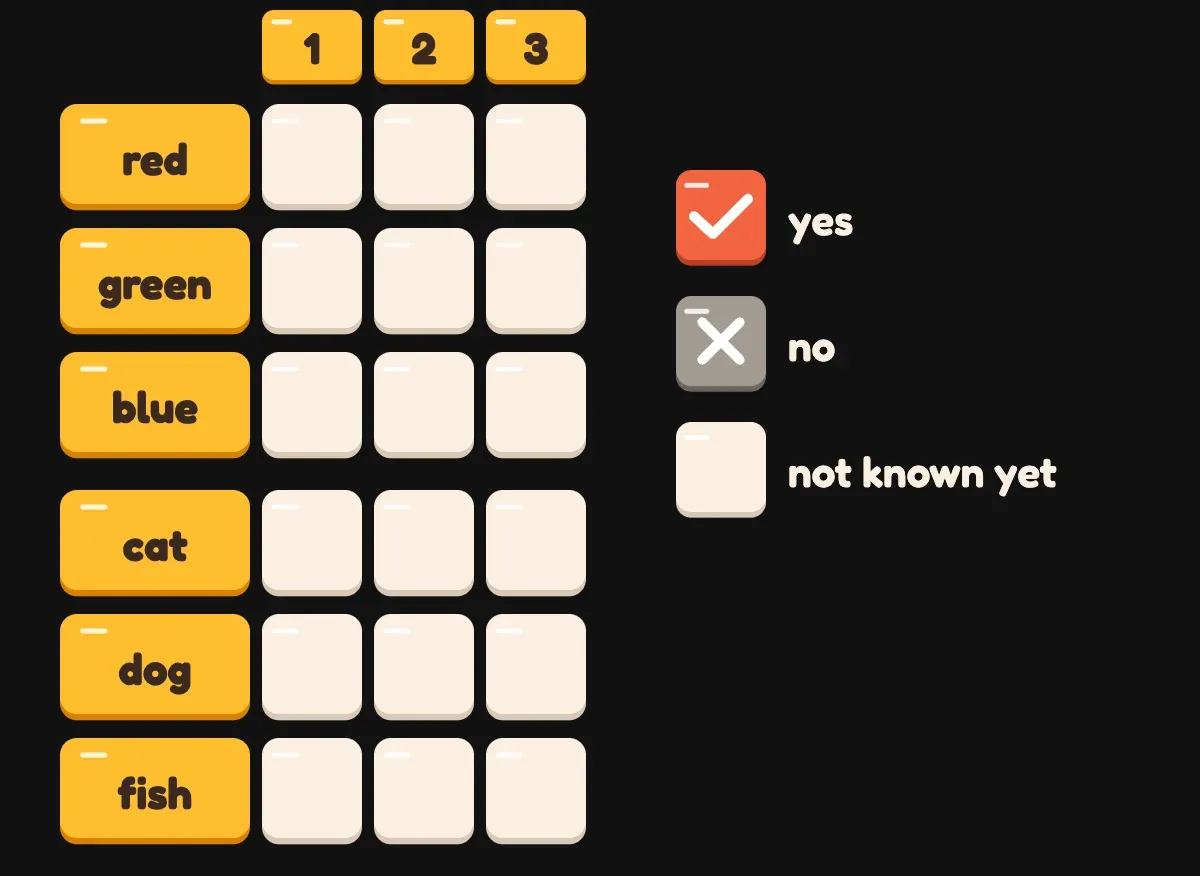
Number the houses 1, 2, 3 from left to right. The colours, pets and drinks are the attributes. Draw a table with the houses across the top and every attribute value down the side. Each cell is a yes-or-no question, such as “is the dog in house 3?”
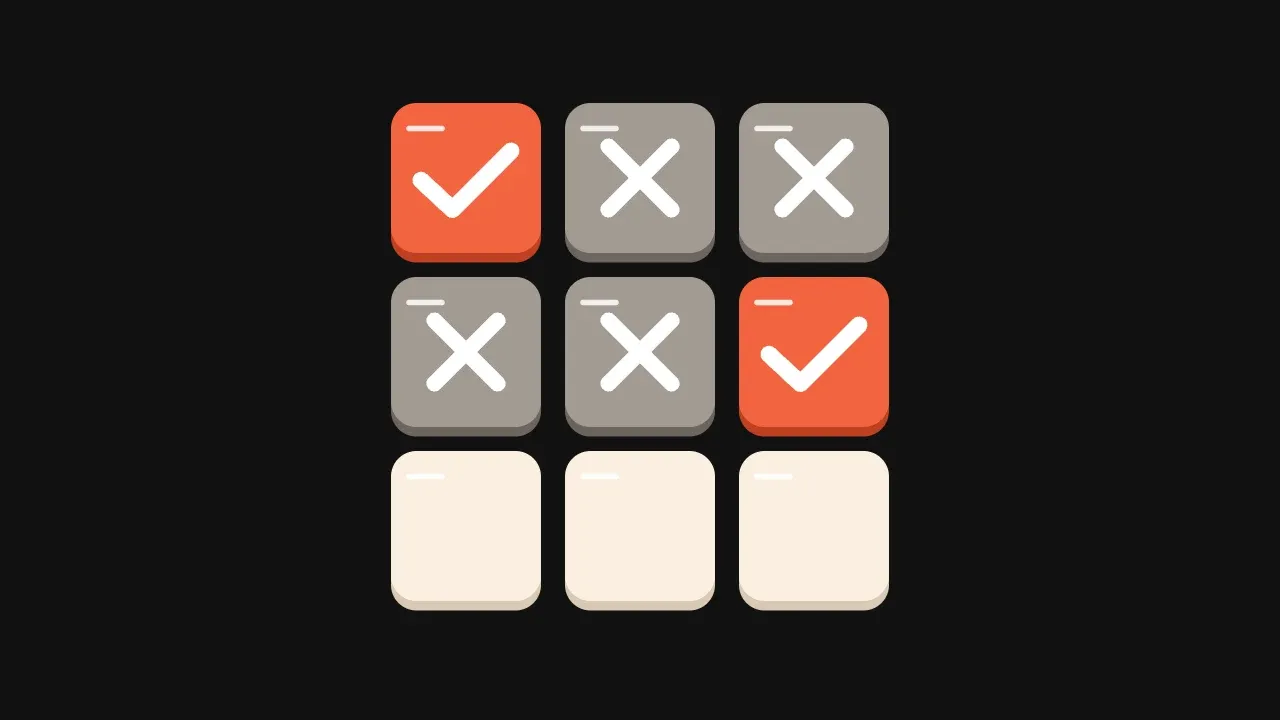
Mark the cells as you learn things:
- A tick means yes.
- A cross means no.
- A blank means you don’t know yet.
A tick also rules out the rest of its row, because each item has only one home. It rules out the other items of the same kind in its house too, because a house has one colour, one pet and one drink.
The three kinds of clue
Every clue narrows the grid in one of three ways.
Direct clues link two items, such as “the dog lives in the green house”. The two items share a house, so whenever one gets a tick or a cross in a house, the other gets the same.
Position clues fix one item to a place, such as “the red house is on the far left” or “the milk is in the middle house”. Tick that cell straight away. These are the easiest start.
Neighbour and order clues place items relative to each other:
- “next to” means one house away, on either side;
- “immediately left of” means exactly one house to the left;
- “somewhere left of” means anywhere to the left, however far.
“Somewhere left of” still rules things out. If A is somewhere left of B, then A can’t be in the last house and B can’t be in the first.
Negative clues, such as “the cat is not in the red house”, give crosses rather than ticks. They’re still worth marking.
A three-house example, tick by tick
Here’s a small puzzle. Three houses stand in a row, left to right. They’re coloured red, green and blue, and the pets are a cat, a dog and a fish. The clues are:
- The red house is on the far left.
- The dog lives in the green house.
- The blue house is somewhere left of the green house.
- The cat lives next to the red house.
Who owns the fish?
Step 1, clue 1: red is house 1, so tick it. Green and blue can’t be in house 1, so cross them there.
Step 2, clue 3: blue is somewhere left of green. House 1 is red, so blue must be house 2 and green must be house 3.
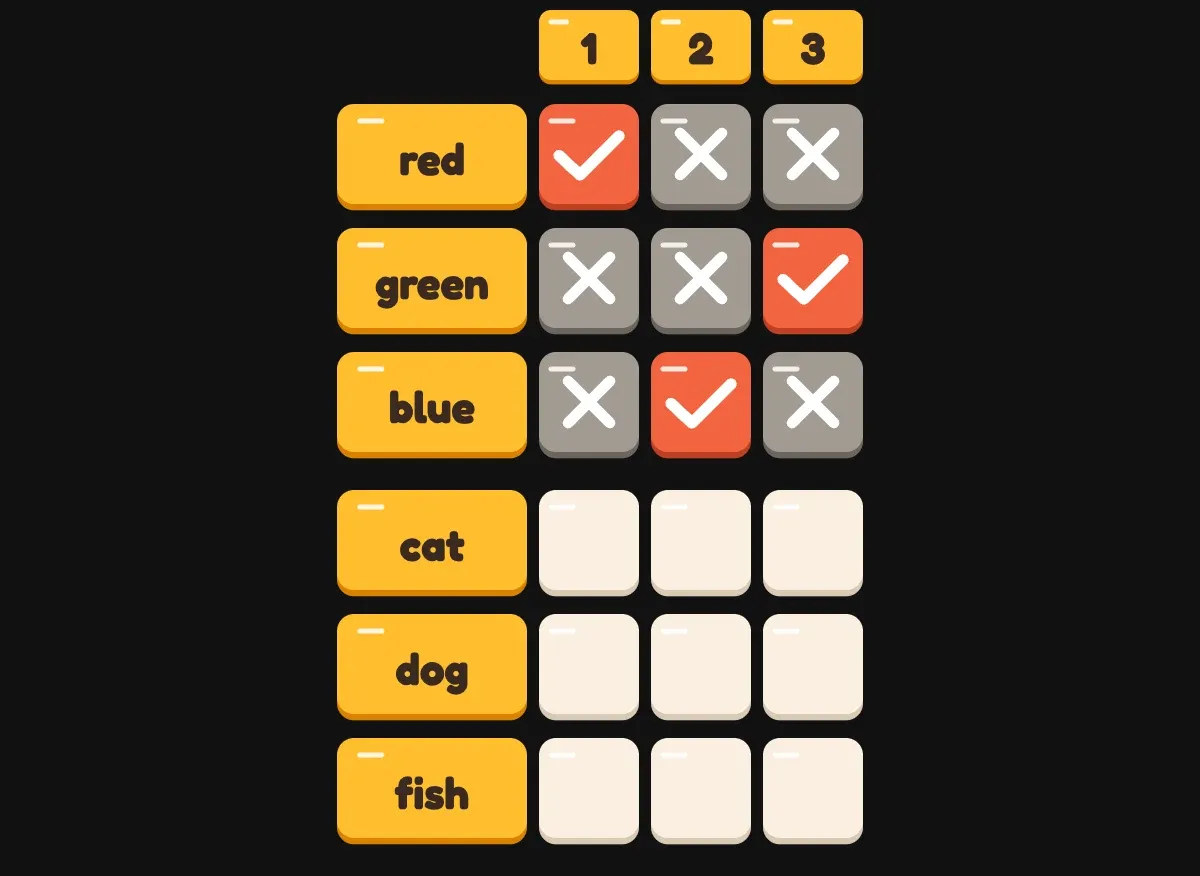
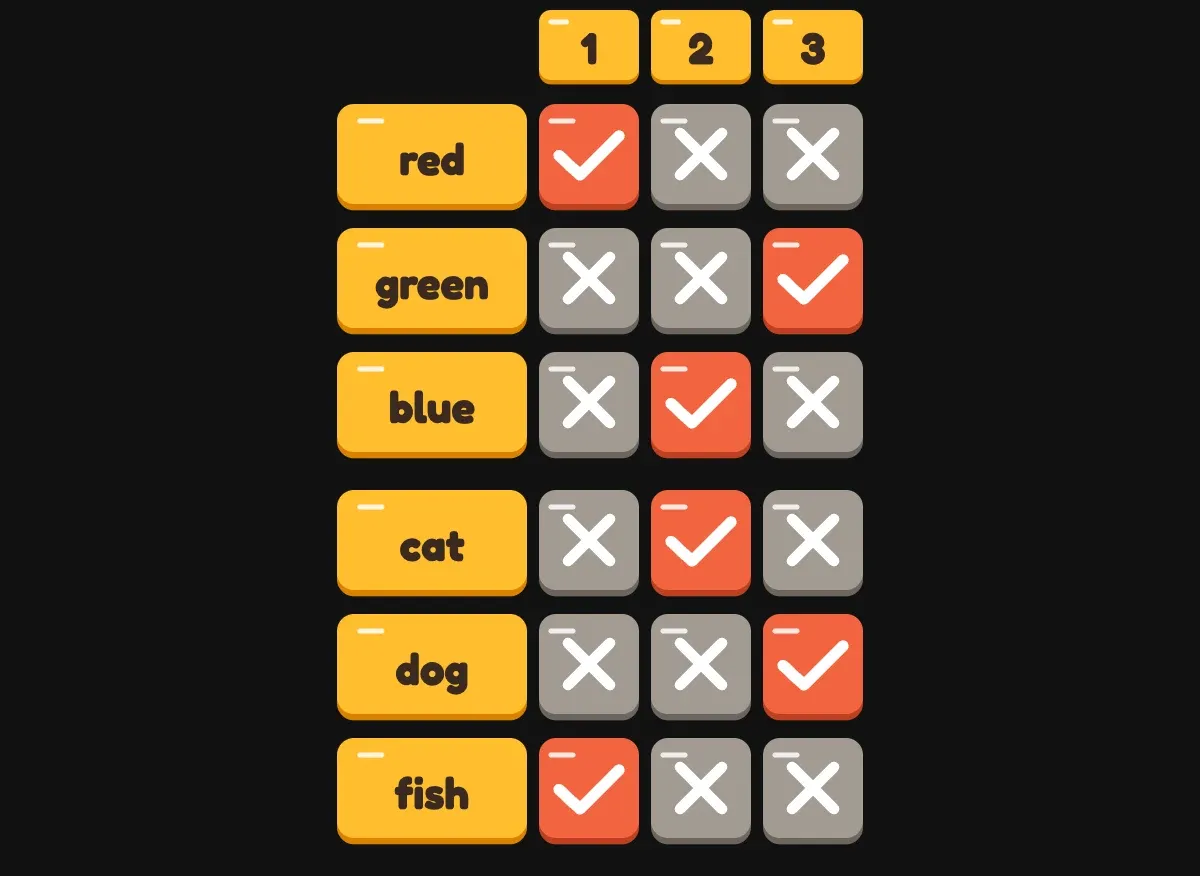
Step 3, clue 2: the dog lives in the green house, so the dog is in house 3.
Step 4, clue 4: the cat lives next to the red house, which is house 1, so the cat is in house 2. That leaves the fish in house 1, the red house.
Answer: the fish lives in the red house.
How to solve zebra puzzles: a routine that works every time
- Start with the position clues, then the direct clues, then the neighbour clues.
- Each time the grid changes, go back to the first clues and read them again. A new tick can unlock a clue you skipped.
- When you’re stuck, look for a row with one blank left and no tick yet: that blank must be the tick. Or ask “where can this item not go?” and cross those houses off.
- Don’t guess. If a clue allows two spots, leave it. Another tick elsewhere often settles it.
- Re-read each clue’s exact words. “Next to” and “immediately left of” are not the same thing.
Try one yourself
Four houses stand in a row, numbered 1 to 4 from left to right. The colours are red, blue, green and yellow. The drinks are tea, coffee, milk and juice. The pets are a cat, a dog, a bird and a fish. The clues are:
- The red house drinks tea.
- The dog lives in the blue house.
- The green house is immediately to the right of the yellow house.
- Milk is drunk in house 1.
- The cat lives next to the green house.
- Coffee is drunk in the green house.
- The bird lives somewhere left of the fish.
- The bird lives in house 2.
- The red house is somewhere left of the blue house.
Who owns the fish, and what does that house drink?
Show the answer
The fish lives in house 3, the red house, and that house drinks tea. The full grid, house by house: 1 yellow, milk, cat; 2 green, coffee, bird; 3 red, tea, fish; 4 blue, juice, dog.
Here’s how to get there, one step at a time:
- Clue 4 puts milk in house 1, and clue 8 puts the bird in house 2.
- Clue 1 says red drinks tea, and house 1 has milk, so red isn’t house 1. Clue 6 says green drinks coffee, so green isn’t house 1 either. Clue 9 says red is left of blue, so blue isn’t house 1. That leaves yellow: house 1 is yellow.
- Clue 3 says green is immediately right of yellow, so green is house 2. Green drinks coffee.
- Red and blue fill houses 3 and 4. Clue 9 says red is left of blue, so red is house 3 and blue is house 4.
- Red, house 3, drinks tea. Milk is house 1 and coffee is house 2, so juice is house 4.
- Clue 2 puts the dog in the blue house, house 4. Clue 7 says the fish is somewhere right of the bird, house 2, and house 4 is the dog, so the fish is house 3. That leaves the cat in house 1.
- Read the finished grid back against all nine clues: each one holds. Clue 5 checks last: the cat in house 1 is next to the green house, house 2.
How did you do?
Once a grid like this feels easy, try a bigger one: five houses and four attributes use the same method, just with more rows to fill. For the habits behind it, read how to get better at logic puzzles. Nonograms are another way to practise the same kind of deduction: how to solve nonograms.