· Guide
How Arrow Puzzles Work (and How to Solve Any Board)
Arrow puzzles look simple: tap an arrow and it slides away. Here are the rules, why the order matters, and a calm step-by-step way to clear any board.
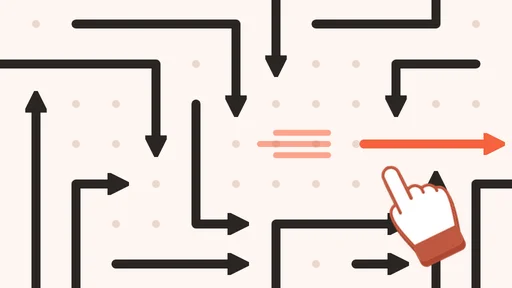
Arrow puzzles (also called arrow escape or tap away puzzles) are one of the simplest puzzle ideas around. A board is covered in arrows. You tap an arrow, and it slides off the board in the direction it points. Clear every arrow and you win.
The catch is that arrows get in each other's way. This guide explains exactly how that works, and gives you a method that solves any fair board without guessing.
The rules
- Every arrow points one way. The arrowhead shows its direction: up, down, left or right.
- A tapped arrow slides straight off the board, following its head, as long as the way is clear.
- If another arrow is in the way, the move is blocked. The arrow stays put. In many games a blocked move costs a life or a point.
- The board is cleared when no arrows are left.
Some boards use long or bent arrows that snake across several squares. Only the head decides where an arrow goes. The rest of its body just takes up space, and that space can block other arrows.
The one question that solves everything
For every arrow, ask: is there anything between its head and the edge of the board?
Look along the line the arrow points to, all the way to the edge. If every square on that line is empty, the arrow is free: tapping it is always safe. If any square holds part of another arrow, it's blocked for now.
An arrow never blocks itself. A bent arrow whose body curls back across its own path still leaves cleanly, because the whole arrow moves together.
Why the order matters
Removing an arrow can only ever free other arrows. It never blocks anything new, because it leaves an empty space behind.
That gives arrow puzzles a lovely property: you can't get stuck by tapping the wrong free arrow. Any free arrow is a safe move, and taking it only opens up the board. The only real mistake is tapping an arrow that is still blocked.
So the order matters in one way only: some arrows have to wait for others to leave first. A board is a chain of "this one, then that one", and your job is to find where the chain starts.
A step-by-step method
- Start at the edges. Arrows near the edge that point outward have the shortest path, so they're the most likely to be free.
- Trace each arrowhead to the edge. Don't judge by how crowded an area looks. Follow the line and check every square on it.
- Tap every free arrow you find. Each one is safe.
- Look again. Every arrow that leaves opens a line, and arrows that were blocked a moment ago may now be free. Big boards clear in waves like this.
- When nothing seems free, trace again, slowly. On a fair board there is always at least one free arrow until the board is empty. Check the long arrows: a body crossing a line is easy to miss.
That's the whole method: find a free arrow, take it, repeat.
Can a board be impossible?
Yes, if it's badly made. Picture two arrows on the same line pointing straight at each other. Each one is in the other's path, so neither can ever leave, and anything stuck behind them can't leave either.
Well-made arrow puzzles are checked so this never happens: the designer, or a program, removes free arrows until the board is empty. If that works, the board can be solved, and the method above will solve it.
Mistakes to avoid
- Tapping by feel. An arrow on the edge can still be blocked by a body lying across its path. Trace the line.
- Forgetting the bodies. On boards with long arrows, the body is what blocks you, not the head.
- Rushing the end. The last few arrows feel obvious, and that's where a slip costs a life. Same question, every time: is the line clear?
Why they're so satisfying
Arrow puzzles give you a steady stream of small wins. Every correct tap clears space, and every cleared space makes the next move easier to see. Big boards end in a rush of chain reactions as the last arrows slide away. And because a board never has to be done quickly, they're perfect for a calm few minutes.
Try one
Our arrow puzzle, Arrowscape, is free to play in your browser. When you've cleared a few boards, see how to get better at logic puzzles, or try a few brain teasers for a 5-minute break.