If you want to know how to make a zebra puzzle (a logic grid puzzle), it’s easier than it looks, and making one for a friend is even better than solving one. The steps are: pick the categories, write the answer first, add clues one at a time, check that exactly one answer is left, and tune the difficulty. A small three-house puzzle is built live, with the possible answers counted after every clue. A puzzle to try comes at the end, with its answer hidden.
How to make a zebra puzzle: what you need
A zebra puzzle is a row of houses. Each house has one item from every category, and the clues leave exactly one way to fill them in. Your job as the maker: write clues that are all true. Keep them few enough to be fun, yet enough together for one answer.
A pen and paper is all you need. If you haven’t solved a zebra puzzle yet, start with the solving guide.
1. Pick the houses and categories
Start small: three houses and three categories for a first puzzle, four houses for a normal one, and five for a hard one. Choose categories whose items are easy to tell apart, such as colours, pets, drinks, snacks, hobbies or fruit. Each category needs exactly as many items as there are houses.
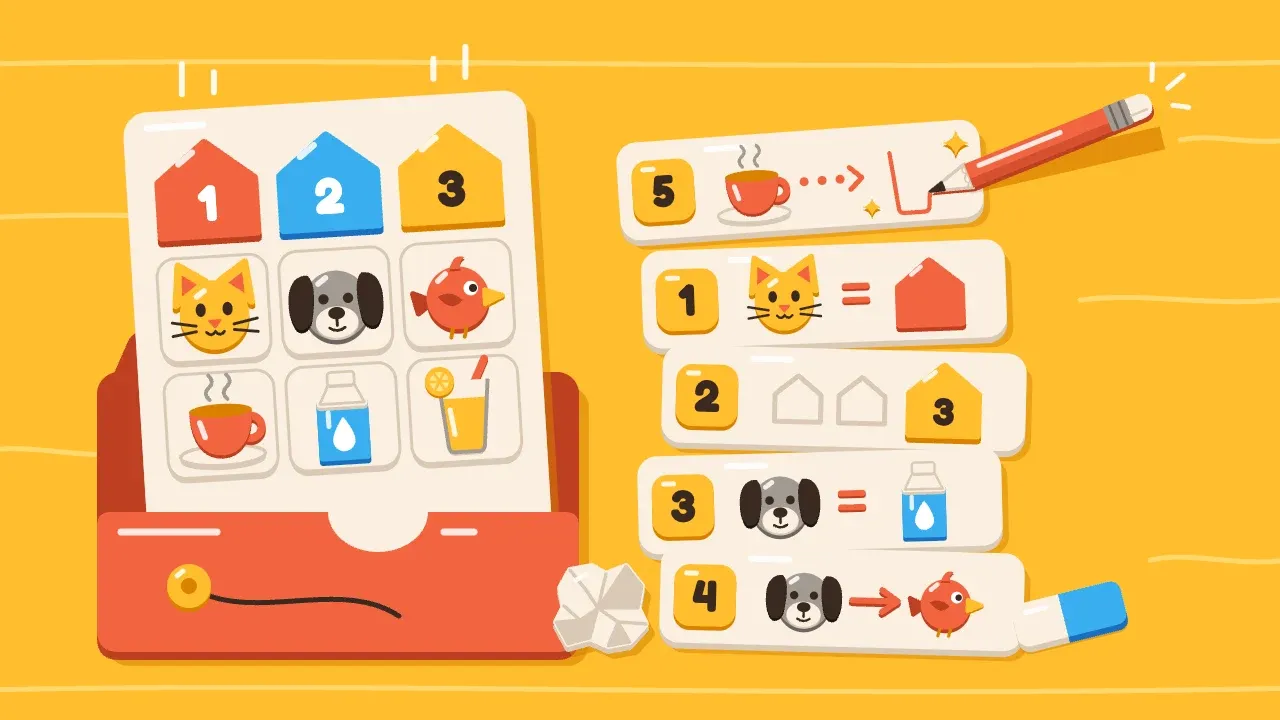
The worked example here uses three houses. Its categories are colours (red, blue, yellow), pets (cat, dog, bird) and drinks (tea, milk, juice).
2. Write the answer first
Fill in the finished grid before you write any clue. You choose every item yourself, so each clue you write later is true by construction. You never have to hunt for a puzzle that has an answer.
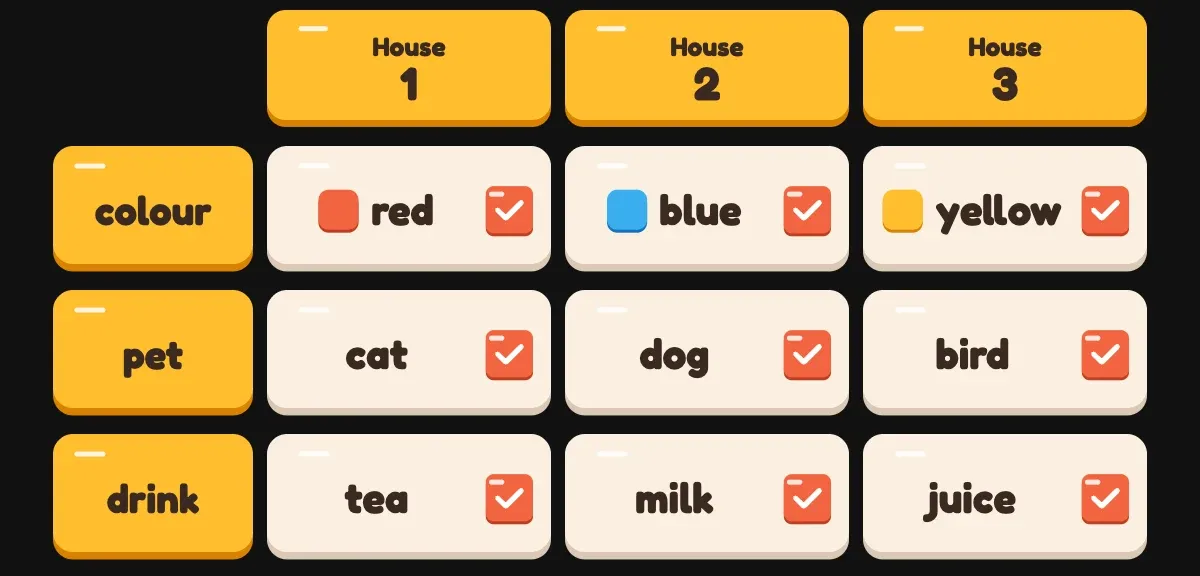
For the example, the answer is: house 1 is red, with the cat and tea; house 2 is blue, with the dog and milk; house 3 is yellow, with the bird and juice.
3. Know your clue types
There are four types of clue. Each example below is true in the answer key above.
- Direct: the cat lives in the red house.
- Position: the yellow house is house 3.
- Neighbour or order: the bird lives immediately right of the dog; the tea is somewhere left of the juice.
- Negative: the cat does not drink milk.
“Next to” is another neighbour clue: the dog lives next to the red house. “Either-or” clues (the dog lives in the red or the blue house) are harder, so leave them out of a first puzzle.
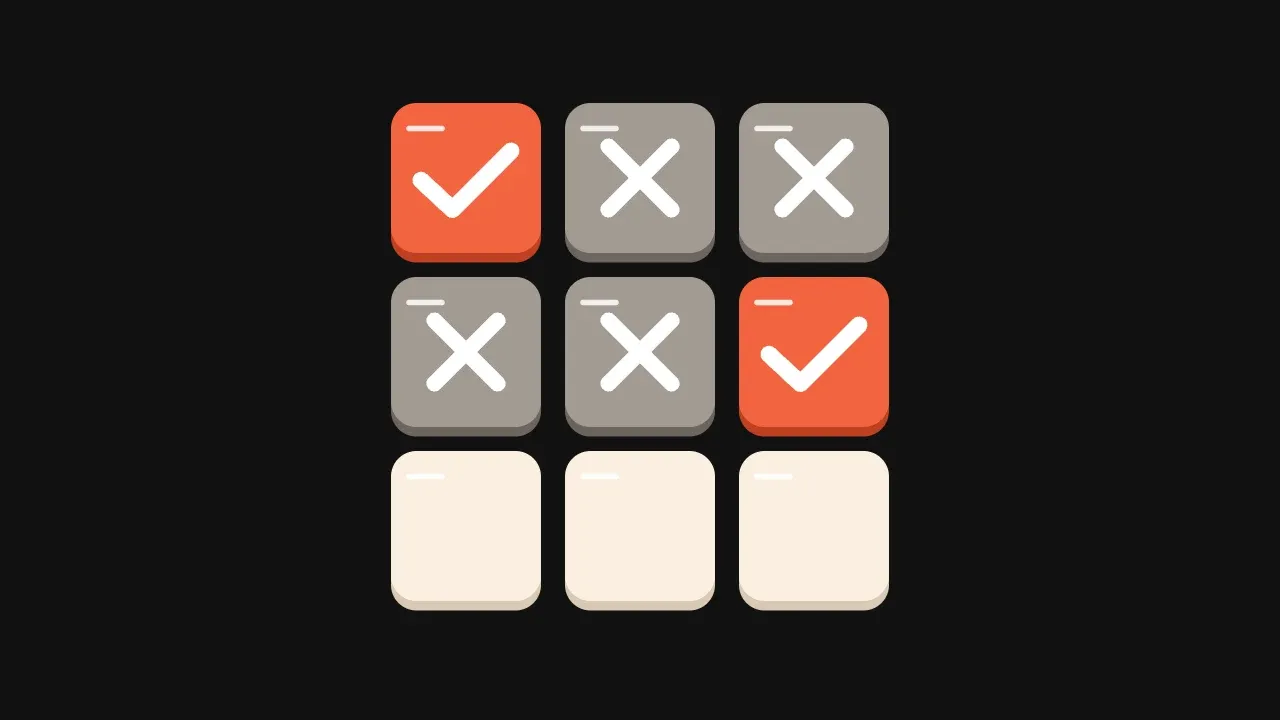
Direct and position clues give ticks in the grid, and order clues give crosses. A mix of types keeps the puzzle from feeling like one trick. Use at most one position clue per puzzle, since it hands the solver a free start.
4. Add clues one at a time and count what is left
With no clues, every arrangement fits. The example starts with 216 arrangements (6 × 6 × 6, because each category has six ways to fill three houses). Each clue cuts the list. The count left tells you what the next clue must do.
Here are the clues in order, with the arrangements left after each one:
- The cat lives in the red house. 72 left.
- The yellow house is house 3. 24 left.
- The dog drinks milk. 8 left.
- The bird lives immediately right of the dog. 2 left.
Clue 1 links pets and colours, clue 2 gives the solver a start, and clue 3 links the dog to a drink. Clue 4 uses order. Could the dog be in house 1? Then the bird would be in house 2 and the cat in house 3. But house 3 is yellow, and the cat lives in the red house, so that can’t be. So the dog is in house 2, the bird in house 3 and the cat in house 1.
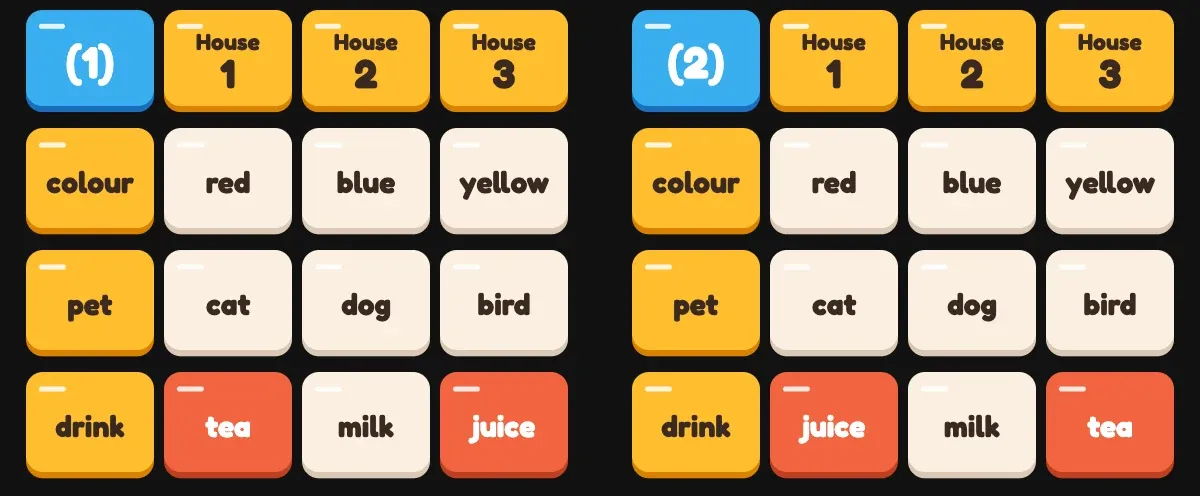
After clue 4 the houses, colours and pets are settled, but two arrangements remain. Milk is fixed in house 2 with the dog, so the tea and juice can swap between houses 1 and 3.
5. Test that only one answer is left
The clues must leave exactly one arrangement. Keep adding clues until the count reaches one, or solve the puzzle from its clues alone on a clean grid, using only what the clues say and never the hidden answer.
In the example, clue 4 left two arrangements, with tea and juice swapped. Clue 5 settles it: the tea is somewhere left of the juice. The tea must be in house 1 and the juice in house 3, which leaves one arrangement: the answer key.
To test a tight puzzle, take away each clue in turn and see whether the answer stays unique. Does every clue matter in the example? Yes. Without clue 1, 2, 3, 4 or 5 there are 4, 4, 3, 4 or 2 arrangements. A clue that changes nothing is fine as a hint for a beginner. A maker should still know which clues are spare.
More than one answer left? Add a clue about whichever items still swap. A clue that only repeats the others? Cut it or swap it for a different kind. Last, hand the puzzle to a friend: if they get stuck or find a second answer, the clues need work.
6. Make it easier or harder
Easier? Use fewer houses, more direct and position clues, and one extra hint clue. Harder? Use five houses, a fourth category, negative and order clues rather than direct ones, and no position clue at all.
When you write the finished puzzle, put the most helpful clue (a position or direct one) first. Place each order clue after the clues it depends on, and end with a question whose answer isn’t in any clue, such as “who drinks the juice?”
Try a puzzle built this way
Four houses in a row, numbered 1 to 4 from left to right. Each house has one colour (red, blue, green, yellow), one fruit (apple, banana, cherry, plum) and one hobby (chess, knitting, hiking, drawing).
Clues:
- The blue house is somewhere left of the plum.
- The hiker lives in the blue house.
- The red house is somewhere left of the chess player.
- The banana is immediately right of the chess player.
- The knitter lives next to the blue house.
- The knitter lives somewhere left of the blue house.
- The green house is immediately right of the cherry.
Question: Which fruit and hobby go with the green house, and what does the yellow house have?
Show the answer
House 1: red, apple, knitting. House 2: blue, cherry, hiking. House 3: green, plum, chess. House 4: yellow, banana, drawing. So the green house has the plum and chess, and the yellow house has the banana and drawing.
To solve it, in order:
- Clues 5 and 6 together put the knitter immediately left of the blue house. Clue 1 puts blue left of the plum, so blue is house 2 or 3.
- If blue were house 3, the hiker would be in house 3 too, and the knitter in house 2. The chess player would then be in house 1 or 4. House 1 breaks clue 3 (nothing’s left of it), and house 4 breaks clue 4 (nothing’s right of it). So blue is house 2: the knitter is in house 1 and the hiker in house 2.
- The chess player is in house 3 or 4. Clue 4 needs a house to the right, so chess is in house 3 and the banana in house 4.
- Clue 3 puts red left of the chess player, so red is house 1 or 2. House 2 is blue, so red is house 1.
- Clue 1 puts the plum in house 3 or 4. House 4 has the banana, so the plum is in house 3.
- Clue 7 puts the cherry immediately left of green. If green were house 4, the cherry would be in house 3, which has the plum. So green is house 3, the cherry house 2, the apple house 1 and yellow house 4; drawing is in house 4.
Your turn: make one for a friend
Pick three categories close to your friend’s interests, write the answer grid, add clues one at a time while counting what’s left, and let your friend test it. Want to see how other zebra puzzles are built and solved? Read zebra puzzles with answers.