A tangram for kids looks easy until you hold seven odd little pieces and a shape to copy that seems to fit none of them. Below are the pieces and two rules, a beginner method, and five easy shapes built step by step. Each answer stays hidden until you click.
1. Tangram rules: seven pieces, two rules
A tangram is a puzzle of seven flat pieces, called tans, that fit together into a square. The goal: copy a shape shown only as an outline.
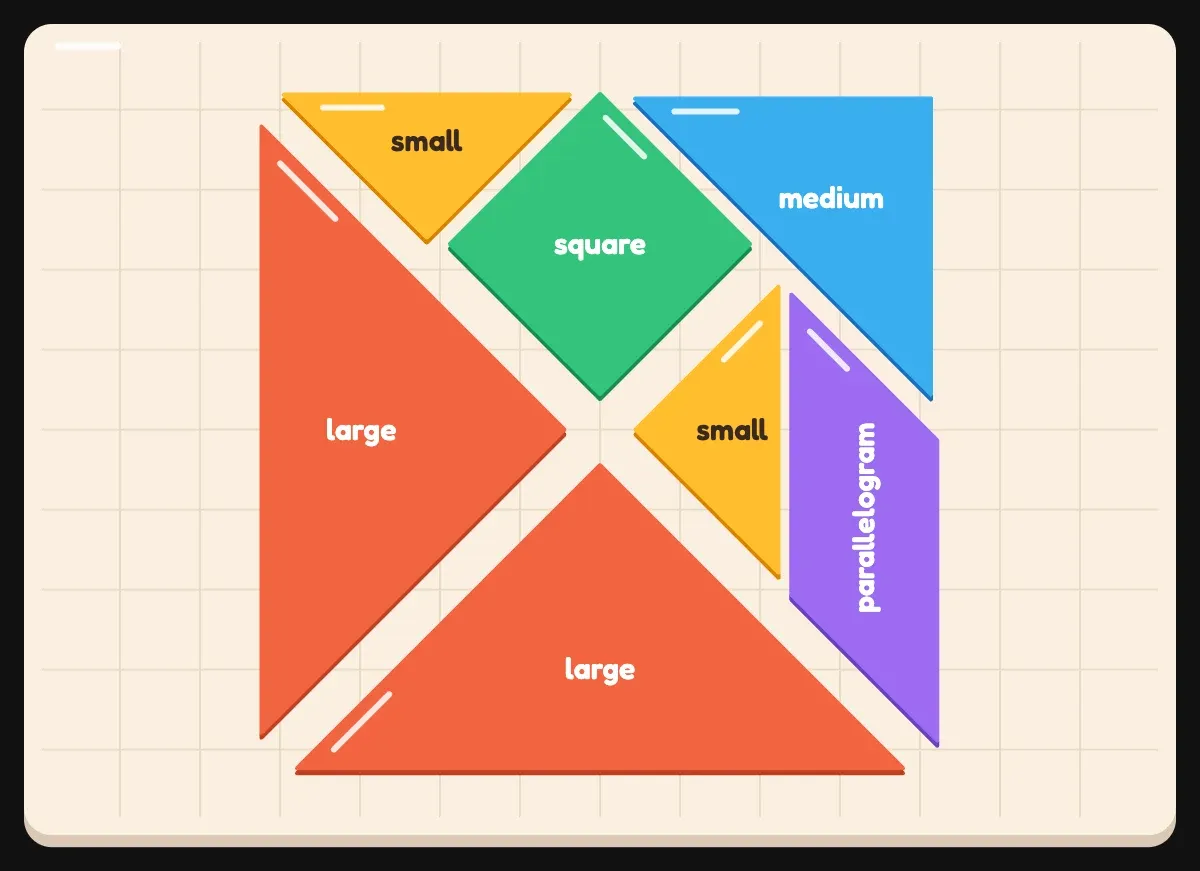
The seven tans are two large triangles, one medium triangle, two small triangles, one square and one parallelogram. Every triangle is a right triangle with two equal sides.
Two rules. Use all seven pieces every time, and let pieces touch but never overlap. You can turn any piece. Only the parallelogram looks different when flipped over, so it’s the one that may need flipping.
Sizes. A large triangle is 4 small triangles. A medium triangle is 2. The square and the parallelogram are 2 each. Two small triangles cover the square. They cover the medium triangle too.
2. How to solve a tangram: 5 habits
Habit 1, big triangles first. The two large triangles take up half the area. Place them first, and the rest has less room to go wrong.
Habit 2, look for right angles and long edges. A long straight edge in the outline? It suits the long side of a large or medium triangle. A square corner? That suits a triangle’s right angle.
Habit 3, try the two large triangles together. Side by side, they make a square or a bigger triangle. Try that first.
Habit 4, small pieces last. The two small triangles, the square and the parallelogram fill the gaps that are left.
Habit 5, flip the parallelogram. Last gap just a little too slanted? Turn the parallelogram over.
If you are stuck for a couple of minutes, take everything off except the big triangles. Then start the rest again.
3. Easy shape 1: the big triangle
The outline is one big triangle, with a flat base and its point up: 16 long at the base, 8 tall.
Try first: the two large triangles stand side by side on the left half, one with its long side on the base and the other upright beside it.
Show the answer
One way to fill it, in seven steps.
- The first red large triangle, its long side on the base at the left.
- The second red large triangle upright beside it, its long side vertical.
- The blue medium triangle in the bottom corner, where the base meets the upright side.
- A yellow small triangle at the top of the upright side, pointing right.
- The green square, like a diamond, in the notch between the blue and yellow triangles.
- The purple parallelogram on the base at the right end, flipped over, its slanted edge lying along the blue triangle’s long side.
- The last yellow small triangle on top of the parallelogram, which finishes the right side.
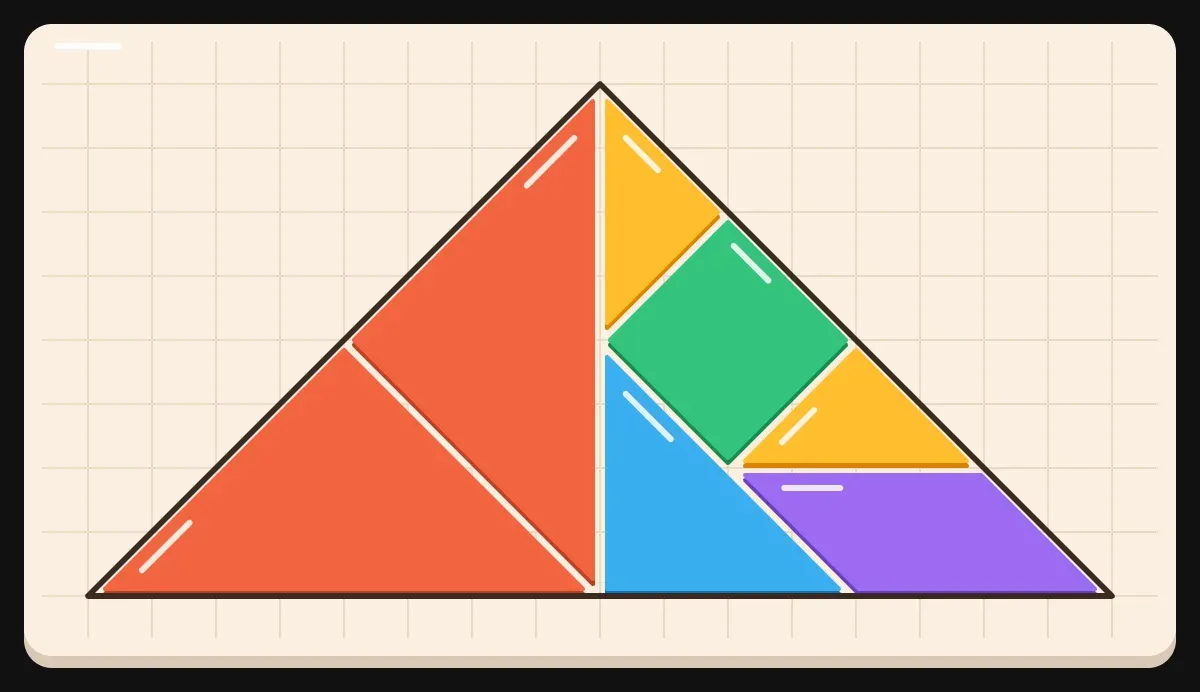
The left half is just the two large triangles. The right half holds the other five.
4. Easy shape 2: the parallelogram
The outline is a slanted parallelogram, 8 long at the base and 8 tall, leaning right.
Try first: the same two large triangles, side by side on the left, make a right triangle. The rest makes a second right triangle on the right.
Show the answer
One way to fill it, in six steps.
- The two red large triangles, side by side, as in the big triangle.
- A yellow small triangle at the bottom of the upright side, pointing right.
- The blue medium triangle at the top of the upright side, its right angle at the top corner.
- The green square as a diamond, in the gap between the yellow and blue triangles.
- The second yellow small triangle against the square’s upper-right edge, its point down.
- The purple parallelogram in the top right corner, which completes the slanted right side.
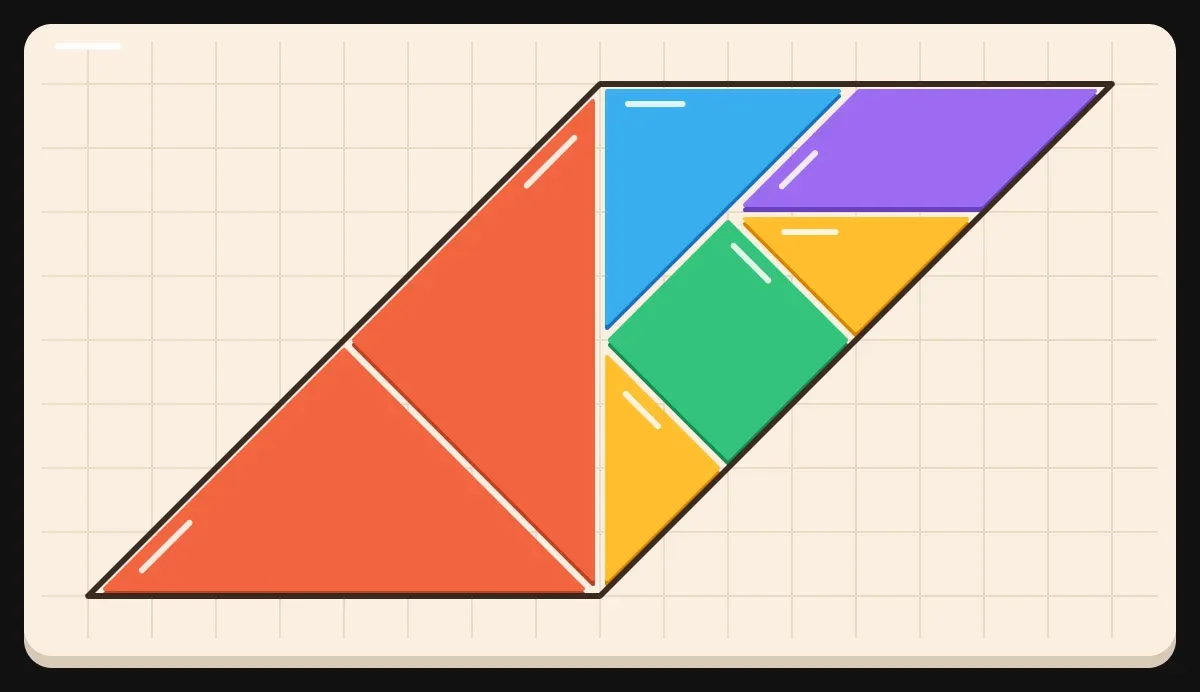
One of the pieces is itself a parallelogram. Fun to point out.
5. Easy shape 3: the trapezium
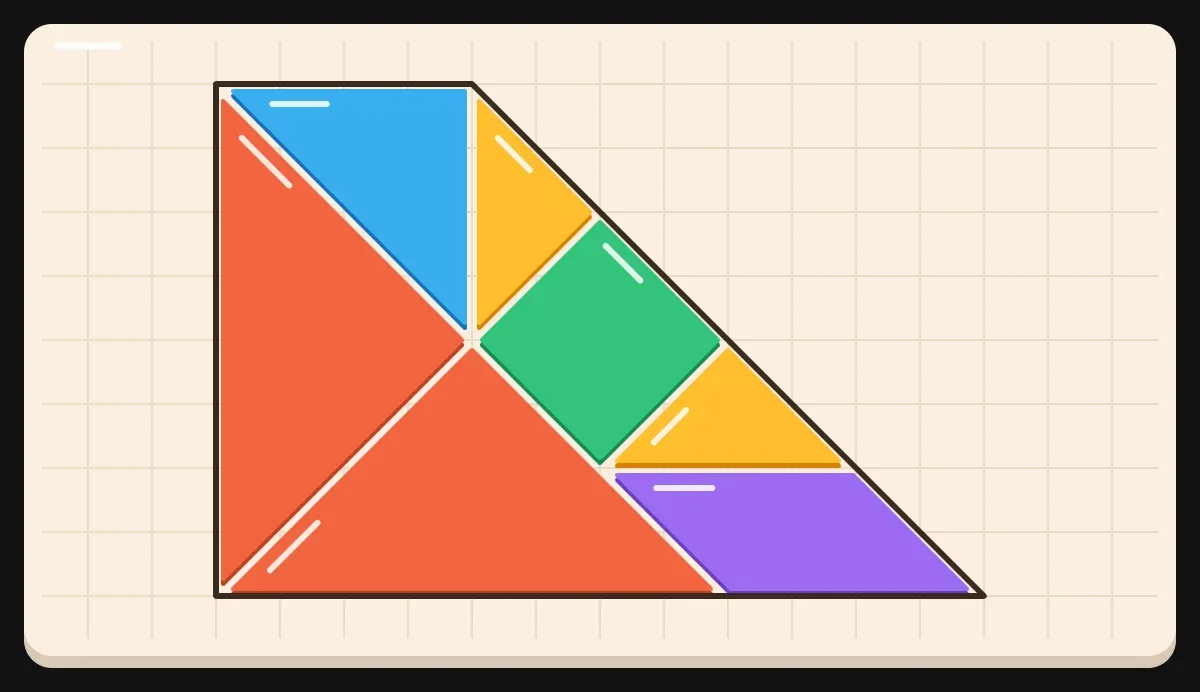
The outline is a trapezium: four sides, with one pair parallel (Americans call it a trapezoid). It has an upright left side and a slanted right side.
Try first: put the two large triangles in the bottom-left corner. Together they make a right triangle.
Show the answer
One way to fill it, in seven steps.
- The first red large triangle, its long side on the upright left side.
- The second red large triangle, its long side on the base.
- The blue medium triangle fills the top-left corner.
- A yellow small triangle beside it along the top, its right-angled corner on the slanted side.
- The green square, like a diamond, next to the yellow small triangle.
- The purple parallelogram, flipped over, on the base at the right end.
- The last yellow small triangle on top of the parallelogram, which completes the slanted side.
6. Easy shape 4: the rectangle
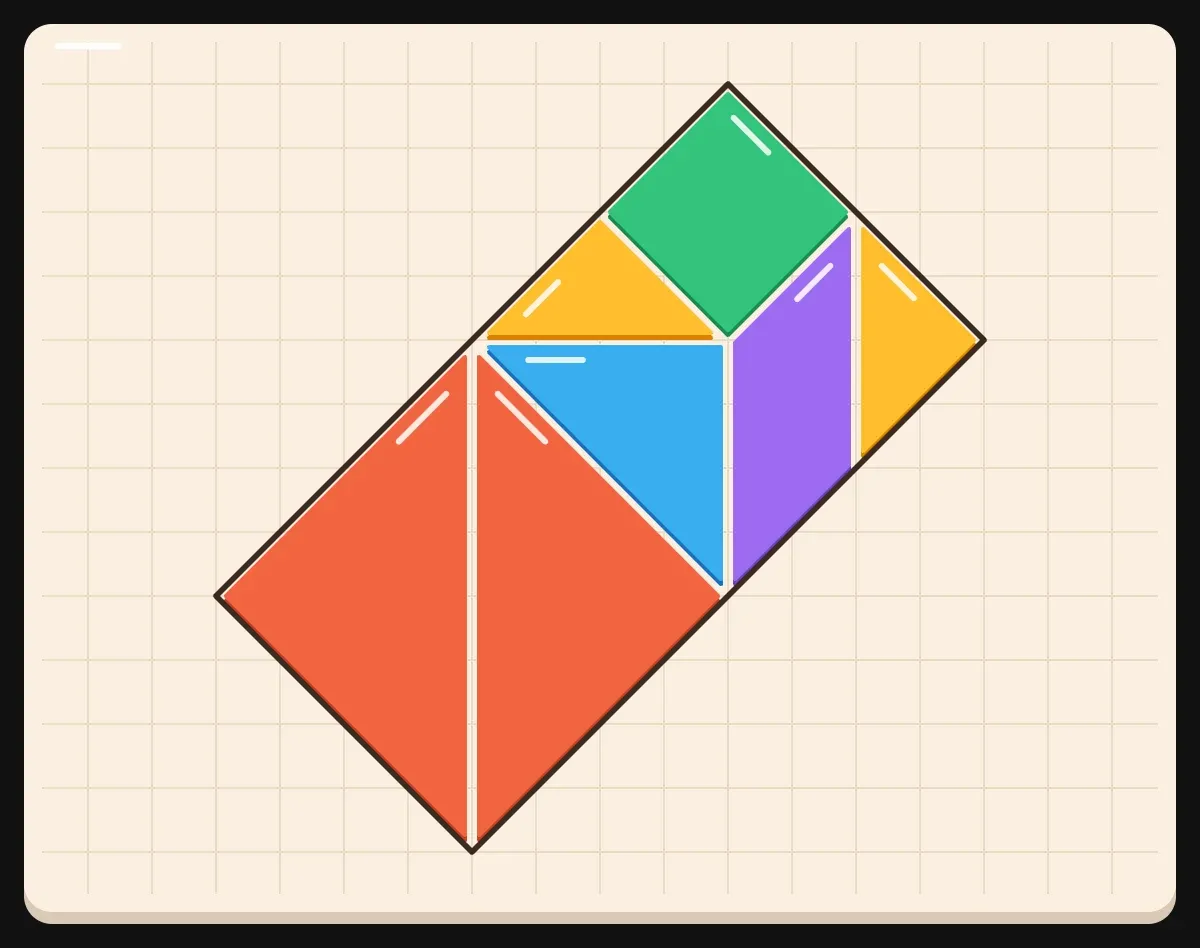
The outline is a rectangle twice as long as it is wide, tilted 45 degrees.
Try first: the two large triangles, with their long sides together, make a diamond-shaped square at one end. The other five pieces make a second square of the same size.
Show the answer
One way to fill it, in six steps.
- The two red large triangles, long sides together, make the diamond square at the left end.
- The blue medium triangle on the upper-right edge of that square, its right angle pointing away from it.
- A yellow small triangle on top of the blue triangle’s flat top edge, its point up.
- The green square against the yellow triangle’s right edge.
- The purple parallelogram against the blue triangle’s right edge.
- The last yellow small triangle at the right end, its point to the right.
7. Easy shape 5: the classic square
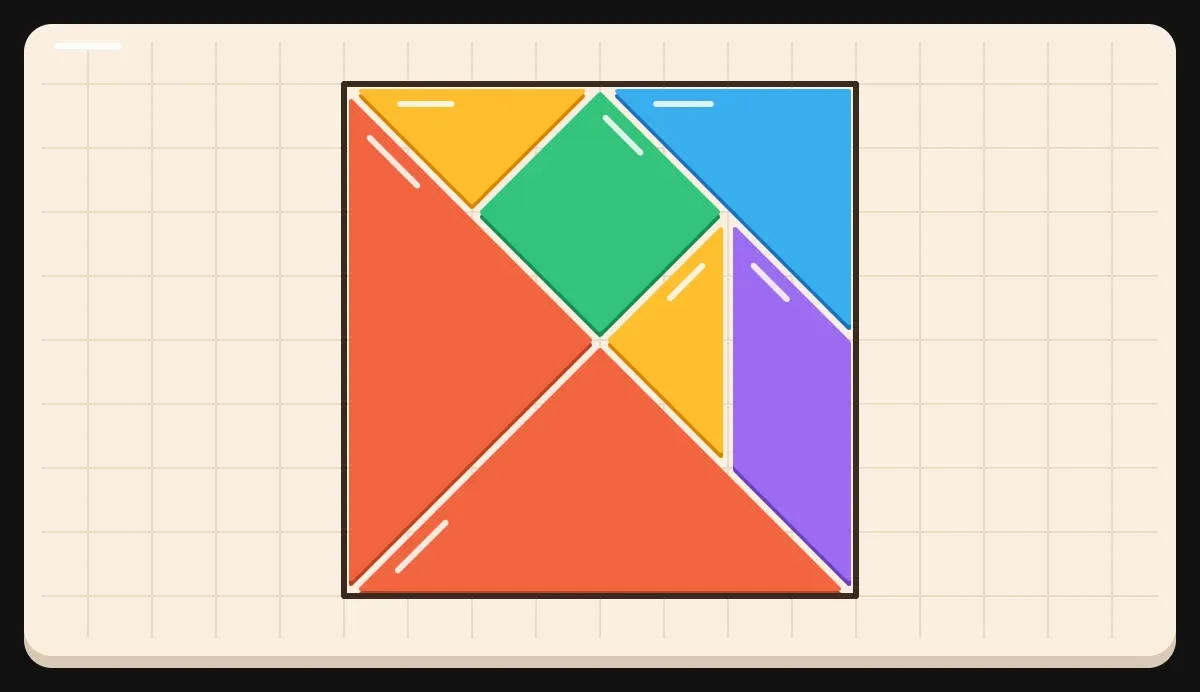
The outline’s a plain square: the shape the seven pieces come from.
Try first: the two large triangles go in the bottom-left half, where together they make one big triangle.
Show the answer
One way to fill it, in six steps.
- The two red large triangles, in the bottom-left half.
- The blue medium triangle in the top-right corner.
- A yellow small triangle in the top-left corner.
- The green square as a diamond in the middle.
- The other yellow small triangle below and to the right of the square, its point on the diagonal.
- The purple parallelogram fills the last gap on the right, standing upright.
If it still won’t close, check that both large triangles are in the bottom-left half, and try turning the parallelogram over.
8. Make your own tangram from paper
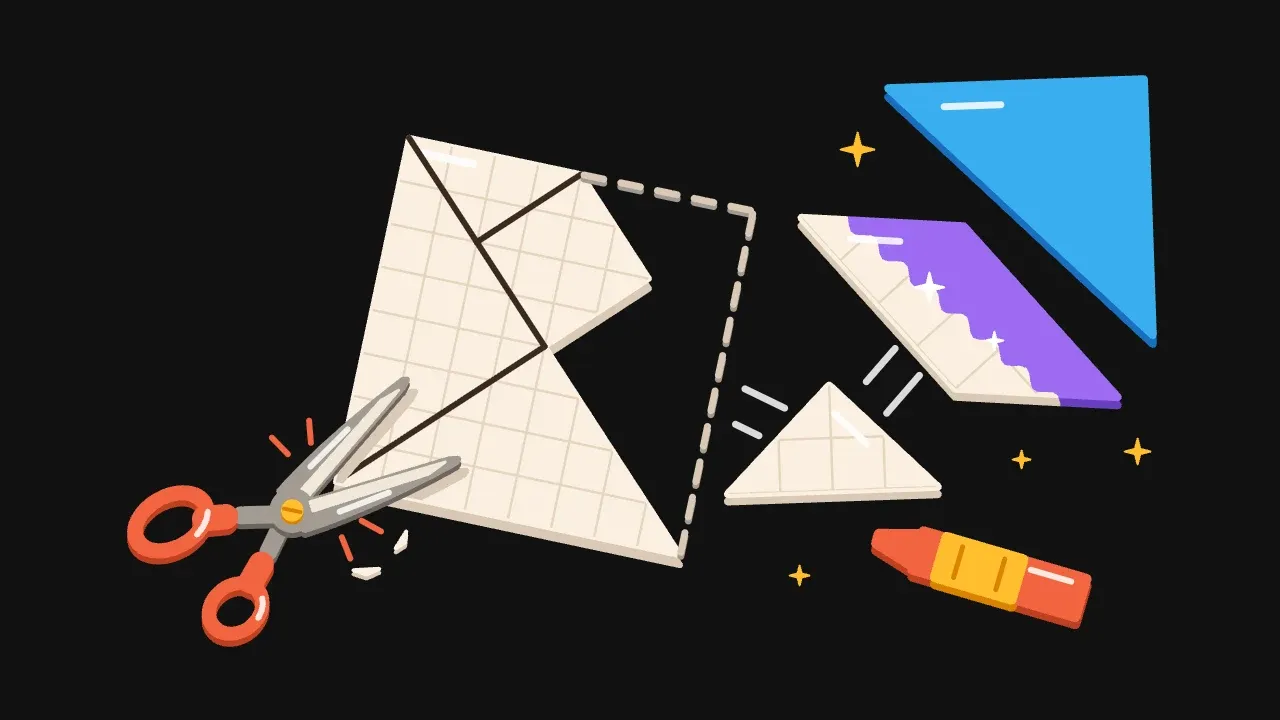
You’ll need a square of paper or card, scissors and, ideally, grid paper. Nothing needs printing.
On grid paper, draw an 8-by-8 square and copy the lines of the square answer in section 7 (open its box to see them). Cut along the lines. Why does this work? Every corner of every piece lands on a grid corner.
For small hands, make it bigger: 2 cm for each grid square gives a 16 cm square. Colour the two large triangles one colour and the small ones another, so a child can name the pieces.
9. Tangram for kids: notes for parents and teachers
- Names. Right triangle, square, parallelogram, trapezium, rectangle. Ask the child to name each shape as they build it.
- Fractions. A large triangle is a quarter of the square. The medium triangle, the square and the parallelogram are an eighth each. A small triangle is a sixteenth. Ask: how many small triangles cover the square? (Two.)
- Turns and flips. The parallelogram’s the one piece that looks different when flipped, so a child can feel the difference between turning and flipping.
- Keep it a game. Start with the big triangle, give the first two pieces as a hint, and let the child finish.
- Origin. The tangram’s a Chinese puzzle. The earliest known printed books of tangram pictures date from the early 1800s.
10. Put it into practice
Challenge: rebuild all five shapes without looking at the answers, then build one of them again from a different first piece.
Of all the shapes the seven tans can make, 13 are convex, which means the outline has no dents. That’s a known result, first worked out by Wang and Hsiung in 1942.
Want the habits behind all this? Read how to get better at logic puzzles. For more short puzzles, try 10 brain teasers for a 5-minute break.