Want to know how to solve nonograms? They look like a wall of numbers until you know the first move, and most people guess until then. This post gives you the few rules that work, walks through one 5x5 puzzle step by step, and ends with a new one to try.
1. What a nonogram is (and what the numbers mean)
A nonogram is a grid with numbers beside each row and above each column. Those numbers say how many filled cells the line has, in order. The filled cells make a hidden picture, and your job is to fill exactly the right ones. Nonograms are also called griddlers.
A clue of 3 means one block of three filled cells. A clue of 2 1 means a block of two, then at least one empty cell, then a block of one.
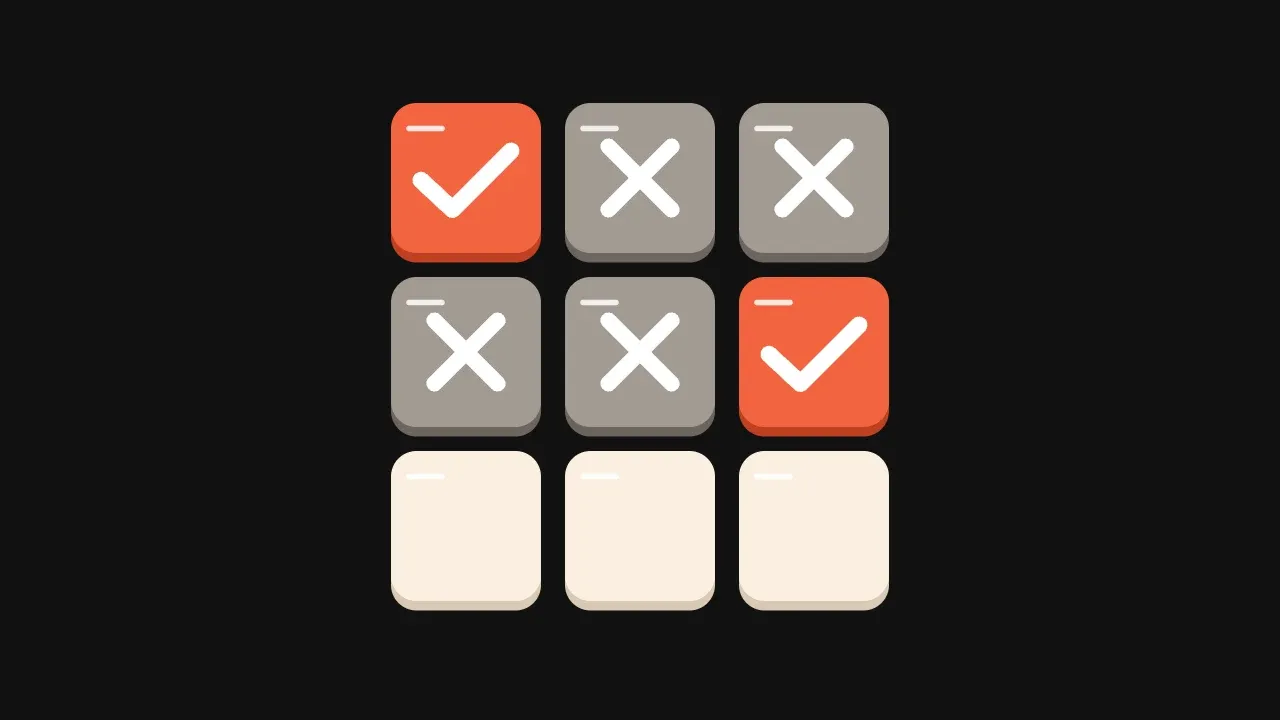
You mark a cell in two ways: a filled square, and a cross for “definitely empty”. Crosses matter as much as fills: they show what you’ve ruled out, which makes the next clue easier.
2. Start with the lines that are already solved
Some lines solve at a glance. A clue equal to the line’s length fills the whole line, and a clue of 0 leaves it empty.
Other clues fit exactly once you add up the blocks and one gap between each pair. If that total equals the line’s length, there’s only one way to fill it:
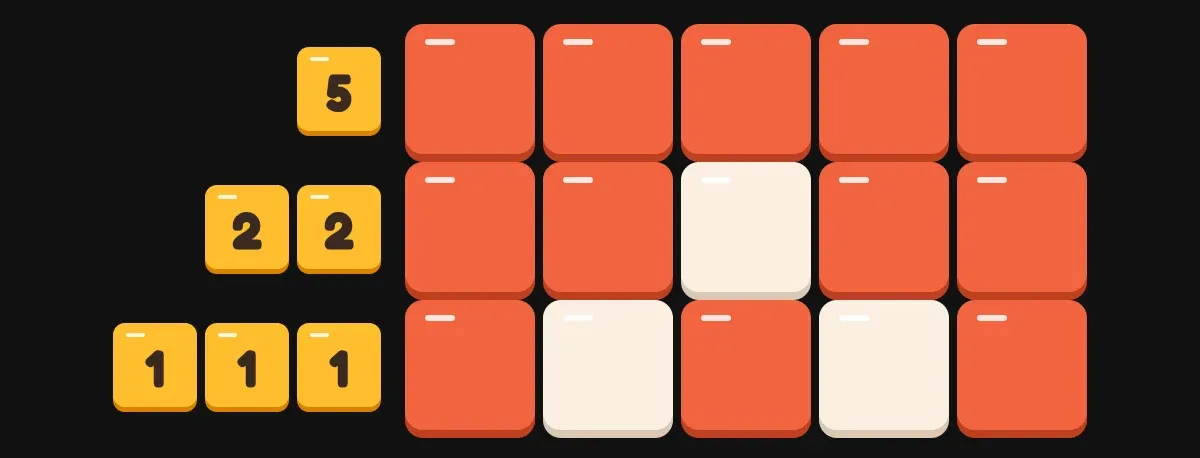
Two blocks of 2 need 2 + 1 + 2 = 5 cells, so there’s no room to spare.
3. The overlap trick
Long clues are where real progress starts. If a block is longer than half the line, some of its cells are filled wherever it sits. To find them, slide it fully left, then fully right, and keep the cells filled in both positions.
Take a clue of 4 in a line of 5. Here are its two positions and the cells they share:
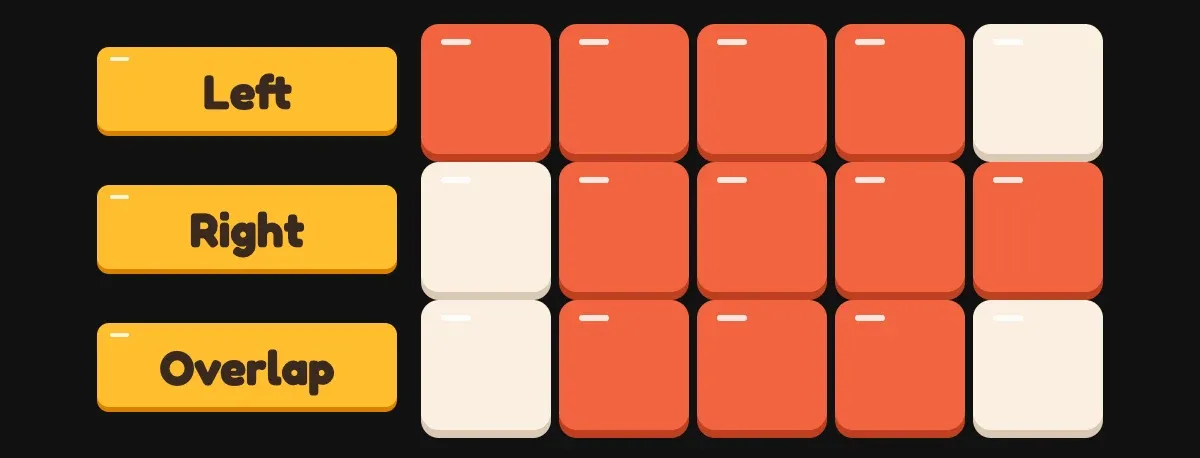
So the middle three cells are certain. A clue of 3 in 5 cells has only one certain cell: the middle one.
A quick check: subtract the blocks and gaps from the line’s length to get the spare room. A block longer than the spare room has certain cells, equal to its length minus the spare room. A 4 in 5 has one spare cell, so 4 − 1 = 3 cells are certain.
4. Cross out what can’t be filled
When a block is complete, cross out the cells at both of its ends. When every block in a line is complete, cross out whatever is left in that line. Cells too far from any block can go too.
Crosses make the next overlap work, so check each row and column after every change.
5. How to solve nonograms step by step: a 5x5 example
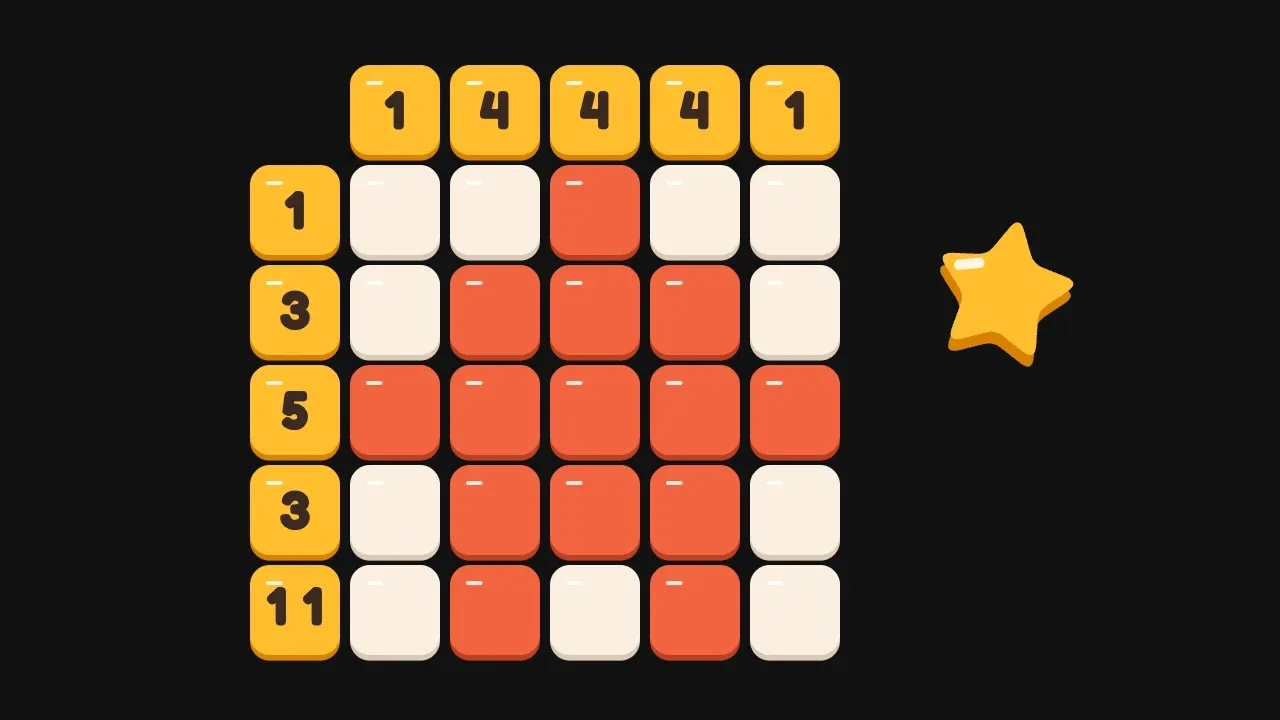
Row clues sit on the left and column clues on top, stacked where a column has two numbers.
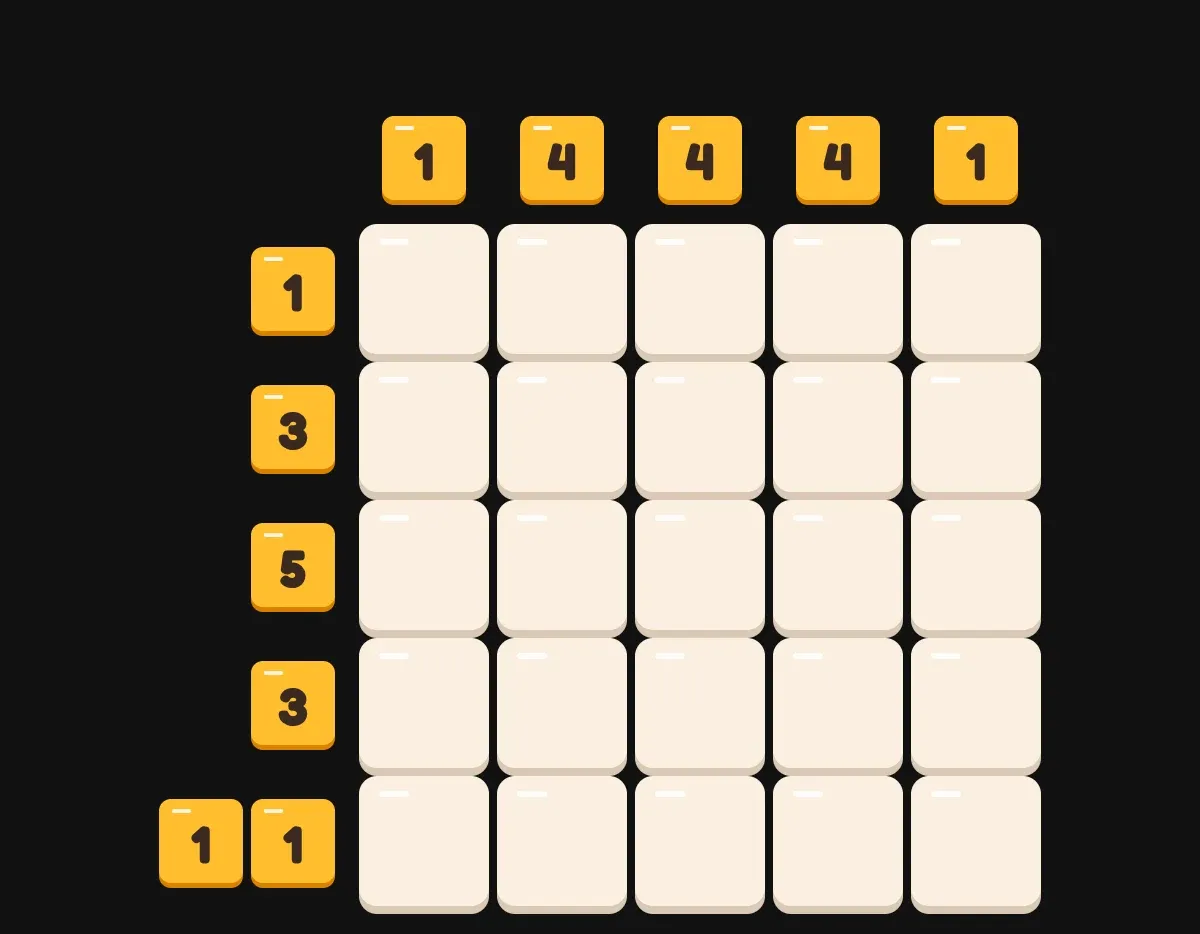
Every step is a sure deduction, so you never have to guess.
Step 1: the row with a 5 fills the whole row.
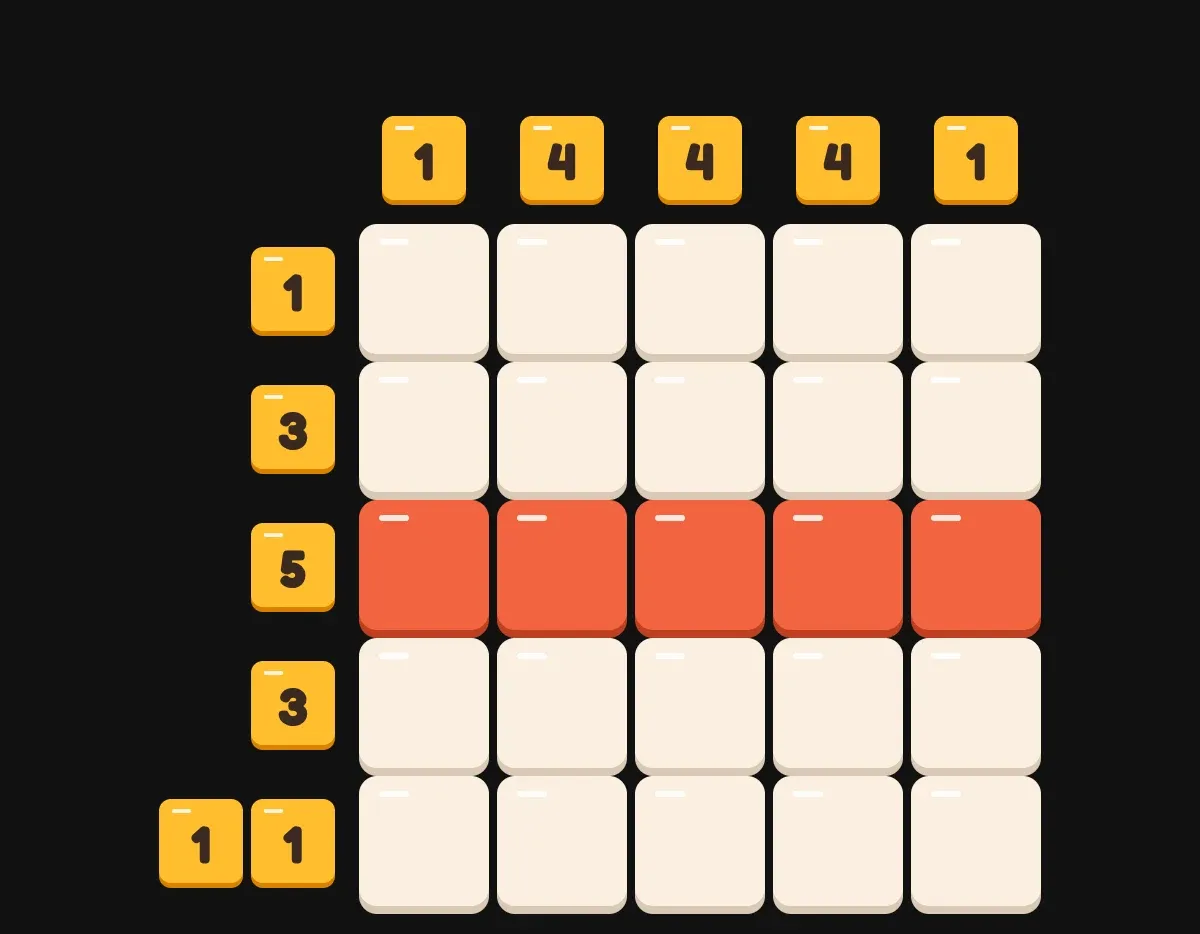
Step 2: columns 2, 3 and 4 are 4s in 5 cells, so rows 2 to 4 are filled in each.
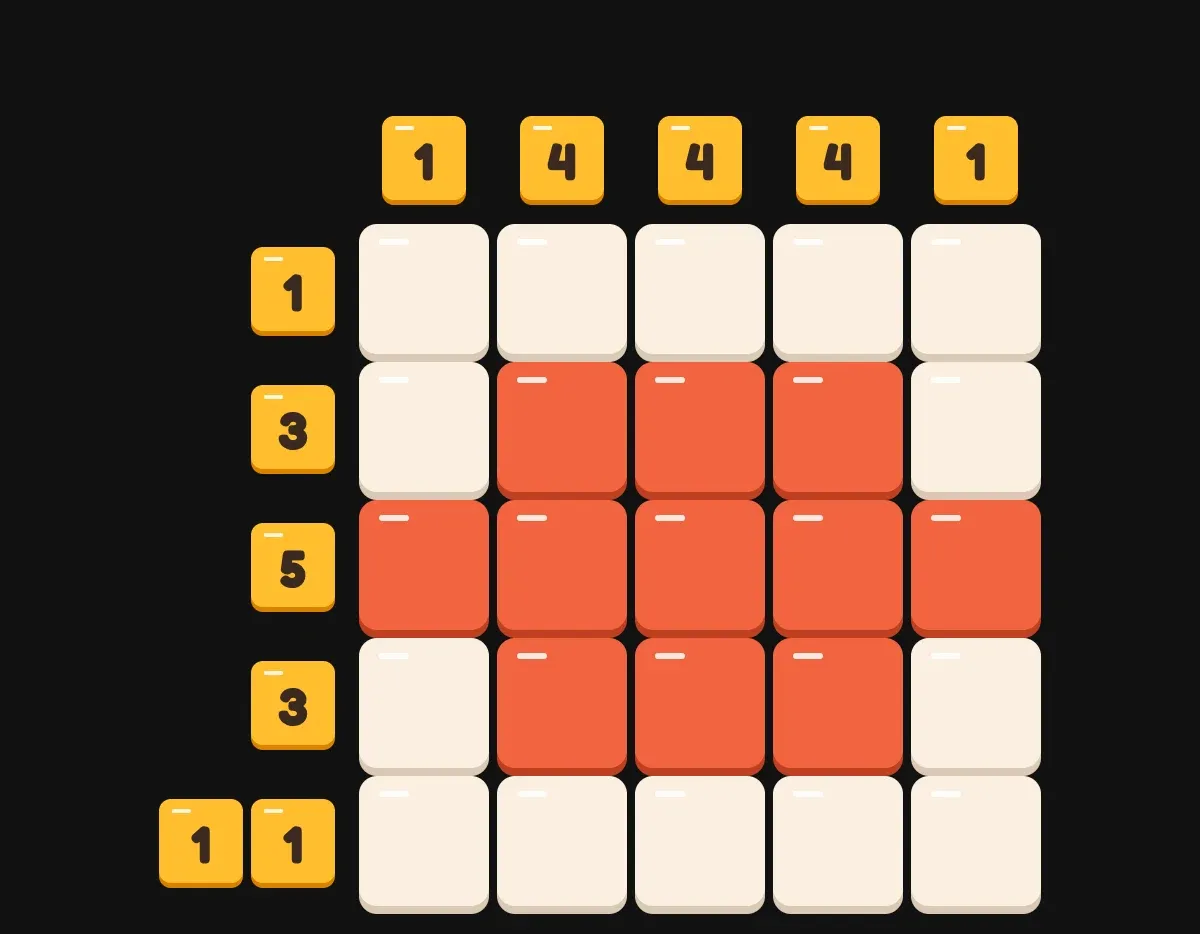
Step 3: rows 2 and 4 are 3s, already filled in columns 2 to 4, so they’re complete. Cross out their ends in columns 1 and 5. Those columns are 1s with their one cell in row 3, so cross out the rest: rows 1 and 5.
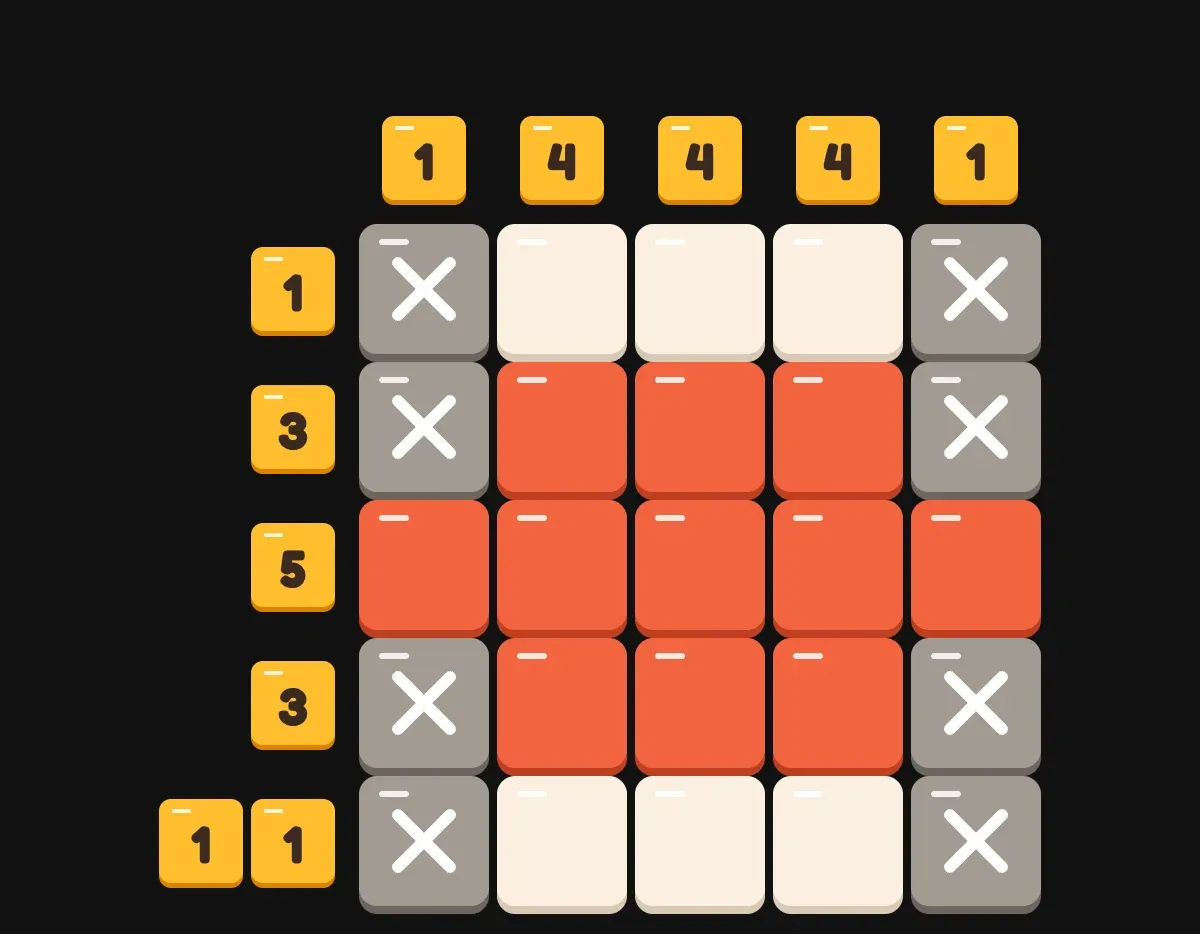
Step 4: row 5 is 1 1, and its ends in columns 1 and 5 are crossed out. The two blocks have only columns 2 to 4 to fit in, with a gap between them, so there’s one way: columns 2 and 4 filled, column 3 crossed out.
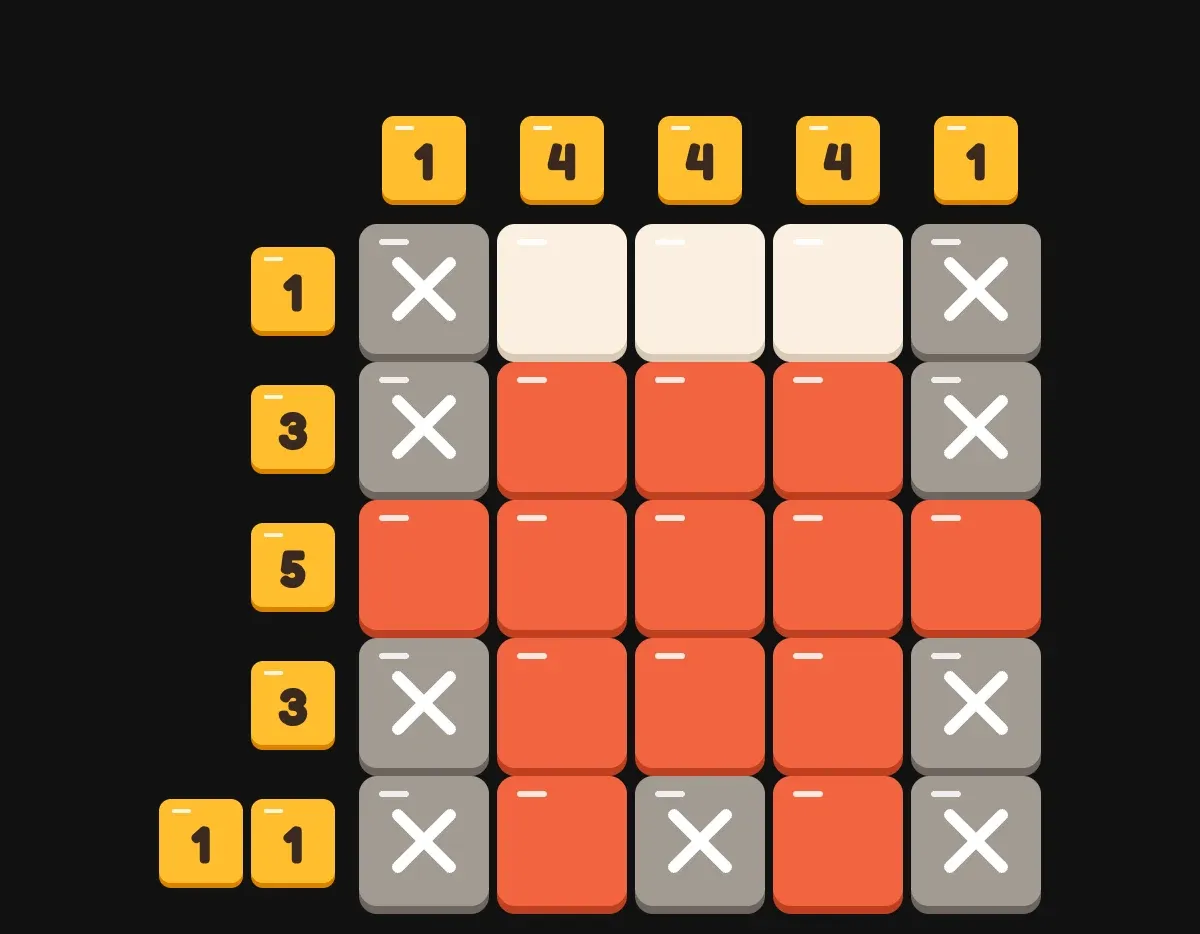
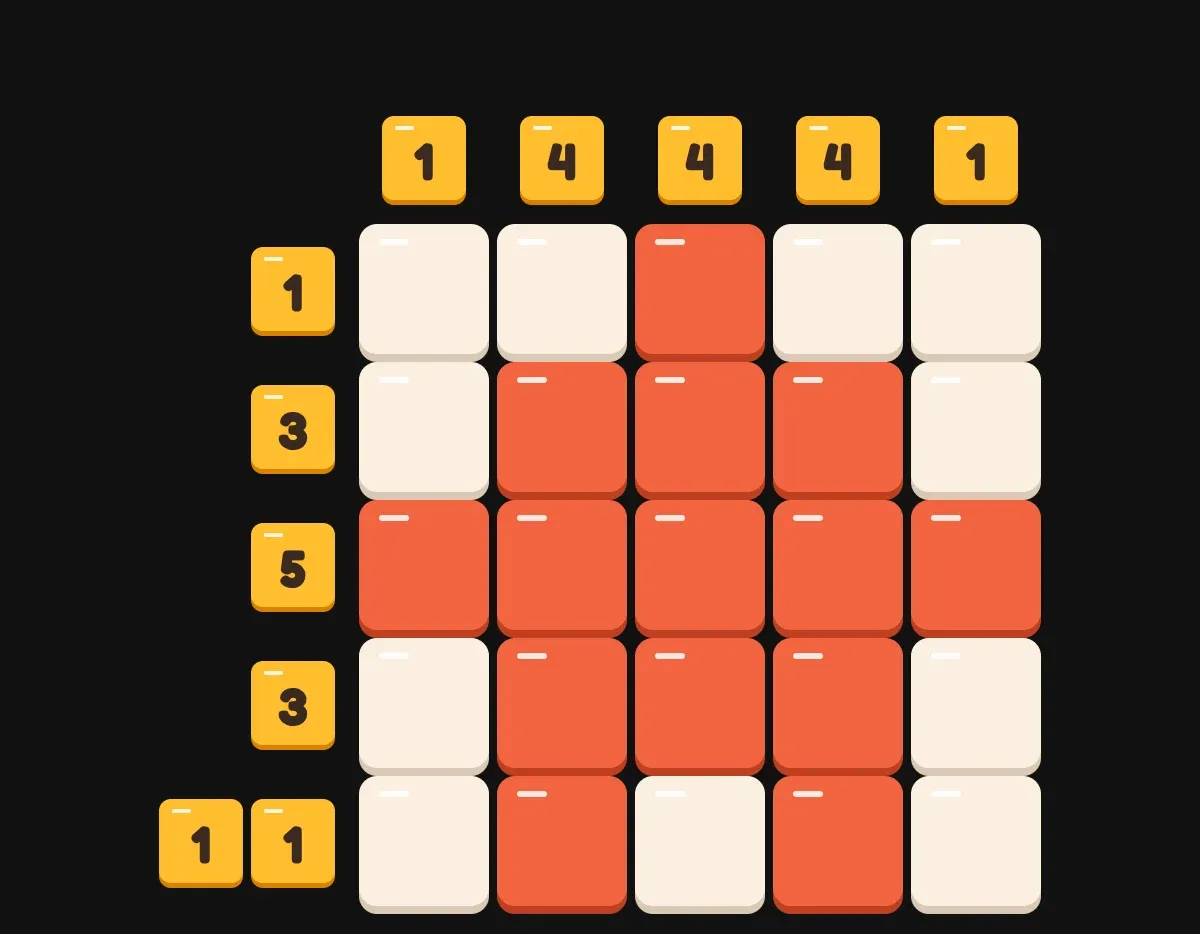
Step 5: column 3 is a 4 with its bottom cell crossed out, so its block runs from row 1 to row 4. Columns 2 and 4 already have rows 2 to 5, so their row 1 cells are crossed out. Every cell is now decided, and the picture is a little shape with a point at the top:
6. Safe first moves: a checklist
- Fill or clear whole lines: a clue equal to the line’s length fills it, and a 0 clears it.
- Fill any line where the blocks and gaps add up to the line’s length.
- Use the overlap on every long clue.
- Cross out the ends of finished blocks, and the rest of finished lines.
- Switch between rows and columns after every change.
- When you’re stuck, re-read the line with the fewest unknown cells.
7. Why you shouldn’t guess
A wrong guess hides its own mistake and spoils everything you fill in after it. So when you’re stuck, don’t guess. Look for the clue with the fewest possible positions, or check a line you haven’t looked at since the last change.
Start on small grids like this 5x5, and move up to 10x10 once the overlap trick feels automatic.
8. Try one yourself
Here’s a 5x5 to try.
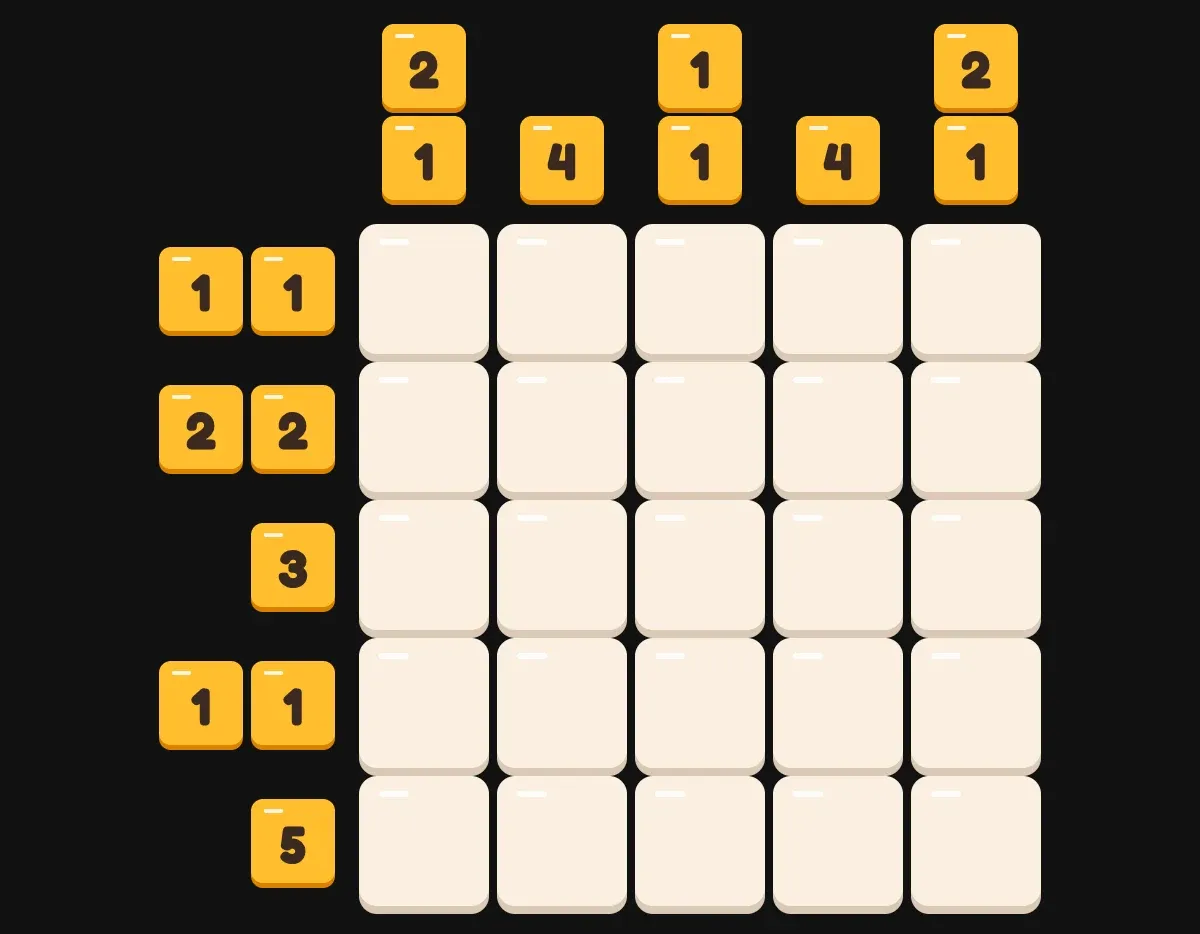
Hint: start with the row that has a 5.
Show the answer
The picture:
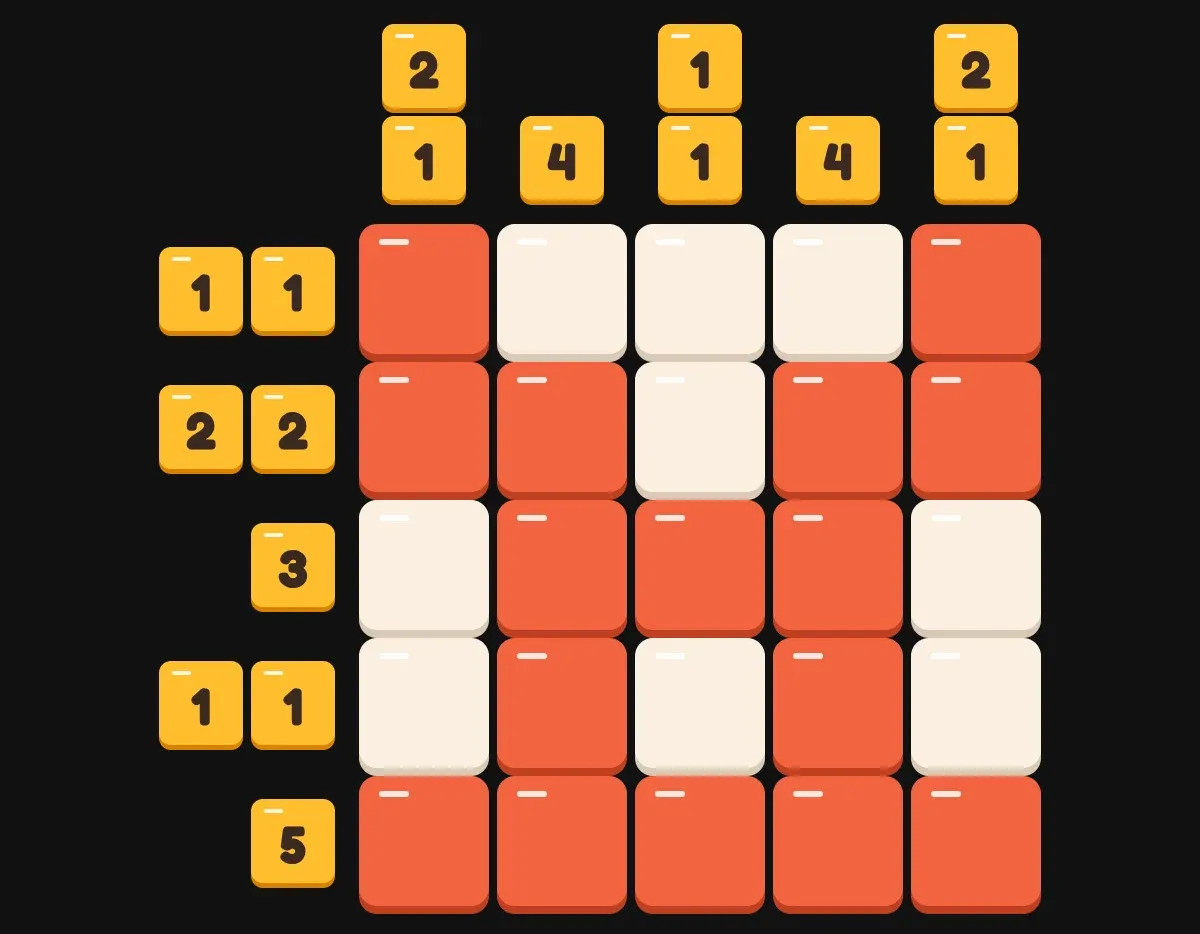
Start with the bottom row, the 5. Columns 2 and 4 are both 4s, so they run from row 2 down to row 5. That makes row 2 a 2 2, which fits only as ##.##, and rows 3 and 4 then fall into place. Columns 1 and 5 are both 2 1, and row 3 is empty at their ends, so their 2-blocks sit in rows 1 and 2.
Once these feel automatic, read how to get better at logic puzzles for habits that work on any puzzle.