Number sequence puzzles feel like guessing until you know what to look for. You stare at 3, 4, 6, 9, 13 and nothing comes. This post gives you a short checklist that finds the pattern in most sequences, then ten to try, from easy to tricky, each with its answer and rule hidden until you click.
What is a number sequence puzzle?
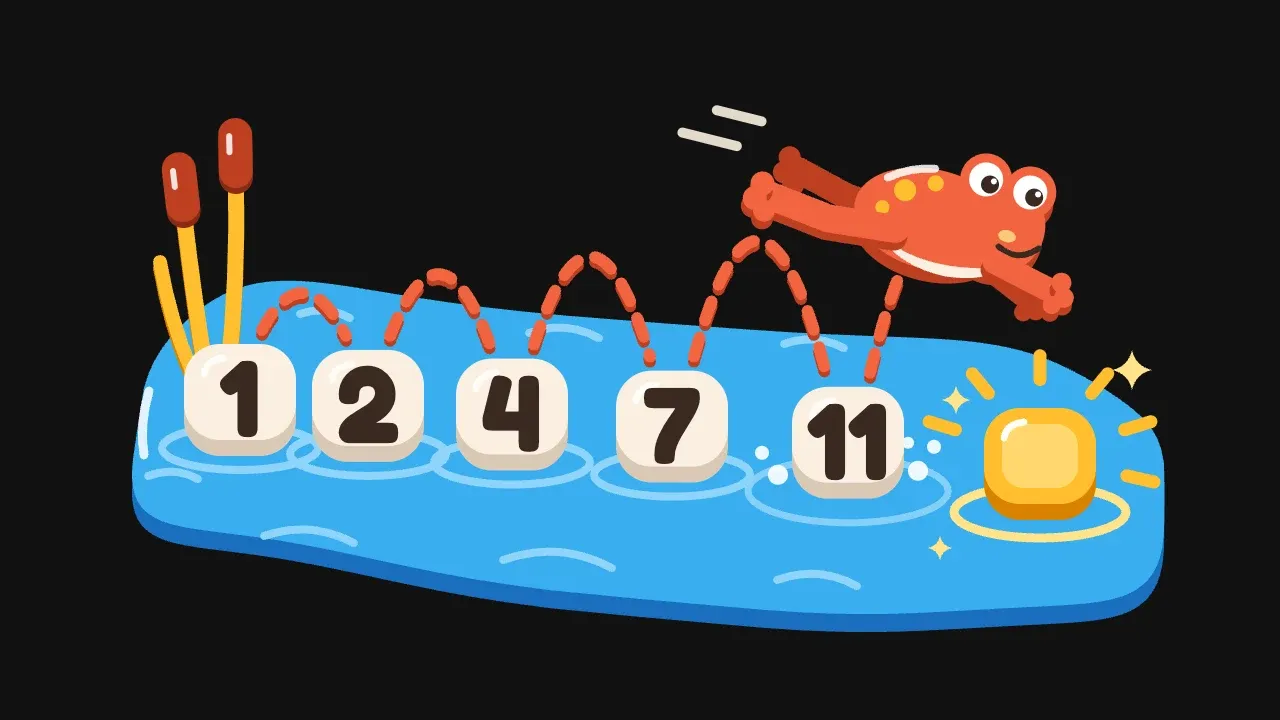
A number sequence puzzle gives you a row of numbers that follows a rule. Your job is to find the rule and use it to give the next number. In 2, 4, 6, 8, ?, the rule is add 2, so the answer is 10.
Most puzzles use only a few kinds of rule, so a checklist works. Try the steps in order, and the first one that fits every number gives you the rule.
Step 1: Look at the differences
Subtract each number from the next one and write the gaps down. If the gaps are all the same, the rule is add that gap each time. A gap of -7 means subtract 7.
Worked example: 4, 9, 14, 19, 24. The gaps are 5, 5, 5, 5, so the next number is 24 + 5 = 29.
Step 2: Check for multiplying
If the numbers grow faster and faster, divide each number by the one before it. If the answers are all the same, the rule is multiply by that number.
Worked example: 3, 6, 12, 24. Each number is double the one before, so the next number is 48.
The same check works for dividing. In 80, 40, 20, each number is half the one before, so the next is 10.
Step 3: Look at the differences of the differences
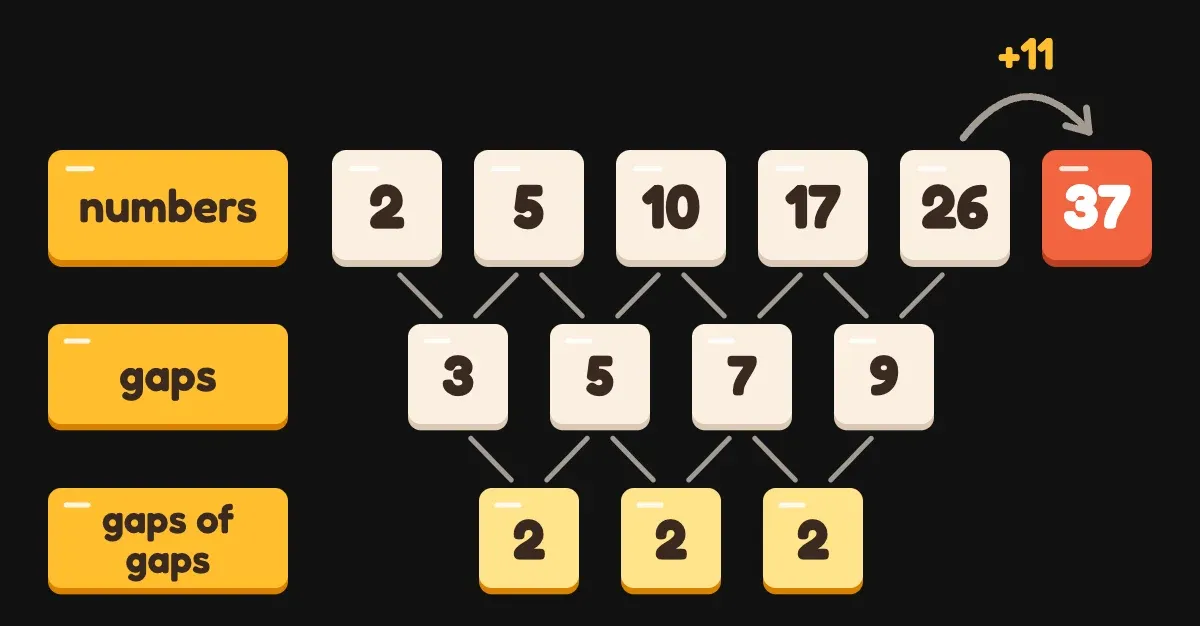
Sometimes the gaps are not equal, but they change by the same amount each time. Then the gaps follow a pattern of their own, so find the gaps first and then the gaps between the gaps.
Worked example: 2, 5, 10, 17, 26. The gaps are 3, 5, 7, 9. The gaps of the gaps are all 2, so the next gap is 11 and the next number is 26 + 11 = 37. The numbers are also the squares plus 1 (1 + 1, 4 + 1, 9 + 1, 16 + 1, 25 + 1).
Step 4: Split it into two interleaved sequences
If the numbers jump up and down, read every other number as its own sequence. Take the 1st, 3rd and 5th numbers as one sequence, and the 2nd, 4th and 6th as another.
Worked example: 1, 10, 2, 20, 3, 30. The odd places give 1, 2, 3, and the even places give 10, 20, 30. The next two numbers are 4 and 40, one from each sequence.
Step 5: Know the famous sequences
Some patterns come up again and again. Learn these first terms and you will spot them quickly:
- Squares: 1, 4, 9, 16, 25 (each is a number times itself).
- Cubes: 1, 8, 27, 64 (a number times itself, times itself again).
- Triangular numbers: 1, 3, 6, 10, 15 (the gaps go up by 1 each time: 2, 3, 4, 5).
- Fibonacci: 1, 1, 2, 3, 5, 8, 13 (each number is the sum of the two before it).
- Primes: 2, 3, 5, 7, 11, 13 (numbers that divide evenly only by 1 and themselves).
- Powers of 2: 1, 2, 4, 8, 16 (each is double the one before it).
If a sequence looks like one of these but every number is one out, try adding 1 or taking 1 from each number.
Can a sequence have more than one answer?
Yes. Take 1, 2, 4, ?. Doubling gives 8. But the gaps are 1 and 2, and if the gaps grow by 1 each time, the next gap is 3 and the answer is 7. Both rules fit every number given, so both answers are valid.
Not every sequence has just one right answer. The usual choice is the simplest rule that fits all the numbers. If two simple rules tie, give both answers and say so. More numbers in the row rule out more wrong rules.
10 number sequence puzzles to try
Each answer and its rule are inside the box under the puzzle.
1. 5, 10, 15, 20, ?
Show the answer
25. Each number is 5 more than the one before, so the rule is add 5.
2. 100, 93, 86, 79, ?
Show the answer
72. Each number is 7 less than the one before, so the rule is subtract 7: 79 - 7 = 72.
3. 2, 6, 18, 54, ?
Show the answer
162. Multiply by 3 each time: 2 × 3 = 6, 6 × 3 = 18, 18 × 3 = 54, 54 × 3 = 162.
4. 1, 4, 9, 16, 25, ?
Show the answer
36. These are the square numbers: 1 × 1, 2 × 2, 3 × 3, and so on, so 6 × 6 = 36. The gaps are 3, 5, 7, 9, 11 and go up by 2 each time.
5. 1, 3, 6, 10, 15, ?
Show the answer
21. These are triangular numbers. The gaps go 2, 3, 4, 5, so the next gap is 6, and 15 + 6 = 21.
6. 2, 3, 5, 8, 13, ?
Show the answer
21. Each number is the sum of the two before it: 2 + 3 = 5, 3 + 5 = 8, 5 + 8 = 13, and 8 + 13 = 21. It’s the Fibonacci idea from step 5 with a different start.
7. 3, 4, 6, 9, 13, ?
Show the answer
18. The gaps are 1, 2, 3, 4. They grow by 1 each time, so the next gap is 5, and 13 + 5 = 18.
8. 2, 5, 11, 23, ?
Show the answer
47. Double each number and add 1: 2 × 2 + 1 = 5, 5 × 2 + 1 = 11, 11 × 2 + 1 = 23, 23 × 2 + 1 = 47. The gaps 3, 6 and 12 double each time too, so the next gap is 24, and 23 + 24 = 47.
9. 1, 20, 3, 18, 5, 16, ?, ?
Show the answer
7 and 14. Two sequences are mixed together. The odd places go 1, 3, 5, 7 (add 2), and the even places go 20, 18, 16, 14 (take away 2).
10. 1, 2, 6, 24, 120, ?
Show the answer
720. Each step multiplies by the next whole number: 1 × 2 = 2, then × 3 = 6, × 4 = 24, × 5 = 120, × 6 = 720. The multipliers count up one at a time: 2, 3, 4, 5, 6.
How did you do?
The checklist runs in order: differences, multiplying, gaps of the gaps, two sequences, then famous sequences. If a puzzle beat you, run the checklist on it again.
Then try the reverse. Write five numbers that follow a rule, put the rule on the back of the paper, and give the row to a friend. If you enjoyed these, try 10 brain teasers for a 5-minute break, or read how to get better at logic puzzles.