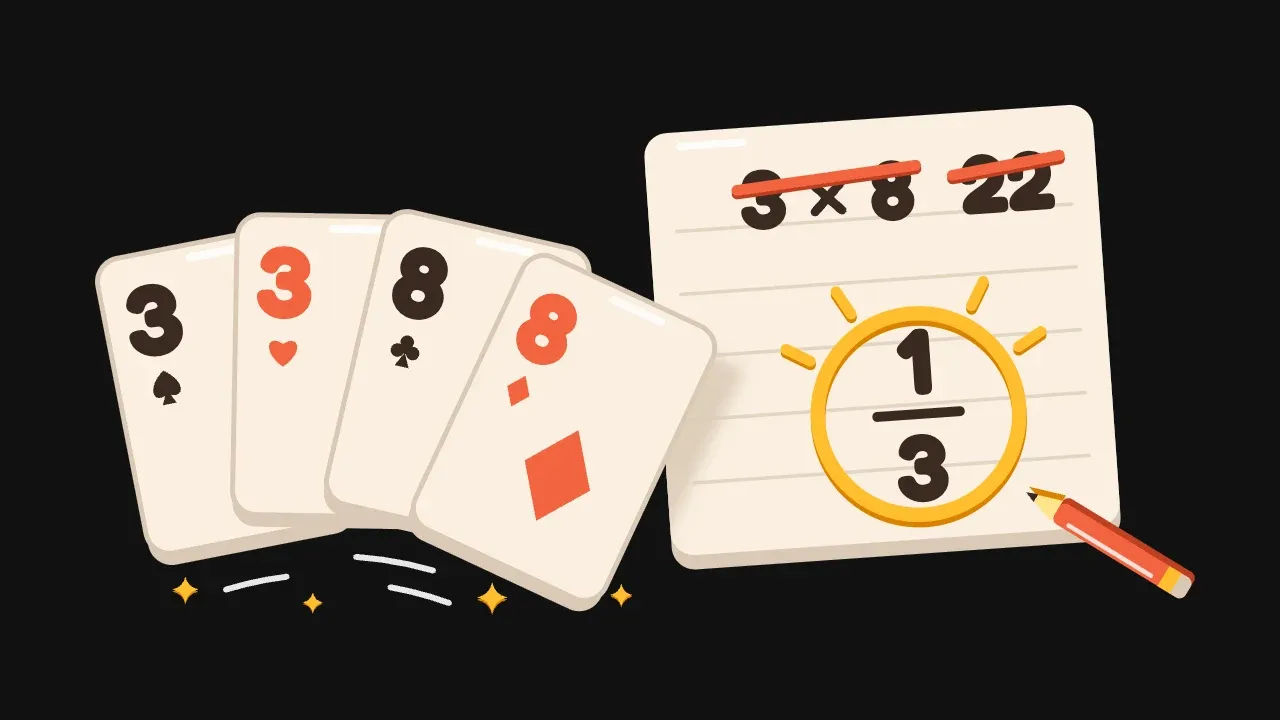
Most 24 game hands can be solved quickly, but the hardest 24 game hands can keep you stuck for minutes. The most famous is 3, 3, 8, 8. This is about those hard hands, not the rules. Want the rules? Read how to play the 24 game. A hard hand has very few answers, sometimes exactly one, and it may need a fraction on the way to 24. Here are the toughest hands, the idea behind each, a way to spot a hard hand, and four hands to try with the answers hidden.
The hardest 24 game combinations: what makes a hand hard?
A computer checked all 495 hands you can make from the cards 1 to 9. A hand is four numbers, and their order doesn’t matter. Of the 495, 404 can be solved and 91 can’t.
Most solvable hands have many answers. But some have exactly one, such as 1, 2, 7, 7 and 5, 5, 9, 9. Changing the order or grouping of an addition or a multiplication doesn’t count as a new answer.
Exactly 7 hands can only be solved through a fraction: 1, 3, 4, 6; 1, 4, 5, 6; 1, 5, 5, 5; 1, 6, 6, 8; 3, 3, 7, 7; 3, 3, 8, 8; and 4, 4, 7, 7. We look for whole numbers first, which is why these feel impossible. Sections 1 and 2 cover the fraction hands, and section 3 covers the traps.
1. The famous one: 3, 3, 8, 8
Try this hand before you open the answer.
Show the answer
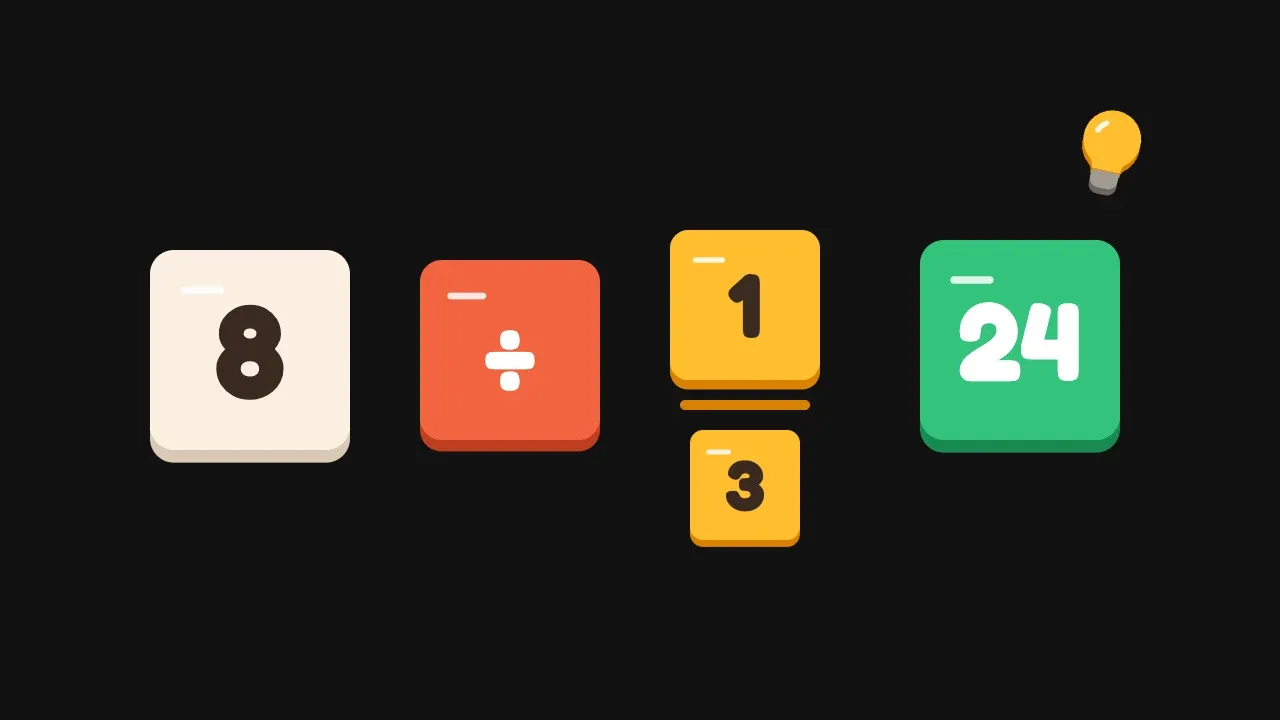
8 ÷ (3 − 8 ÷ 3) = 24. Work it from the inside out:
- 8 ÷ 3 = 2 2/3.
- 3 − 2 2/3 = 1/3.
- 8 ÷ 1/3 = 24, because dividing by 1/3 is the same as multiplying by 3.
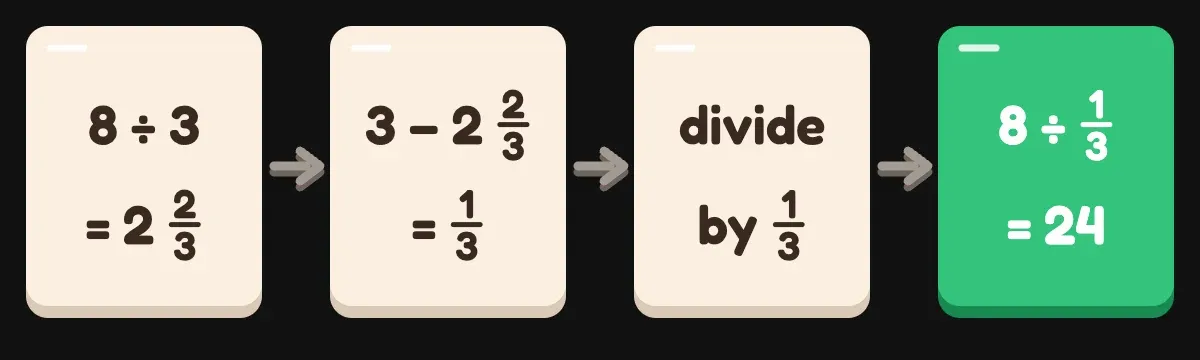
Why is this the only route? It’s a one-answer hand, and no whole-number idea gets there. 3 × 8 = 24 leaves a 3 and an 8, which can’t make 1 or 0. Adding everything gives 22, which misses by 2. That leaves one thing: make a small fraction and divide by it.
Tip: when 3 × 8 = 24 is staring at you but the leftovers won’t cancel, look for a number to divide by. Here that number is 1/3.
2. Two more fraction hands: 1, 6, 6, 8 and 4, 4, 7, 7
The other four fraction hands are solved in how to play the 24 game, so they aren’t repeated here.
1, 6, 6, 8
Show the answer
6 ÷ (1 − 6 ÷ 8) = 24. 6 ÷ 8 = 3/4, then 1 − 3/4 = 1/4, and 6 ÷ 1/4 = 24. The idea: turn 6 and 8 into a fraction, take it from 1, and divide.
4, 4, 7, 7
Show the answer
7 × (4 − 4 ÷ 7) = 24. 4 ÷ 7 = 4/7, then 4 − 4/7 = 24/7, and 24/7 × 7 = 24. The idea: the 7 you divide by comes back when you multiply by the other 7.
The pattern: make a fraction from two numbers, add it to or subtract it from something, then multiply or divide it back into a whole number. A rule of thumb? When a 5, 7 or 9 is in the hand and nothing else works, divide by it and see whether the rest comes back to 24.
3. Trap hands: the only answer is a whole number you didn’t expect
3, 3, 5, 5
Only one answer works. The trap? 3 and 5 look as if they should multiply to something useful, but the pairs that work are 3 ÷ 3 = 1 and 5 × 5 = 25.
Show the answer
5 × 5 − 3 ÷ 3 = 24. 3 ÷ 3 = 1, 5 × 5 = 25, and 25 − 1 = 24.
1, 2, 7, 7
Only one answer works. The trap is reaching 49 and then halving it.
Show the answer
(7 × 7 − 1) ÷ 2 = 24. 7 × 7 = 49, 49 − 1 = 48, and 48 ÷ 2 = 24.
Both hands share one idea: look for a big product (25 or 49) just above a multiple of 24, then correct it with the small numbers.
How to spot a hard hand (and a hopeless one)
A rule of thumb for a hard hand: a repeated pair (3, 3, or 7, 7, or 8, 8) is a warning sign, especially when the other two numbers don’t combine neatly.
Some hands look solvable but aren’t. Take 4, 4, 6, 6: its 4 × 6 = 24 seems to finish it, but the leftover 4 and 6 can’t make 1 or 0, so the easy route fails. Others are 3, 4, 6, 7; 6, 6, 7, 7; and 2, 3, 3, 4. A computer checked each one, and none has an answer. In all, 91 hands have no answer.
Practical advice: try the factor pairs of 24, then one fraction move. Both fail? Agree on a time limit before you call it “no solution”. The how to play the 24 game post covers these first steps.
4 hands to try (answers hidden)
These four hands are new. They go from easiest to hardest, and one of them has no answer. Which one? You’ll have to decide when to give up.
1. The hand 2, 4, 4, 9
Show the answer
(9 − 2) × 4 − 4 = 24. 9 − 2 = 7, 7 × 4 = 28, and 28 − 4 = 24.
2. The hand 3, 3, 3, 9
Show the answer
3 × (9 − 3 ÷ 3) = 24. 3 ÷ 3 = 1, 9 − 1 = 8, and 8 × 3 = 24.
3. The hand 4, 5, 5, 8
Show the answer
8 × (4 − 5 ÷ 5) = 24. 5 ÷ 5 = 1, 4 − 1 = 3, and 3 × 8 = 24.
4. The hand 6, 6, 7, 7
Show the answer
No solution. A computer check of every way to combine 6, 6, 7, 7 finds none that makes 24.
Keep practising
Next time you deal four number cards, look for the signs above. For the rules and shortcuts, go back to how to play the 24 game, and for another number puzzle, try number sequence puzzles.