Here is how to play the 24 game: you get four numbers, and you must make exactly 24 from them, using + − × ÷ and brackets. If you are staring at four numbers and nothing clicks, you are in the right place. Below are the rules, two shortcuts that solve many hands, the fractions trick for the awkward ones, and seven hands to try, with the answers hidden until you want them.
How to play the 24 game: the rules
- You get four numbers. Cards 1 to 9 are the usual choice, but any four numbers will do.
- Make exactly 24 with + − × ÷ and brackets.
- Use each number once. You can’t skip one, use one twice, or stick two digits together (a 1 and a 2 don’t make 12).
- Close doesn’t count: 23 or 25 is a miss.
- Division can give fractions on the way, as long as the final answer is exactly 24.
Worked example, the hand 1, 2, 3, 4: 1 × 2 × 3 × 4 = 24. Or (1 + 3) × (2 + 4) = 4 × 6 = 24. Both use every number once.
With friends, everyone sees the same four numbers, and the first valid answer scores. On your own, set a timer.
1. Work backwards from a factor pair of 24
24 splits into pairs of factors: 6 × 4, 8 × 3, 12 × 2 and 24 × 1. Pick a pair and ask whether your four numbers can make those two parts.
- 5, 6, 7, 8: 5 + 7 = 12 and 8 − 6 = 2, so (5 + 7) × (8 − 6) = 12 × 2 = 24.
- 1, 1, 5, 8: 5 − 1 − 1 = 3, so 8 × (5 − 1 − 1) = 8 × 3 = 24.
- 4, 7, 8, 8: 4 + 7 − 8 = 3, so 8 × (4 + 7 − 8) = 8 × 3 = 24.
A 1 is easy to use. Make 24 from the other three numbers, then multiply by the 1 and nothing changes.
2. Look for easy 24s: 12 + 12, 3 × 8, 4 × 6
Check the easy moves first. 3 and 8 make 24 (3 × 8), 4 and 6 make 24 (4 × 6), and two 6s make 12, which is half of 24.
A pair that makes 0 (7 − 7) or 1 (7 ÷ 7) is a free move. Adding 0 or multiplying by 1 changes nothing, so you are left with the other two numbers to make 24 from.
- 6, 6, 6, 6: 6 + 6 + 6 + 6 = 24.
- 2, 3, 4, 12: 2 × 3 = 6, then 6 − 4 = 2, so 12 × (2 × 3 − 4) = 12 × 2 = 24.
A good order to try: add them up, then multiply, then look for pairs that make 0 or 1, then look at differences.
3. The fractions trick for the hands that seem impossible
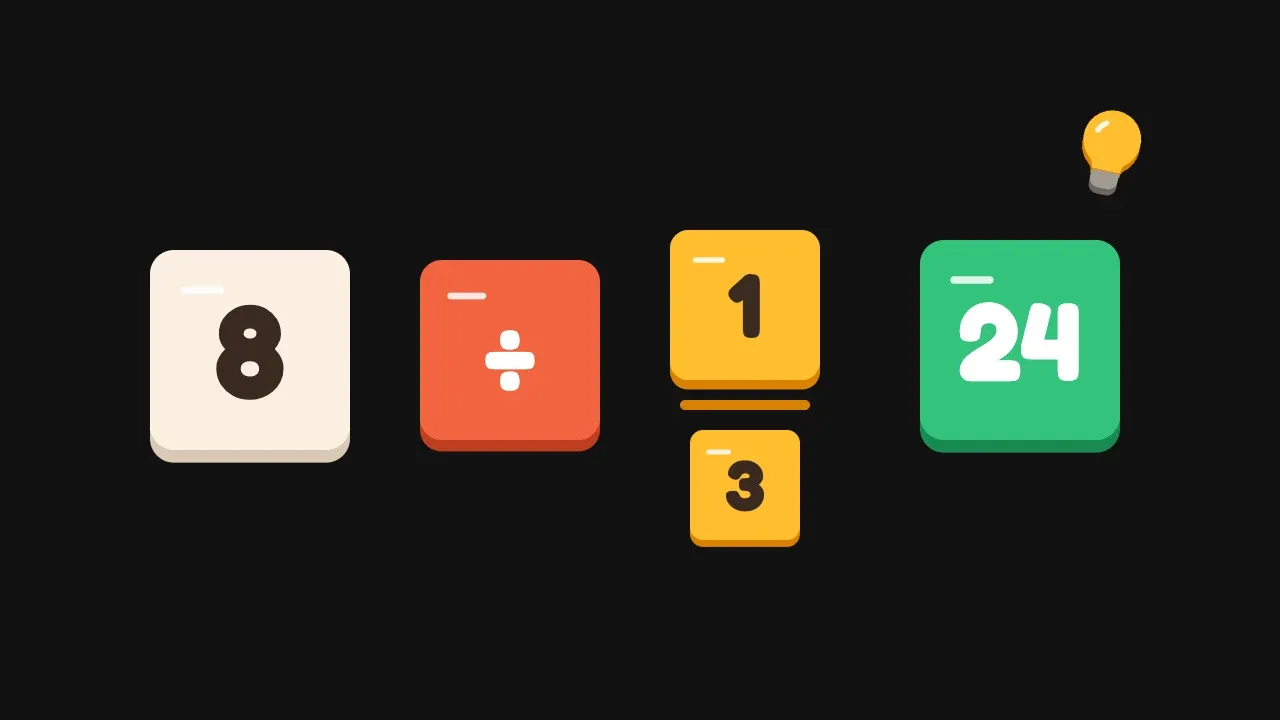
When nothing in whole numbers works, divide by a fraction. A small number between 0 and 1 is the tool: dividing by 1/3 is the same as multiplying by 3, and dividing by 1/4 is the same as multiplying by 4.
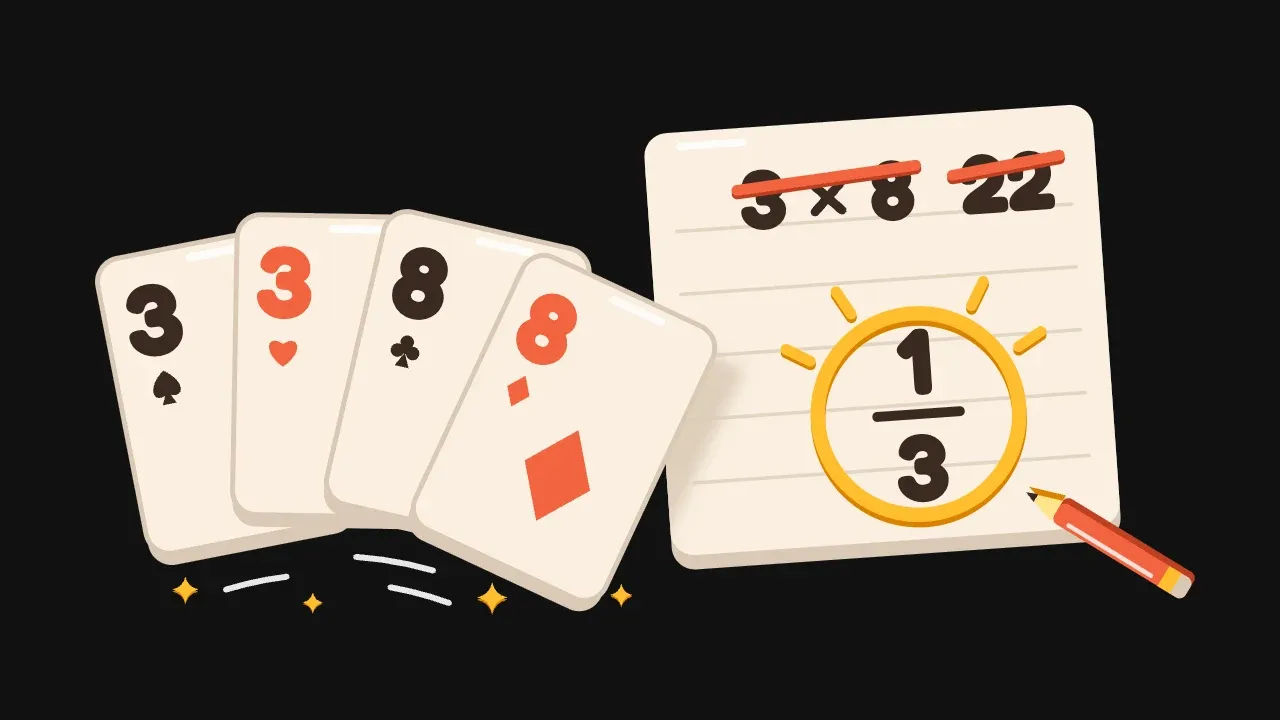
- 3, 3, 8, 8: 8 ÷ 3 = 2 2/3, then 3 − 2 2/3 = 1/3, and 8 ÷ 1/3 = 24. So 8 ÷ (3 − 8 ÷ 3) = 24.
- 1, 4, 5, 6: 5 ÷ 4 = 1 1/4, then 1 1/4 − 1 = 1/4, and 6 ÷ 1/4 = 24. So 6 ÷ (5 ÷ 4 − 1) = 24.
- 3, 3, 7, 7: 3 ÷ 7 = 3/7, then 3 + 3/7 is 3 3/7, and 7 × 3 3/7 = 21 + 3 = 24.
Rule of thumb: if the numbers are awkward (like 7s and 3s), try a division that gives a fraction first, then see what multiplies it back up.
4. Can every hand be solved? How to tell it cannot
No. Of the 495 different hands you can make from cards 1 to 9, 91 (about 1 in 5) have no solution. A computer checked every hand to confirm it. There is no quick test that settles a hand, so when you are stuck, you have to search.
Some hands that can’t reach 24:
- 1, 1, 1, 1: the biggest you can make is 4 (1 + 1 + 1 + 1).
- 2, 2, 2, 2: the biggest you can make is 16 (2 × 2 × 2 × 2).
- 9, 9, 9, 9: you can build numbers far bigger and far smaller than 24, but none of them lands on 24.
Two warning signs: every number is small (with only 1s and 2s, 24 is out of reach), or every number is the same big number, as in 9, 9, 9, 9.
Before you give up, try the factor pairs and one fractions move. If that finds nothing, deal a new hand. In a game, agree before you start how long to search before anyone calls “no solution”.
7 hands to try (answers hidden)
Try each hand before you open its answer. They go from easy to tricky.
1. The hand 1, 1, 1, 8
Make 24 from 1, 1, 1 and 8, each used once.
Show the answer
8 × (1 + 1 + 1) = 24. The three 1s make 3, and 8 × 3 = 24.
2. The hand 3, 4, 5, 6
Show the answer
6 × (5 + 3 − 4) = 24. 5 + 3 − 4 = 4, and 6 × 4 = 24.
3. The hand 2, 5, 6, 9
Show the answer
9 + 6 ÷ (2 ÷ 5) = 24. 2 ÷ 5 is 2/5, and 6 ÷ 2/5 = 15, so 9 + 15 = 24.
4. The hand 4, 4, 10, 10
Show the answer
(10 × 10 − 4) ÷ 4 = 24. 10 × 10 − 4 = 96, and 96 ÷ 4 = 24.
5. The hand 1, 3, 4, 6
Show the answer
6 ÷ (1 − 3 ÷ 4) = 24. 3 ÷ 4 = 3/4, then 1 − 3/4 = 1/4, and 6 ÷ 1/4 = 24.
6. The hand 5, 5, 5, 1
Show the answer
5 × (5 − 1 ÷ 5) = 24. 1 ÷ 5 = 1/5, then 5 − 1/5 = 24/5, and 5 × 24/5 = 24.
7. The hand 1, 1, 2, 2
Show the answer
No solution. The biggest value you can make is 9, as (2 + 1) × (2 + 1), so 24 is out of reach.
Keep practising
Take four number cards from a deck (aces count as 1, face cards out), or ask a friend for four numbers, and try ten hands a day. Before long you’ll see the 6 × 4 and 12 × 2 shapes at once.
For another warm-up, try the brain teasers for a 5-minute break, or the habits that help with logic puzzles.