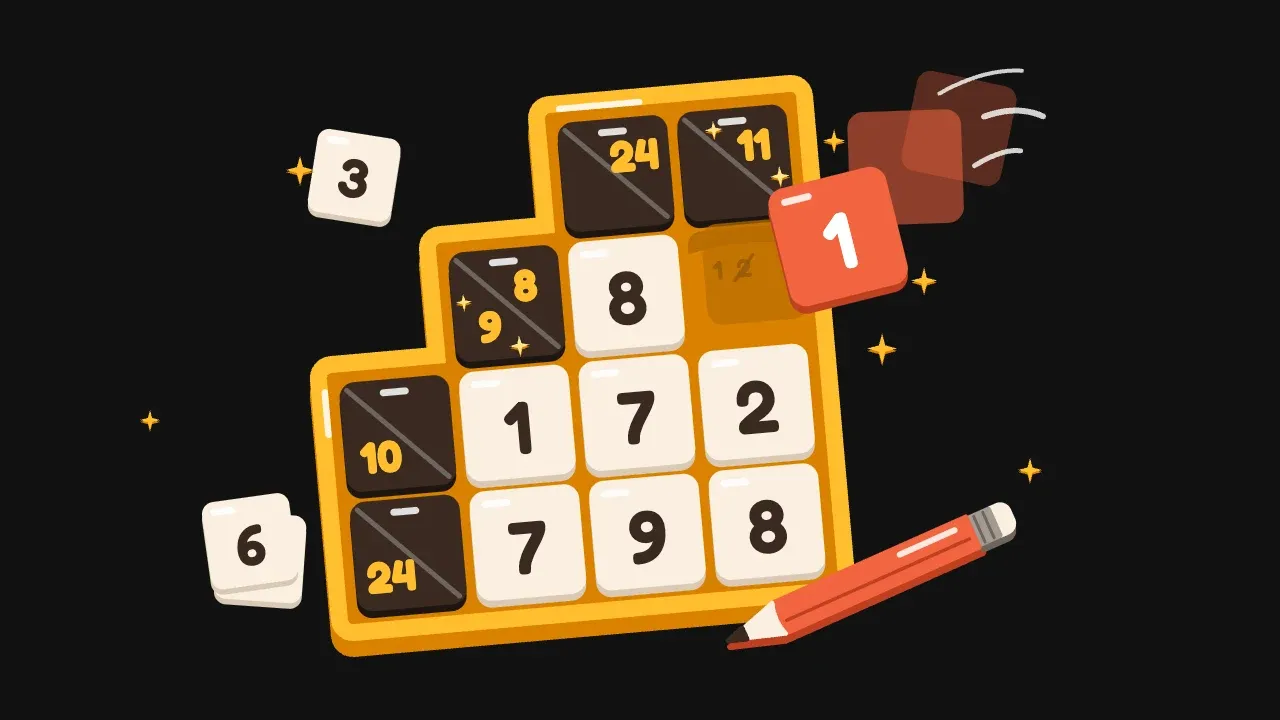
If you want to learn how to solve Kakuro, the first grid can look impossible: a crossword full of numbers. One trick cracks it, a short list of sums that can be made only one way. Below: the rules, a cheat sheet, a solved example and one grid to try.
What is Kakuro? The rules
Kakuro is a number puzzle. White cells take digits; black cells hold the clues. A clue is the total of the run it points to: a line of white cells going down or across. In a black cell split by a diagonal line, the top clue is for the run going down, and the bottom clue is for the run going across.
- Rule 1: digits 1 to 9 only, no zero.
- Rule 2: the digits in a run add up to its clue.
- Rule 3: no digit repeats within a run, though it can appear in another run.
Rule 3 matters. Why can a clue of 4 across two cells only be 1 + 3? Because 2 + 2 repeats the 2.
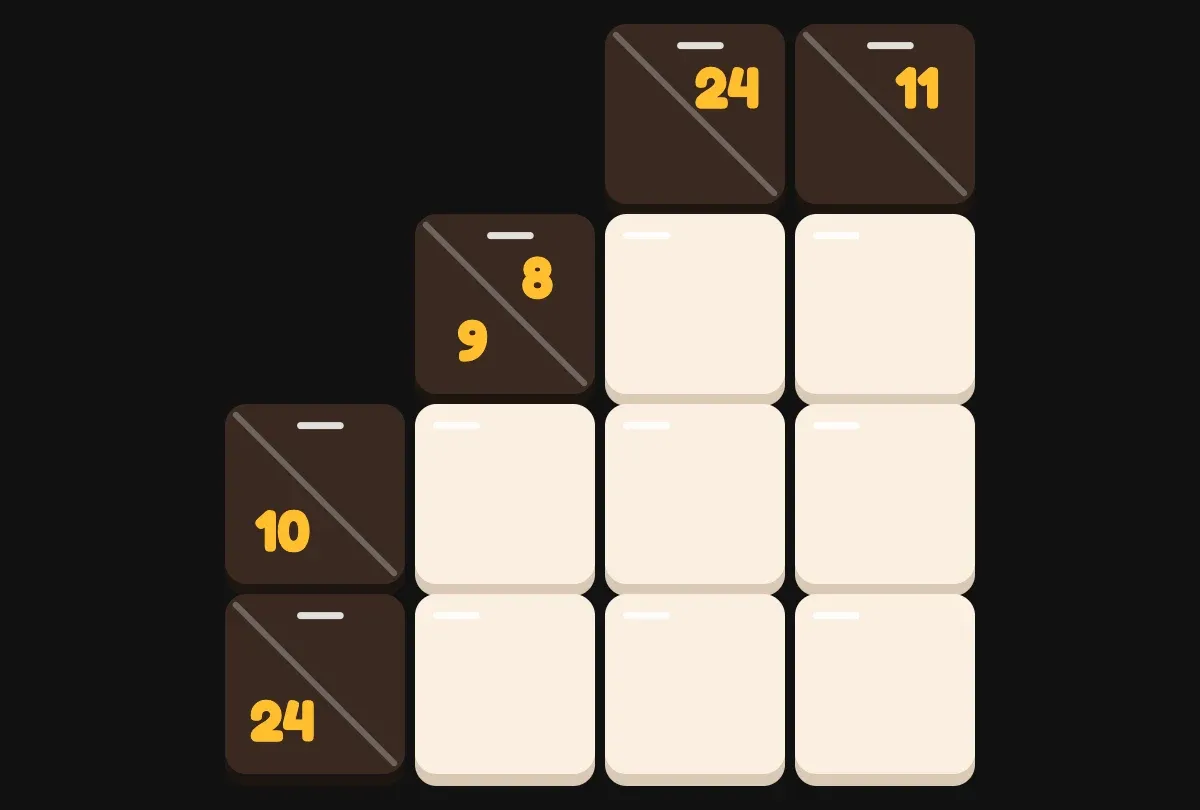
Here’s a small grid, empty, with its clues:
The trick: sums with only one combination
Most sums can be made several ways: 10 in two cells is 1 + 9, 2 + 8, 3 + 7 or 4 + 6. But some have only one way: for two cells, 3 and 17; for three cells, 6 and 24. Start there. The digit order doesn’t matter at first: 17 in two cells means 8 and 9, and the crossings show which goes where.
There’s a shortcut for the big sums. Replace each digit with 10 minus the digit, and a three-cell sum mirrors to 30 minus the sum: 6 is 1 + 2 + 3, and 24 is 7 + 8 + 9.
Cheat sheet: combinations to remember
Keep this table as a bookmark. Each sum in it has only one combination:
| Cells | Sum = its only combination |
|---|---|
| 2 | 3 = 1 + 2, 4 = 1 + 3, 16 = 7 + 9, 17 = 8 + 9 |
| 3 | 6 = 1 + 2 + 3, 7 = 1 + 2 + 4, 23 = 6 + 8 + 9, 24 = 7 + 8 + 9 |
| 4 | 10 = 1 + 2 + 3 + 4, 11 = 1 + 2 + 3 + 5, 29 = 5 + 7 + 8 + 9, 30 = 6 + 7 + 8 + 9 |
Every other sum for two, three or four cells has at least two combinations. For example, 10 in two cells is 1 + 9, 2 + 8, 3 + 7 or 4 + 6. You don’t need to memorise it all: start with the sums in the first two rows.
How to solve Kakuro: a grid step by step
The worked grid’s clues, with rows and columns counted from the top and left:
- Across: row 1 (2 cells) 9; row 2 (3 cells) 10; row 3 (3 cells) 24.
- Down: column 1 (2 cells) 8; column 2 (3 cells) 24; column 3 (3 cells) 11.
Step 1: Row 3 and column 2 both sum to 24 in three cells. Only 7 + 8 + 9 makes 24, so the five cells of the bottom row and middle column are 7, 8 or 9.
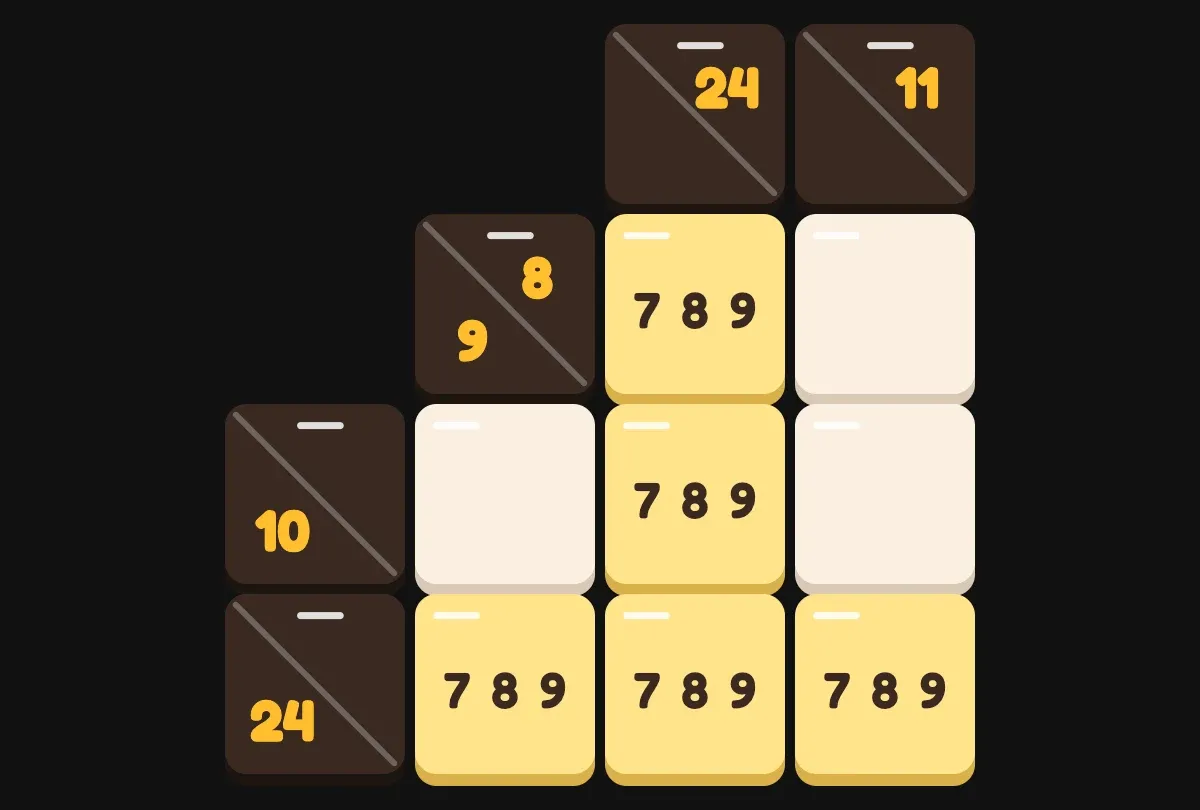
Step 2: Column 1 sums to 8 in two cells, and its bottom cell is 7, 8 or 9. The pairs for 8 are 1 + 7, 2 + 6 and 3 + 5. Which one has a 7, 8 or 9? Only 1 + 7, so the bottom is 7 and the top is 1.
Step 3: Column 3 sums to 11 in three cells. Its bottom cell is 8 or 9, since row 3 has a 7. A 9 would leave 2 for the other two cells, which two different digits can’t make. So the bottom is 8, the bottom-middle cell is 9, and the top two cells are 1 and 2.
Step 4: Row 2 sums to 10, and its left cell is the 1 from step 2. Its right cell is 1 or 2, one of column 3’s top two, and it can’t repeat the 1. So it’s 2, the centre is 7, and the top of column 3 is 1.
Step 5: Row 1 sums to 9 with a right cell of 1, so its left cell is 8. Check: column 2 reads 8, 7, 9, which is 24. Every run adds up.
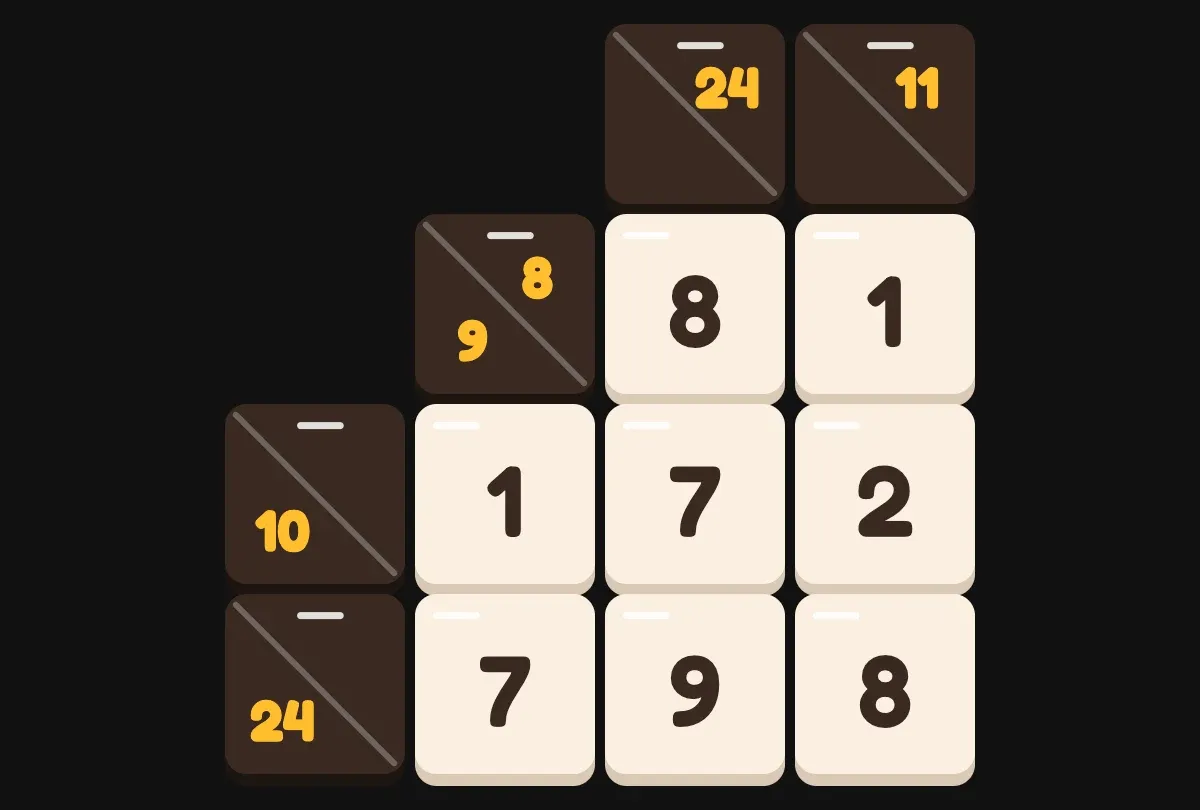
Three habits solved it: find the sums with one combination, use each crossing to cut the choices, and ask what a digit cannot be because of rule 3.
Try it yourself
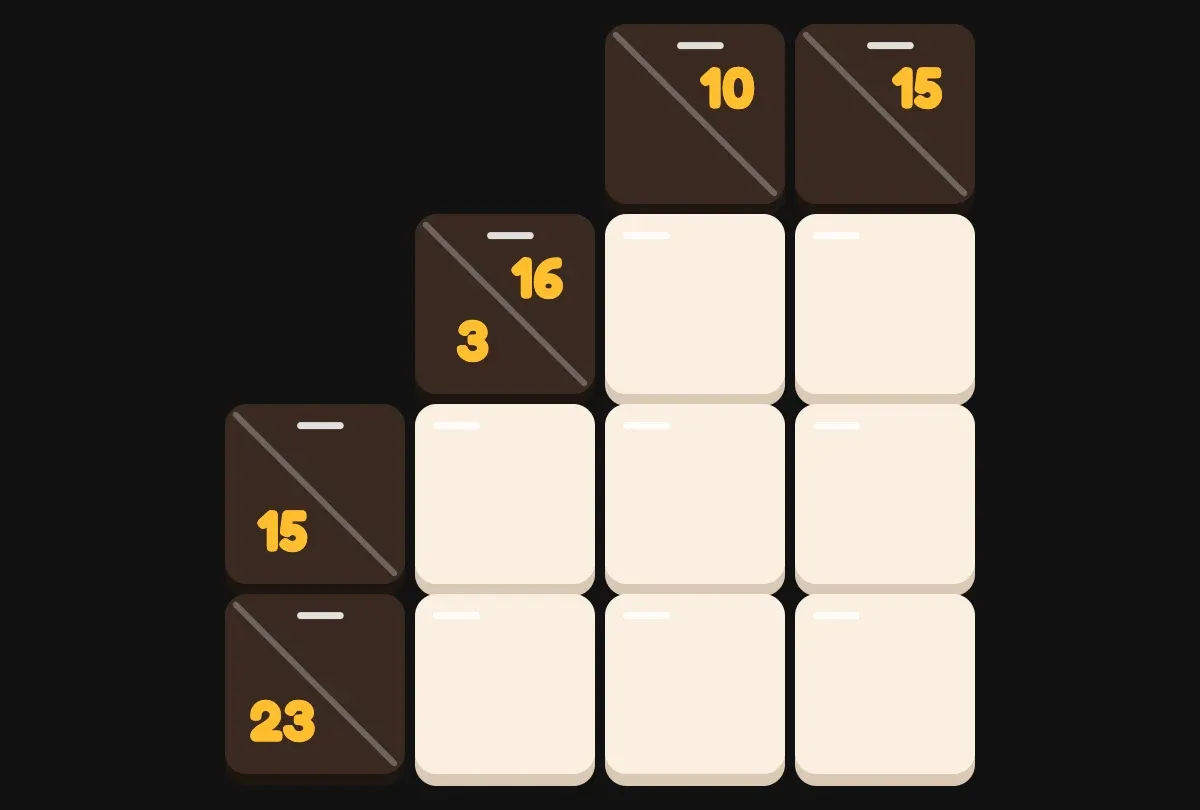
Here’s a grid of the same shape, with new clues:
- Across: row 1 (2 cells) 3; row 2 (3 cells) 15; row 3 (3 cells) 23.
- Down: column 1 (2 cells) 16; column 2 (3 cells) 10; column 3 (3 cells) 15.
Hint: start with the two-cell clues, 3 and 16.
Show the answer
Row 1: 1, 2. Row 2: 7, 3, 5. Row 3: 9, 6, 8.
Row 1 is 1 + 2, the only pair for 3, and column 1 is 7 + 9, the only pair for 16. Row 3 is 23 in three cells, so it’s 6 + 8 + 9. Its left cell is in column 1, which holds 7 or 9, so it’s 9 and row 2’s left cell is 7. Column 2 is 10 with a 1 on top, so its bottom cell is 6 or 8. An 8 would leave a 1 in the middle, a repeat, so it’s 6, the middle is 3, and row 3’s right cell is 8. Then row 2 is 7 + 3 + 5 = 15, and column 3 is 2 + 5 + 8 = 15.
Common beginner questions
- Can a number repeat in a grid? Yes, in different runs, but not within one run.
- What if I get stuck? Pencil in the possible digits, called candidates, and cross out any that break a crossing run. Don’t guess until you have used every one-combination sum.
- Are Kakuro grids always unique? Well-made ones have one solution, so logic is enough. If you think you must guess, re-read the clues: one is probably misread.
Put it into practice
Start with small grids and keep the cheat sheet nearby. Use pencil marks. Want another grid puzzle? Read how to solve nonograms. Want habits that help with any logic puzzle? Read how to get better at logic puzzles.