Here’s how to play gomoku: two players take turns putting a stone on an empty point of a grid, and the first to line up five in a row, across, down or diagonally, wins. The rules are short, and you’ll draw the paper setup in a minute. A short game with a puzzle to solve shows how it plays, and five tips will help you stop losing.
The game is also called five in a row, and the ICGA wiki lists Gobang and WuZiQi among its other names. “Gomoku” comes from the Japanese gomokunarabe (五目並べ). According to Wikipedia, “go” means five, “moku” is a counter for pieces, and “narabe” means line-up. Think of it as tic-tac-toe all grown up: five in a row on a wide-open grid, not three on a 3x3 square.
What you need to play
You’ll need two players, a grid and two kinds of mark. A real board uses black and white stones. On paper, graph paper and two marks do the job: X and O, or two pen colours. The Renju International Federation’s gomoku rules even allow crosses and circles to stand in for stones.
The standard board is 15x15, which gives 225 crossings, and stones go on the crossings. A 19x19 board, the size of a Go board, is also used, according to the ICGA wiki. In his 1994 thesis, Victor Allis notes that early games used a Go-board size, and that larger boards increase Black’s advantage.
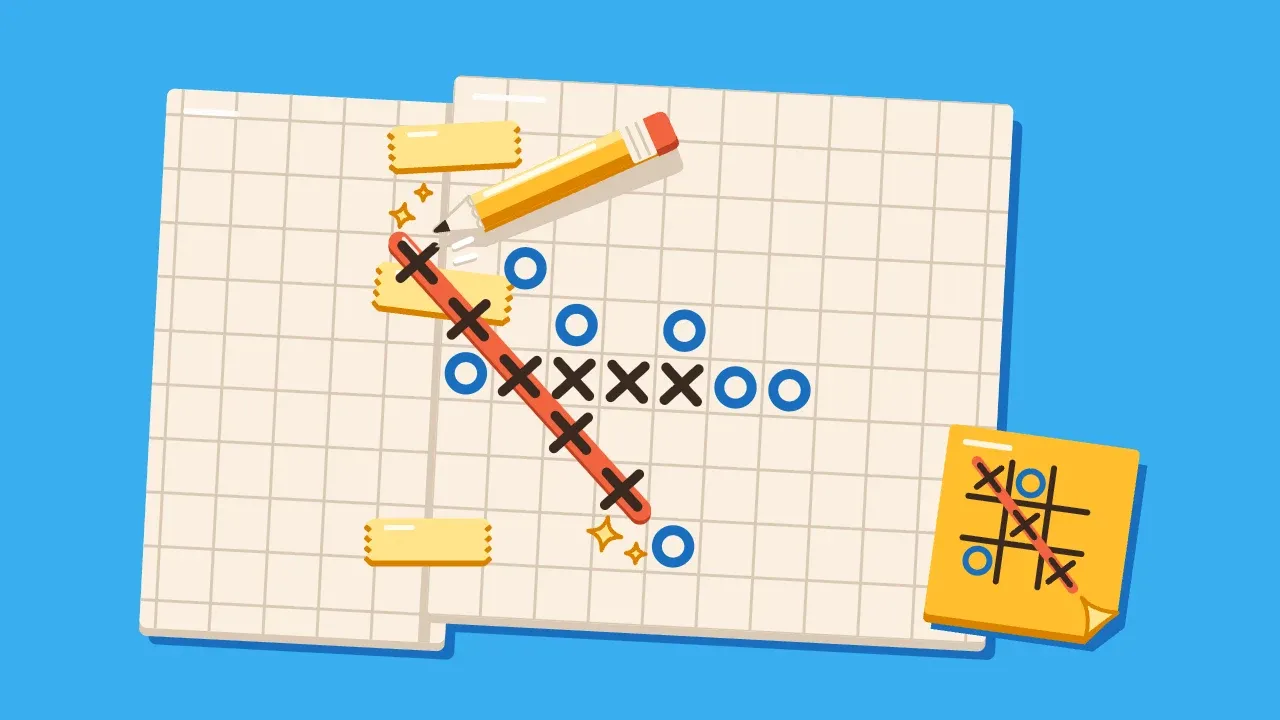
On graph paper you can mark the squares or the corners. The game doesn’t care, so pick one. We’ll use squares here: count out 15 by 15 and you’ve got the same 225 points. Label the columns A to O along the bottom and the rows 1 to 15 up the side if you want to call moves out loud.
Can’t fit the game on the sheet? The federation’s basic rules for five-in-a-row games say the playing ground “has no special limits”, so tape on another page. Allis notes that pencil and paper lets you play virtually everywhere, even classrooms. If you like having a few pen and paper games in your bag, this is one that needs nothing else. For a word game with a friend, try games for two.
The rules in 5 steps
- Black goes first. The players are Black and White. On paper, X is Black and O is White.
- Place one stone per turn on any empty point.
- Stones never move or leave the board. There aren’t any captures.
- Five in an unbroken row wins: across, down or along a diagonal.
- A full board with no five is a draw.
Those five steps match the rules in Allis’s thesis and on the federation’s page. One detail changes with the version you play. Freestyle gomoku lets a line of five or more win, so six in a row still counts. Under standard gomoku, only exactly five wins, and six or more doesn’t win for either player, per Allis and the federation’s rules. Which one are you playing? Agree before you start. Renju has its own rules, covered below.
A short example game
Black is X and White is O. Columns run A to O from the left, rows 1 to 15 from the bottom. The first ten moves go like this:
| Move | 1 | 2 | 3 | 4 | 5 | 6 | 7 | 8 | 9 | 10 |
|---|---|---|---|---|---|---|---|---|---|---|
| Stone | Black H8 | White H9 | Black I8 | White J9 | Black J8 | White K8 | Black H7 | White G10 | Black I6 | White L8 |
Black’s third stone, J8, makes H8-I8-J8, three in a row with both ends open (G8 and K8 are empty). That’s an open three: if White ignores it, Black can make an open four next turn, which can’t be stopped. So White blocks at K8.
Then Black builds a second line. H7 and I6 sit on a diagonal pointing up and to the left at G8, and White never takes G8. White’s stones, meanwhile, never make a three. The position, cropped to the part of the board that matters:
11 . . . . . . . . . .
10 . . . O . . . . . .
 9 . . . . O . O . . .
 8 . . . . X X X O O .
 7 . . . . X . . . . .
 6 . . . . . X . . . .
 5 . . . . . . . . . .
   D E F G H I J K L M
Your turn: spot the winning move
It’s Black’s turn, move 11. Look for one stone that makes a four and another threat at the same time. Don’t open the answer yet; take a minute.
Show the winning move
G8. It makes G8-H8-I8-J8, a four across. K8 is White’s, so Black’s only way to five is F8, and White has to take it. At the same moment G8 starts the diagonal G8-H7-I6, an open three, with F9 and J5 both empty. A four plus an open three is a 4-3 double threat.
White blocks F8. Now Black plays F9, which makes F9-G8-H7-I6, an open four. Both E10 and J5 would make five, White can’t block both, so Black takes the other. E10 gives exactly five (E10-F9-G8-H7-I6), so it wins under either version of the rule.
One note: White could’ve spoiled the whole plan by taking G8 earlier, since that’s the point where both of Black’s lines meet.
Four shapes to know
Four shapes are worth knowing. A gap inside a shape still counts, so X X _ X is a three too.
- Open three: three in a row with both ends open. It’s about to become an open four, so block it right away.
- Closed three: three in a row with one end blocked. Don’t rush: it can only become a four, and a four can be stopped.
- Four: four in a row with one point left to make five. You’ve got to block that point at once.
- Open four: four in a row with both ends open. Nothing can stop it, and it’s a win. White blocks one end, and Black fills the other for five.
Who goes first, and why it matters
Black goes first, and that’s a big edge. Using computer search, Allis showed that Black wins gomoku on a 15x15 board with perfect play (his program was called Victoria). The ICGA’s page records the result, and the thesis notes that strong players, Japanese professionals among them, had said Black wins before anyone had a complete proof. The proof covers games with no opening restrictions. It doesn’t cover the opening rules below.
You won’t play perfectly, so the edge is smaller in practice. A casual fix is to take turns being Black, or to play two games and switch colours.
Swap2 for tournaments
Swap2 is an opening rule for tournament gomoku. The first player puts down three stones, two black and one white, per the RenjuNet rule page. The second player then picks: take a colour, or add two more stones (one white, one black) and let the first player choose the colour, per the federation’s gomoku rules. The 2025 world championship rules, from Brno, say its gomoku world championship tournaments are played with Swap2. The idea is that whoever sets up the position doesn’t know which side they’ll get.
Renju: the version that restricts Black
Renju is the expert version, played on 15x15 only, and only Black is restricted. The international rules bar Black from making an overline (six or more in a row), a double-four (4x4) or a double-three (3x3, with a few exceptions the rules allow). Black’s allowed winning fork is a four-three. A forbidden move loses the game for Black, unless it also makes five. White may win with an overline, while Black must make exactly five.
5 tips for beginners
- Play near the centre. A stone there has room to grow in all four directions. Near an edge, a line runs out of space.
- Build twos that point two ways. A stone that sits on two of your lines makes more threats later, and it’s harder for your opponent to guess which one you mean.
- Block an open three right away. Don’t wait for the four. Before each move, scan your opponent’s stones for a three with open ends, and then look at your own.
- Aim for a double threat. A 4-3 or a 3-3 gives two threats at once, and your opponent can’t block both. That’s how the example game ended. Just remember that in Renju, Black’s 3-3 is mostly forbidden.
- Watch the diagonals. Diagonals are easy to miss. In the example, the winning line was a diagonal that White never blocked.
Like spotting a chain before it closes? Try the long-chain rule in Dots and Boxes.
Gomoku, tic-tac-toe and Connect Four
All three games ask you to line up your pieces, but they end differently.
| Game | Board | Goal | With perfect play |
|---|---|---|---|
| Tic-tac-toe | 3x3 | three in a row | a draw |
| Connect Four | 7 columns by 6 rows, pieces fall | four in a row | the first player wins |
| Gomoku | 15x15, open grid | five in a row | Black wins on 15x15, with no opening restrictions |
Tic-tac-toe is a draw with perfect play, which is why the tic-tac-toe strategy is about never losing. Connect Four uses a 7-by-6 grid where pieces fall to the lowest free space. According to John Tromp’s page, it was solved as a win for the first player in 1988, by James Allen and, independently, by Victor Allis. That’s the same Allis who later solved gomoku.
Gomoku has no gravity, so a threat can start anywhere on the grid. Enjoy classic two-player games? Nine Men’s Morris and how to play checkers are good next ones.
When you don’t have a friend or paper
Gomoku is mostly scanning a grid and planning a move or two ahead, and a calm puzzle can keep that habit warm. Try it with Loopaway, a free arrow puzzle in your browser where you tap arrows off the board until none are left. There are more puzzle games on the site too.
Frequently asked questions
Who goes first in gomoku?
Black goes first. On paper, mark one player X and the other O, and let X start. Black's first move is a real edge, so it helps to take turns being Black.
What size board do you need for gomoku?
The standard board is 15x15, which has 225 crossings. A 19x19 board, the size of a Go board, is also used. On paper, a 15x15 block of graph-paper squares does the job.
How do you win at gomoku?
You win by being first to make an unbroken row of five stones, across, down or diagonally. In the standard game it must be exactly five. In freestyle, five or more wins.
What's the difference between gomoku and Renju?
Renju is the expert version, played on a 15x15 board. Only Black is restricted: no overlines, no double-fours and, with a few exceptions, no double-threes. Plain gomoku puts no such limits on Black.
Can you play gomoku on paper?
Yes. All you need is graph paper, a pencil and a friend. Write X and O in the squares, or use two pen colours, and take turns until someone makes five in a row.
Sources
- Searching for Solutions in Games and Artificial Intelligence (Allis, 1994 thesis)
- Go-moku family of games, ICGA
- Gomoku Family, ICGA Wiki
- Gomoku Rules, Renju International Federation
- Gomoku - swap2 rule, RenjuNet
- What is Renju? RenjuNet
- The International Rules of Renju, Renju International Federation
- The basic "completely free" rules of all five-in-a-row games, Renju International Federation
- GRWC Brno 2025 rules
- John's Connect Four Playground (Tromp)
- Connect Four, Wikipedia
- Tic-tac-toe, Wikipedia
- Gomoku, Wikipedia