Want to know how to play Nine Men’s Morris? You may have seen its board, three squares one inside the next. Below: one clear rule set for the standard nine-piece game, a board you can draw in a minute, a short game that ends in a double threat, and three habits for beginners. The game is also called Mills or Merels.
How to play Nine Men’s Morris: draw the board in a minute
You need two players, nine pieces each (coins, buttons, or two kinds of coin), a sheet of paper and a pen.
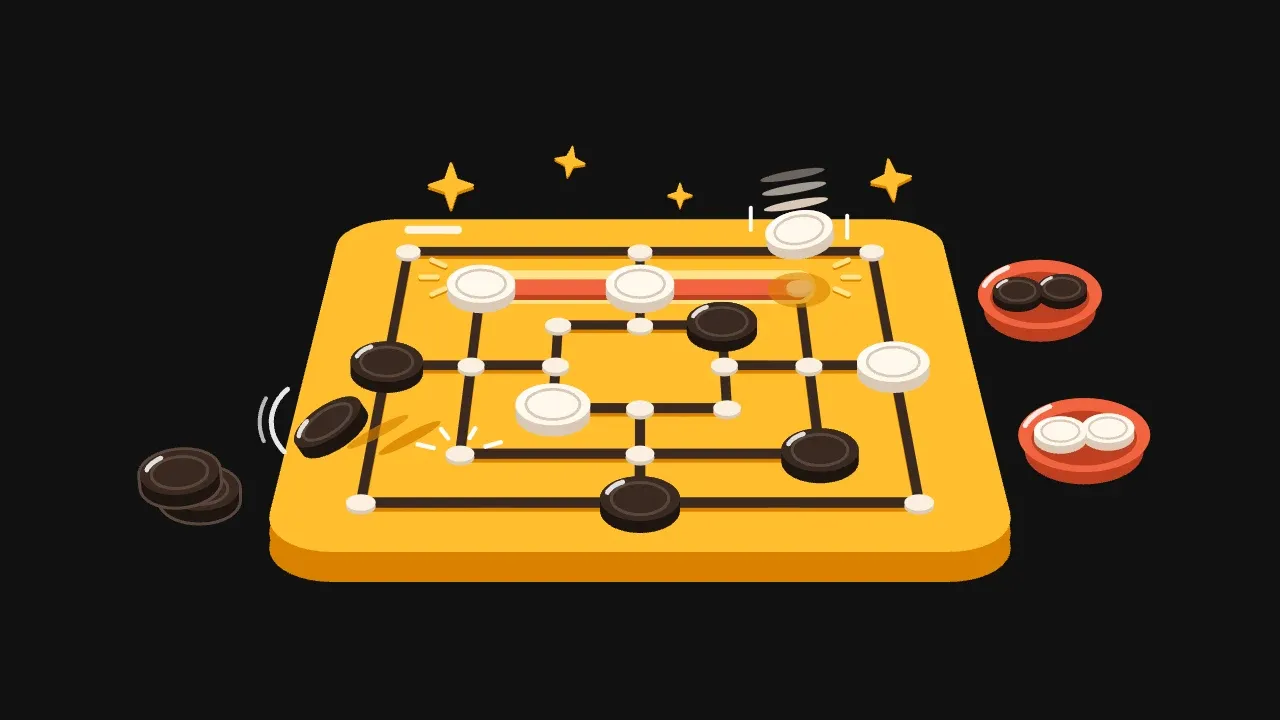
Draw three squares, one inside the next, evenly spaced. Then draw four short lines joining the middle of each side of the outer square to the middle of the matching side of the inner square, passing through the middle square’s side. Don’t join the corners, and draw no diagonals.
The board has 24 points, the corners and side midpoints of the three squares, joined by 32 lines. The empty centre isn’t a point.
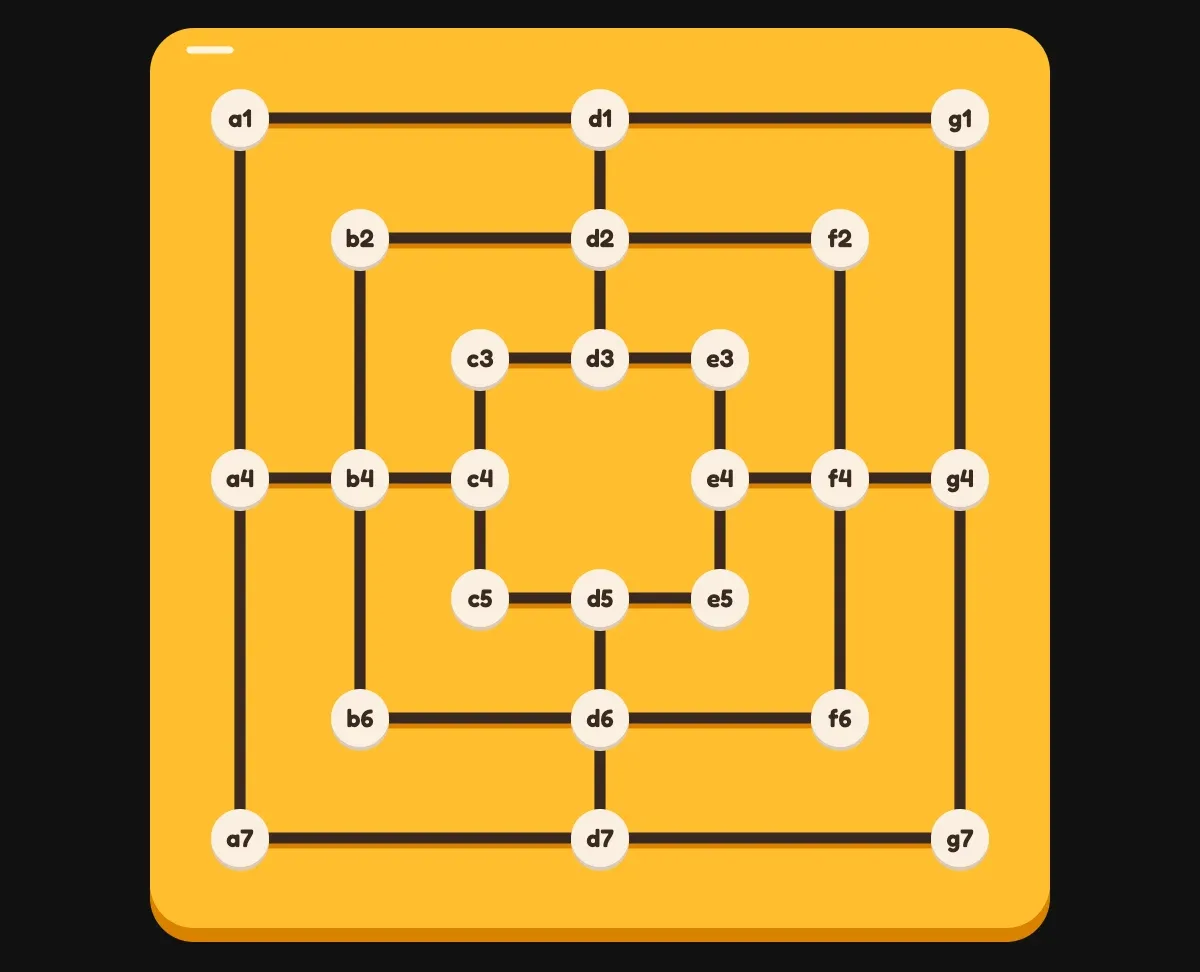
Here the points are named like chess squares, columns a to g and rows 1 to 7, so the outer corners are a1, g1, a7 and g7. You don’t need the names to play.
The goal and the mill
A mill is three of your own pieces in a row along one line of the board: a side of a square, or one of the four cross lines. The board has 16 possible mills, 12 along the square sides and 4 along the cross lines. Each time you complete a mill, you remove one of your opponent’s pieces from the board.
You win when your opponent has only two pieces left, or when they can’t make a legal move on their turn. There are no diagonal lines on this board, so there are no diagonal mills.
Phase 1: placing the pieces
Agree who starts (say, White). Then take turns placing one piece on any empty point until each player has placed all nine. Nothing moves yet.
A piece that completes a mill removes an opposing piece at once, even in this phase. The standard rule is that you may take any opposing piece that is not in a mill. If every opposing piece is in a mill, you may take one of those. Some groups play it differently; see the variants below.
Corners are often the weakest points to place on, since a corner has only two neighbours. Habit 3 explains why.
A worked placing phase: the double threat
White starts, and the moves are:
- White d1, Black b4
- White g4, Black d6
- White g1
Black’s two pieces don’t threaten a mill, and neither stops White’s plan. After White g1, White has two threats at once. On the top row, a1-d1-g1 has two White pieces and an empty a1. Down the right column, g1-g4-g7 has two White pieces and an empty g7. Black has no threat of their own.
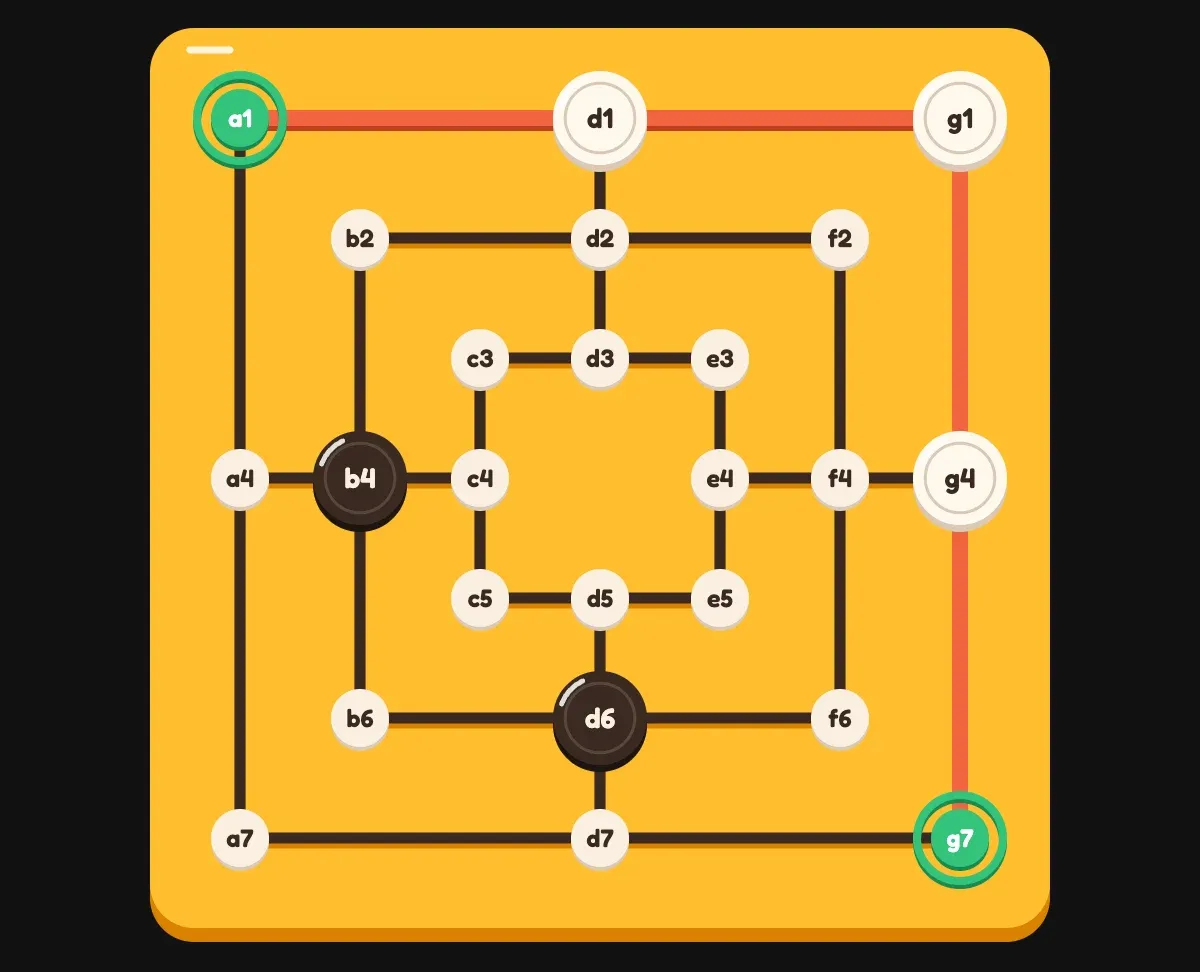
Can Black block both? No, only one. If Black plays a1, White plays g7 and completes the mill g1-g4-g7. White removes a black piece, and can take the blocking piece on a1: the top-row threat comes back, since d1 and g1 are still White and a1 is empty again. Black must spend another move on a1. If Black plays g7 instead, White plays a1 and completes a1-d1-g1.
The lesson: one point on two lines, each already holding one of your pieces, gives you a double threat.
Phase 2: sliding
When all the pieces are placed, players take turns sliding one piece along a line to a neighbouring empty point. You can’t jump, and there are no diagonals to slide along. A mill formed by a slide captures in the same way as before.
A player who can’t slide any piece on their turn loses. So blocking is a real way to win. More neighbours means more freedom: a corner piece has two neighbours, an outer or inner midpoint has three, and the four midpoints of the middle square (d2, b4, f4 and d6) have four.
The mill you can open and close
A strong slide trick is a mill you can open and close again every two moves, capturing each time it closes.
Take White’s mill on g1, g4 and g7, with f4 empty. White slides g4 to f4, which opens the mill. On the next turn White slides f4 back to g4, which closes the mill again and removes a black piece. Can Black stop the return? No: no black piece can reach g4. Its three neighbours, g1, g7 and f4, are all White’s while the piece is on f4.
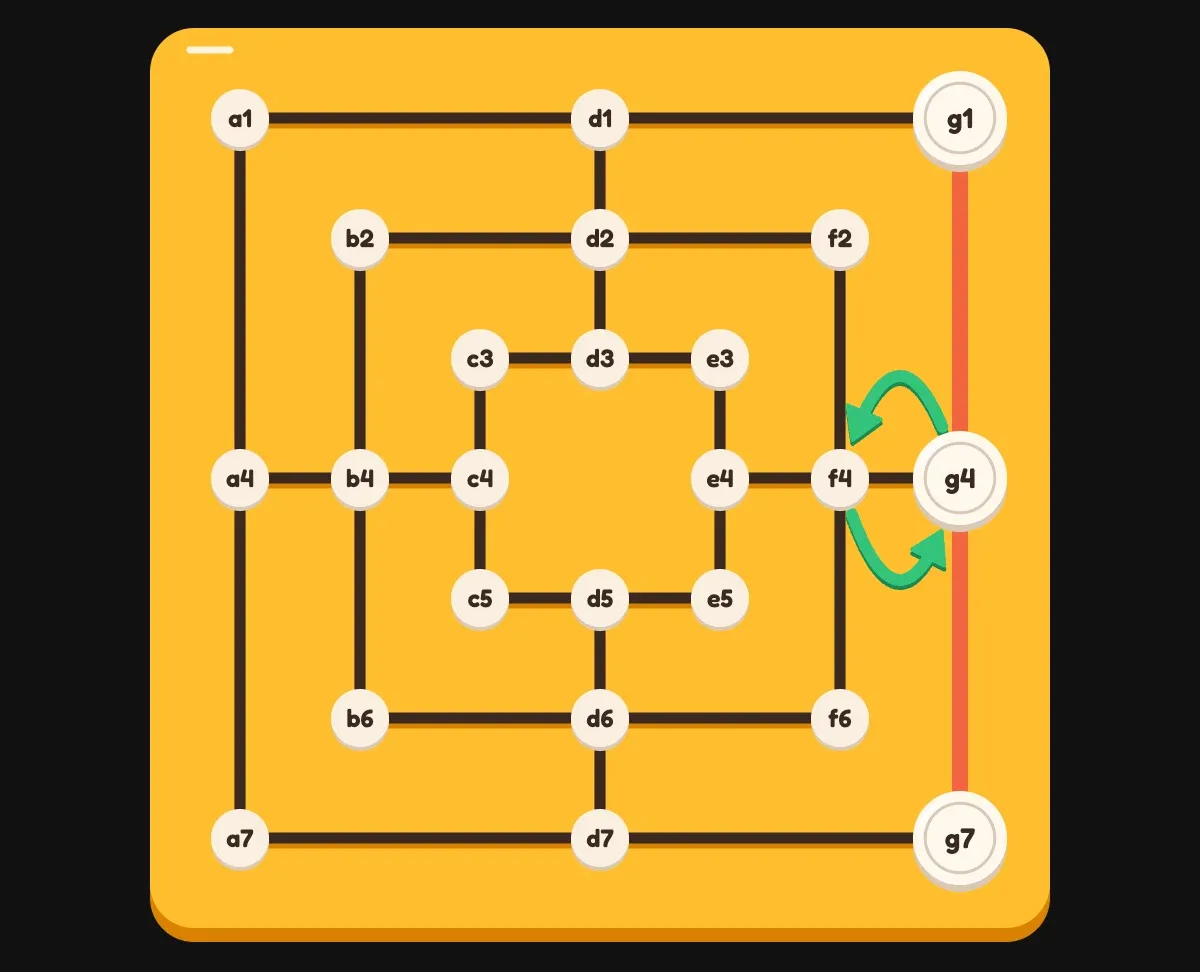
Black has two ways to stop this. They can occupy f4 before White opens the mill, or make a mill of their own in the meantime and remove one of the three White pieces. The trick works in the standard game, where re-forming a mill counts as a new mill.
Phase 3: flying
Down to three pieces? The standard rule lets a player move any piece to any empty point. This is called flying. It rescues a nearly lost player, who can now threaten a mill anywhere on the board.
Have more pieces? Be careful: a flier can jump in to block your line or to make a mill of its own. Close your mills with two threats rather than one.
Variants to agree before you start
Sources say the game was known in the Roman Empire and was popular in medieval England. In North America it’s also called cowboy checkers. With perfect play by both sides, the game is a draw.
These are the house rules to agree before the first move:
- Flying: whether a player with three pieces may fly. The standard rule says yes.
- Mills and removal: whether a piece in a mill may be removed when all of the opponent’s pieces are in mills. The standard rule says yes, in that case.
- Diagonals: some boards add diagonal lines. The board here has none.
- Board size: other Morris games, such as Six Men’s and Twelve Men’s, use different boards.
- Repeats: whether a position that repeats is a draw. Agree it in advance.
Three beginner habits
Habit 1: block early. Before each move, check whether your opponent has two pieces in a line with an empty third point. They do? Take that point first. A piece that blocks them is usually better than one that only builds your own pair.
Habit 2: aim for double threats. Look for a point on two lines, where each line already holds one of your pieces and the rest is empty, as in the worked game. Don’t rush to make a single two-in-a-row. It’s easy to block.
Habit 3: keep your pieces mobile. Prefer points with four neighbours: d2, b4, f4 and d6. Avoid walling your own pieces into corners, because in the sliding phase the player who can’t move loses.
To copy onto a card: block first, look for the double threat, and keep your pieces out of corners.
Put it into practice
Draw a board, find a friend and two sets of nine coins. Then play one game with the three habits.
Nine Men’s Morris is a close cousin of tic-tac-toe: it’s also about lines of three and blocking, but there’s more to think about. For another classic with a moving phase, try how to play checkers.