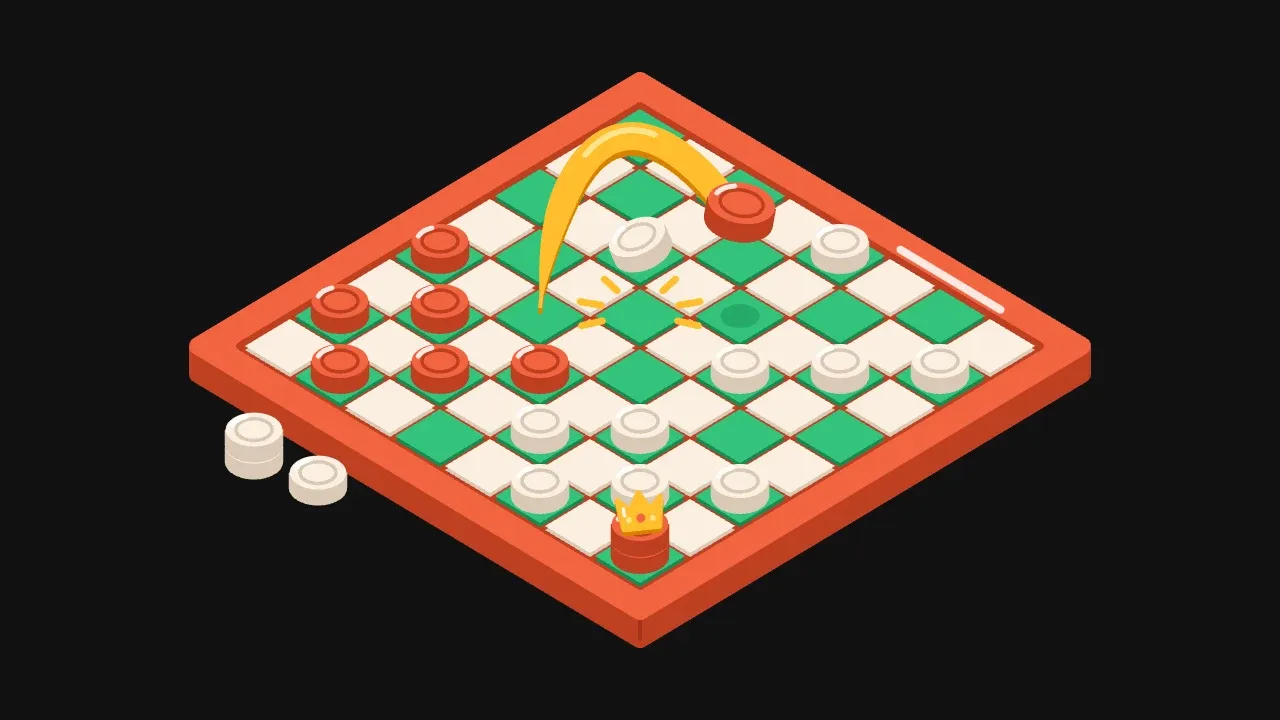
Here is how to play checkers, using the standard American (English) rules on an 8x8 board. It takes about a minute to learn, but new players get stuck on the same few questions: do I have to jump? Can a man jump backwards? What does a king actually do? This guide answers them in plain steps, with a forced jump and a double jump worked through on the board, the rules people argue about, and four beginner tips, each with a small picture.
1. The board and the setup
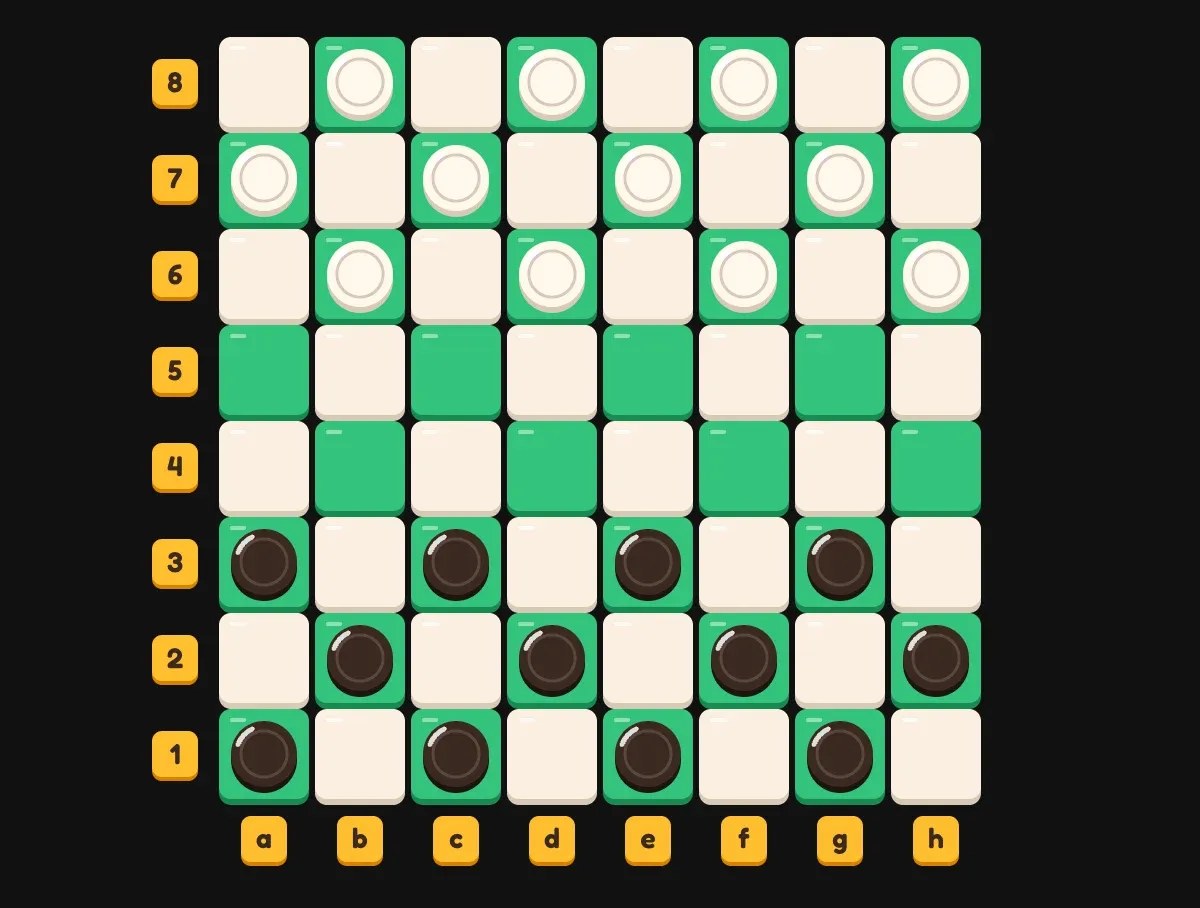
Checkers is played on an 8x8 board, but only the 32 dark squares are used. Each player’s bottom-left corner is a dark square, so the board is set up the same way from either side.
Each player takes 12 men and places them on the dark squares of the three rows nearest to them. The two middle rows start empty.
Dark moves first, and then the players take turns. Sets come in red and black, or white and black, and the colours change nothing. This guide calls the two sides dark and light.
To name a square, we use the same letters and numbers as chess. The columns run a to h from left to right, and the rows run 1 to 8 from dark’s side to light’s. So a1 is the dark square in dark’s bottom-left corner, and dark moves up the board towards row 8.
2. How to play checkers: how men move
A man moves one square diagonally forward, onto an empty dark square. Dark men move up the board and light men move down. A man never moves sideways or backwards. Kings can, as you will see below.
The goal is to capture all of the other side’s pieces. You can also win by leaving them with no legal move, when every one of their pieces is blocked.
3. Jumping: do you have to capture?
Yes. If you can capture, you must.
A man captures by jumping over a neighbouring enemy piece, diagonally, and landing on the empty square directly behind it. The jumped piece is taken off the board. A man can only jump forward.
If you have more than one capture to choose from, you may pick any of them, even a worse one. What you cannot do is skip the capture altogether.
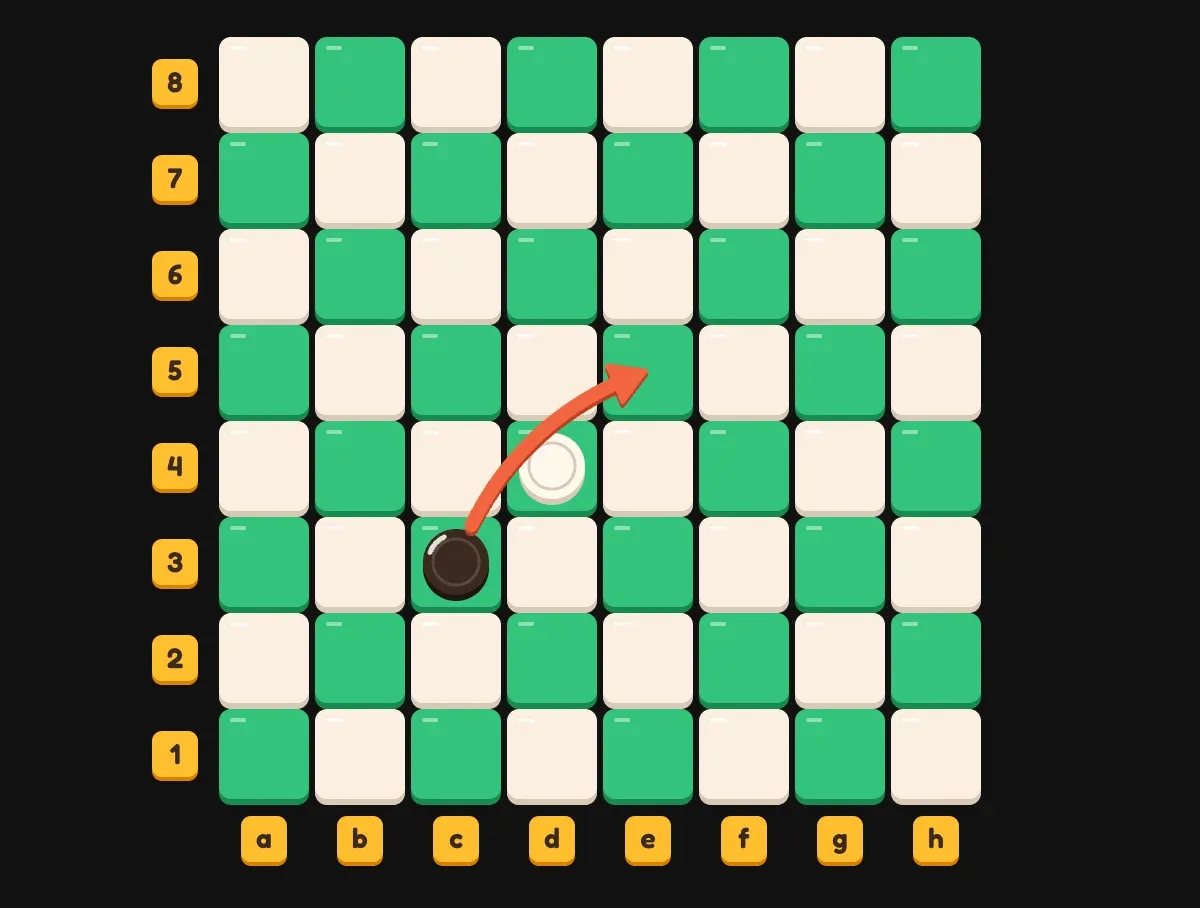
Here is a forced jump. Dark has a man on c3 and light has a man on d4. The square e5 is empty, and it is dark’s turn. Dark must jump from c3 over d4 to e5, and the light man on d4 comes off the board.
4. Multi-jumps: keep going
If the same man can jump again straight after landing, it must keep going in the same turn. It may change direction with each jump, which makes a zig-zag.
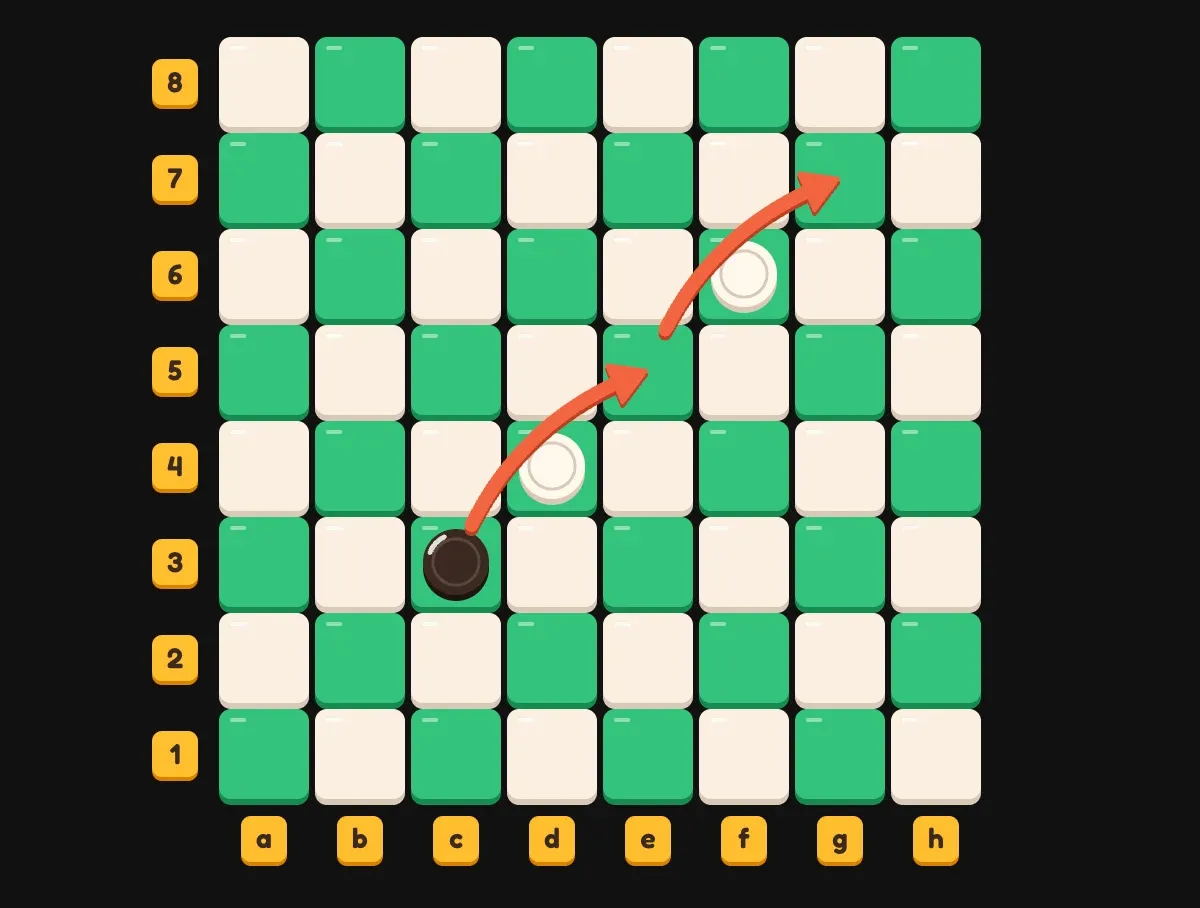
Dark has a man on c3. Light has men on d4 and f6, and e5 and g7 are empty. Dark jumps from c3 over d4 to e5, then from e5 over f6 to g7. That takes two light men in one turn.
The jumped pieces are taken off the board once the whole move is finished, and you can never jump the same piece twice.
5. Kings: what they do
A man that reaches the far row is crowned and becomes a king. For dark, that is row 8. For light, it is row 1. The opponent crowns it by placing a second piece on top.
If the move that crowns a man is a jump, the turn ends there, even if the new king could jump again.
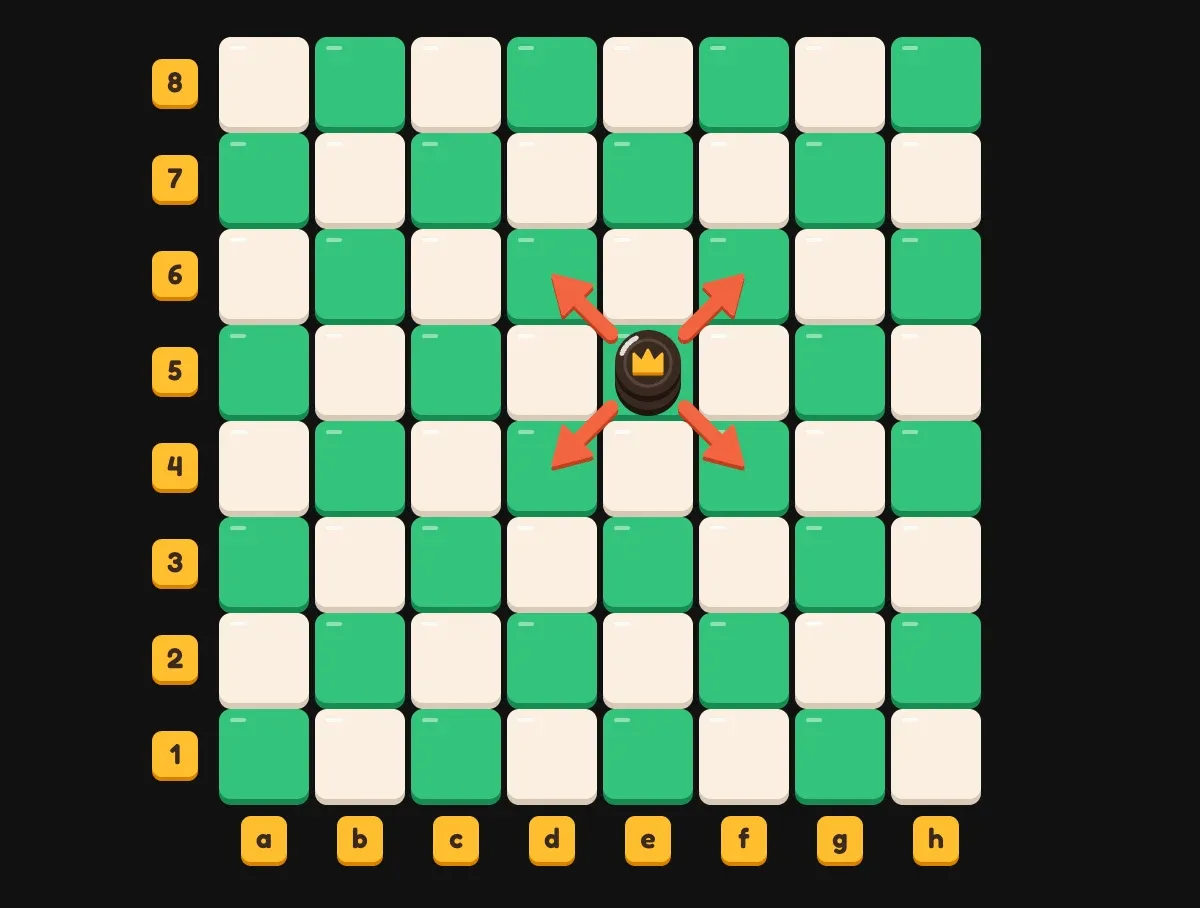
A king moves one square diagonally in any direction, forward or backward. It captures the same way, jumping over one neighbouring piece in any direction, and it can make multi-jumps that change direction, just as a man can.
6. How a game ends
You win when your opponent has no pieces left, or has pieces but no legal move, because all of them are blocked.
A game can also end in a draw. If neither side can make progress, for example when each side has a king and neither can trap the other, the players can agree to a draw. Tournament rules set move limits for this, so when you play at home, agree on a limit before you start.
It is fine to resign when you are clearly behind. Set the board up again and start the next game.
7. Rules people argue about
There are several rule sets, and most arguments over the board come from mixing them. Agree on the rules before the first move. These are the main differences:
- American (English) checkers, the rules in this guide: 8x8 board, 12 men each, men capture only forward, kings move one square, capturing is compulsory, and you may choose any capture.
- International draughts: 10x10 board, 20 men each, men capture backwards as well, kings are “flying” (they move any distance along a diagonal), and you must take the sequence that captures the most pieces.
- Russian and Brazilian draughts: 8x8 board, men capture backwards, and kings fly. Russian draughts lets you choose any capture, while Brazilian draughts, like the international game, makes you take the most pieces.
Huffing is an old house rule: if a player misses a capture, the piece that should have jumped is removed from the board. It is not in the official rules, so use it only if everyone agrees.
For a first game, play the American rules above and write down any change you make.
8. Tip 1: Keep your back row at home
Your back-row men are the wall that stops the other side from getting a king. Move them last, not first.
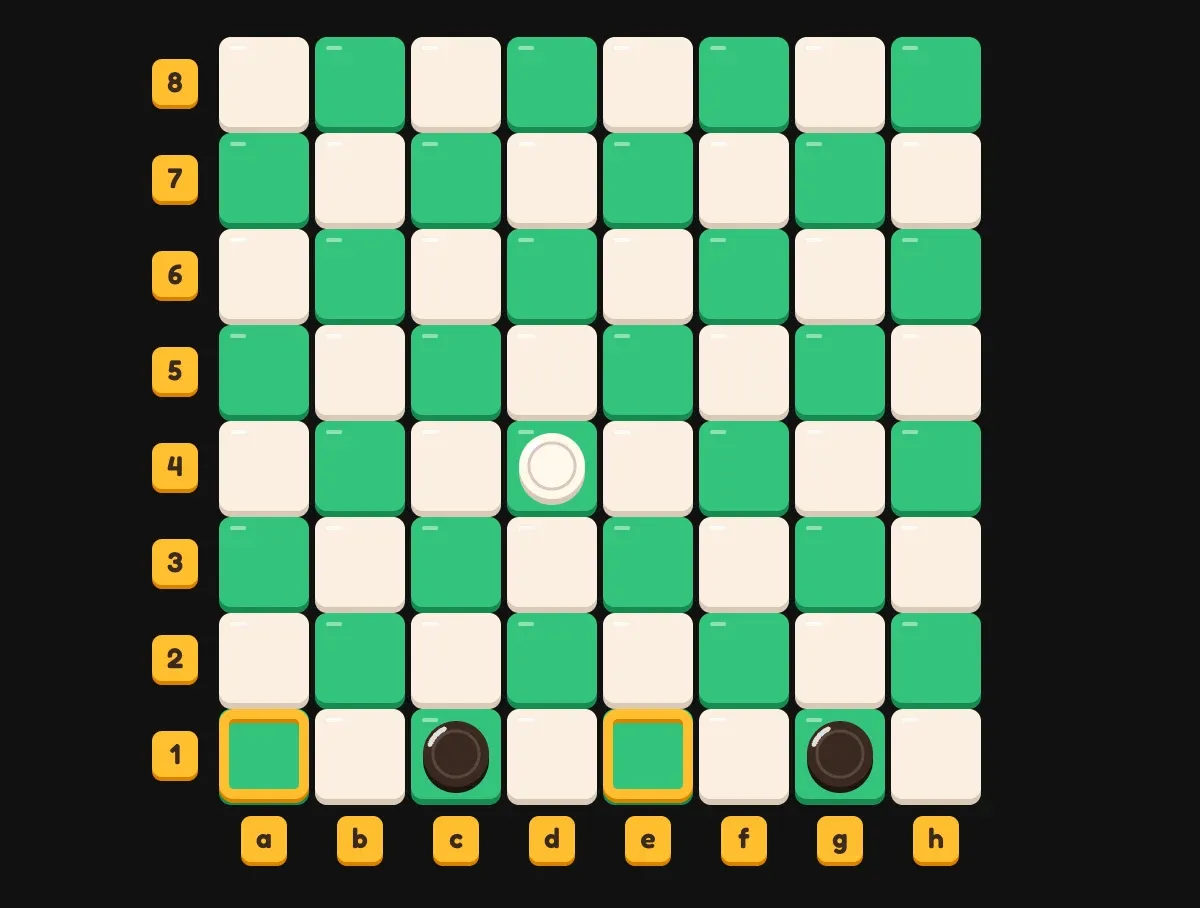
For dark, the back row is a1, c1, e1 and g1. Light men are crowned on those squares, so every back-row square you empty is a door a light man can walk through.
The picture shows dark with only c1 and g1 left at home. The doors a1 and e1 are open, and the light man on d4 is three moves from both of them.
9. Tip 2: Take the centre
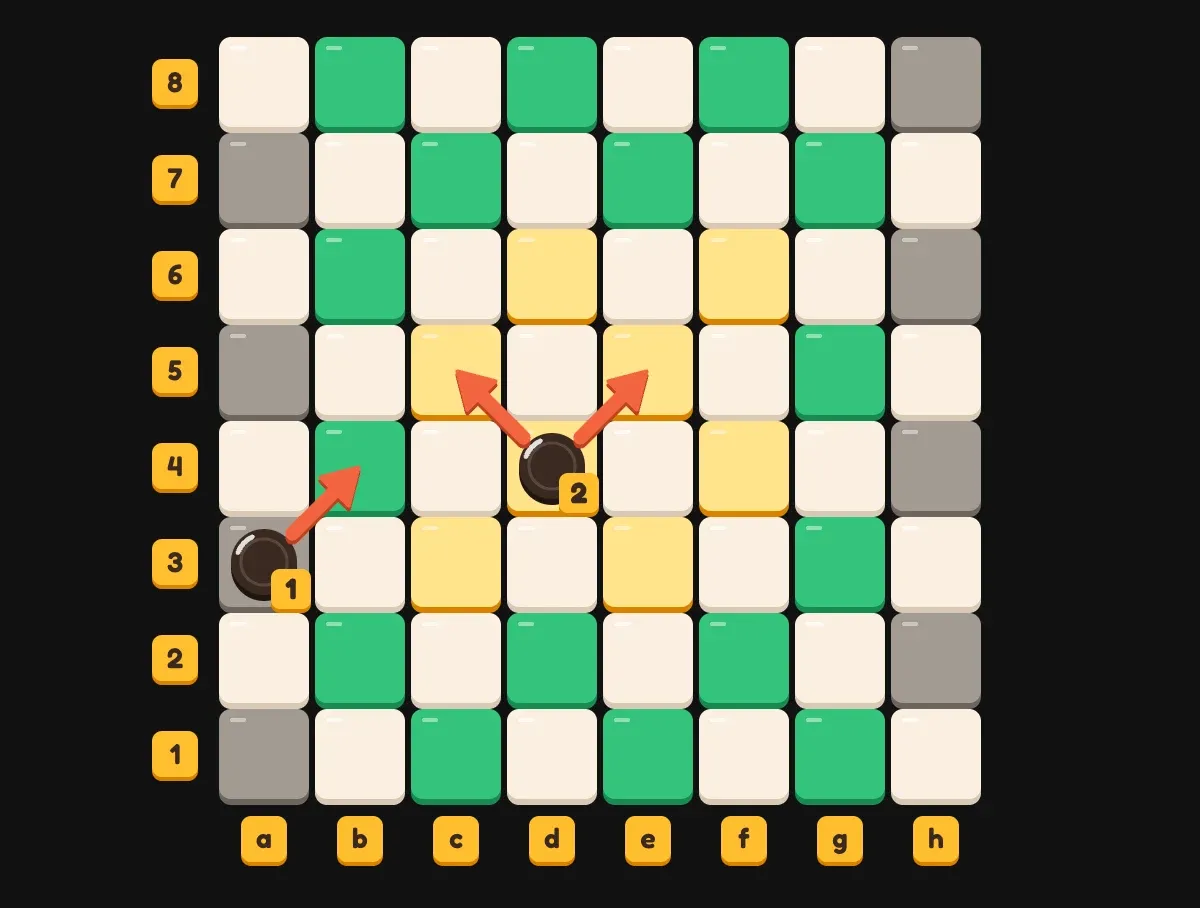
A man in the middle of the board has two squares to move to, and it can head towards either side. A man on the edge, in column a or column h, has only one square to move to, so it is easy to block.
The picture shades the centre of the board. The man on d4 has two moves, to c5 and e5. The man on a3 has one move, to b4.
10. Tip 3: Before every move, check what it lets them jump
Before every move, look at what your opponent can jump afterwards. Pay attention to the square you leave behind, because it can become the landing square for a jump.
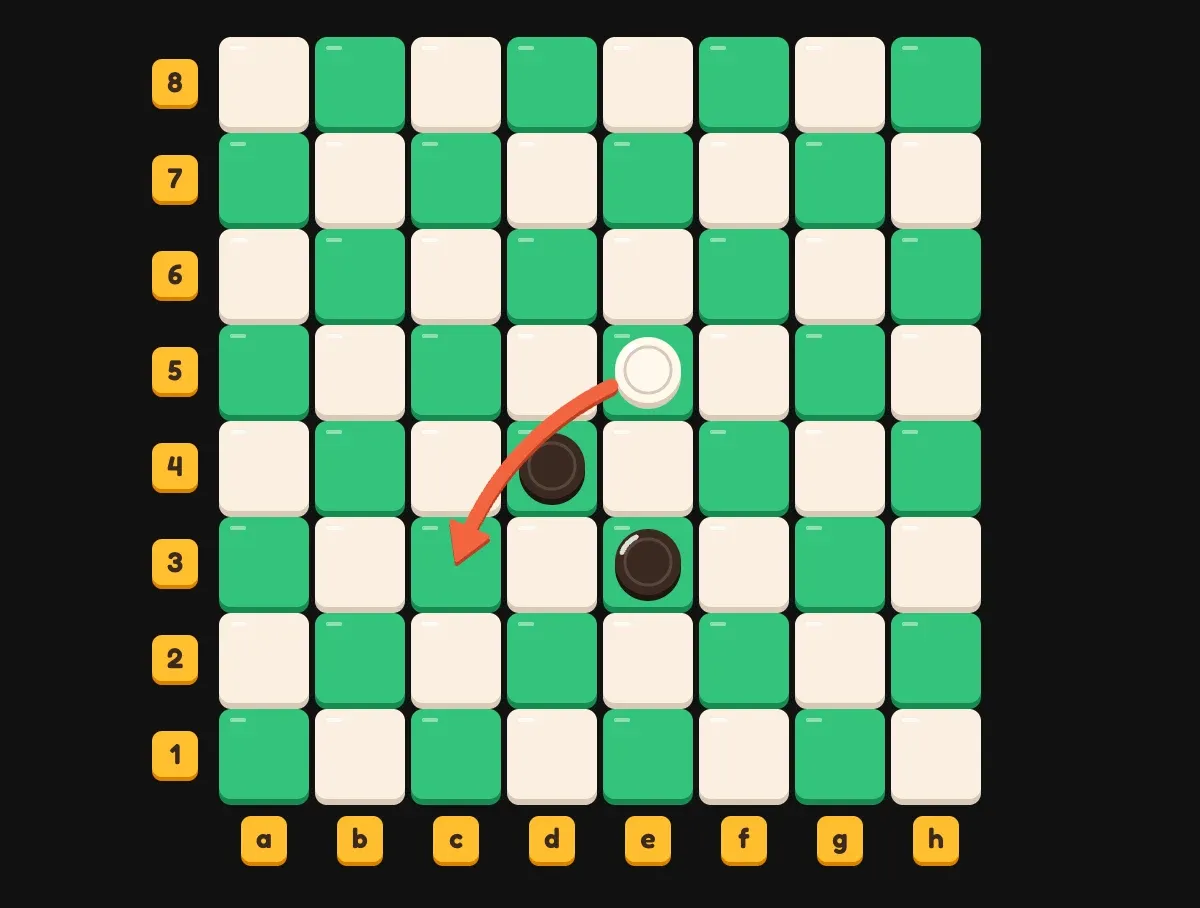
Here is a common mistake. Dark has men on c3 and e3, and light has a man on e5. Dark plays c3 to d4. The square c3 is now empty, so the light man on e5 can jump over d4 to c3.
The fix is to keep c3 filled. Play e3 to d4 instead. Then the light man on e5 cannot jump d4, because c3 is still full. You can also play somewhere else.
11. Tip 4: Use their forced jump (the 2-for-1 shot)
Because the other side must jump, you can sometimes give up one man to pull a piece onto a square where you can take two.
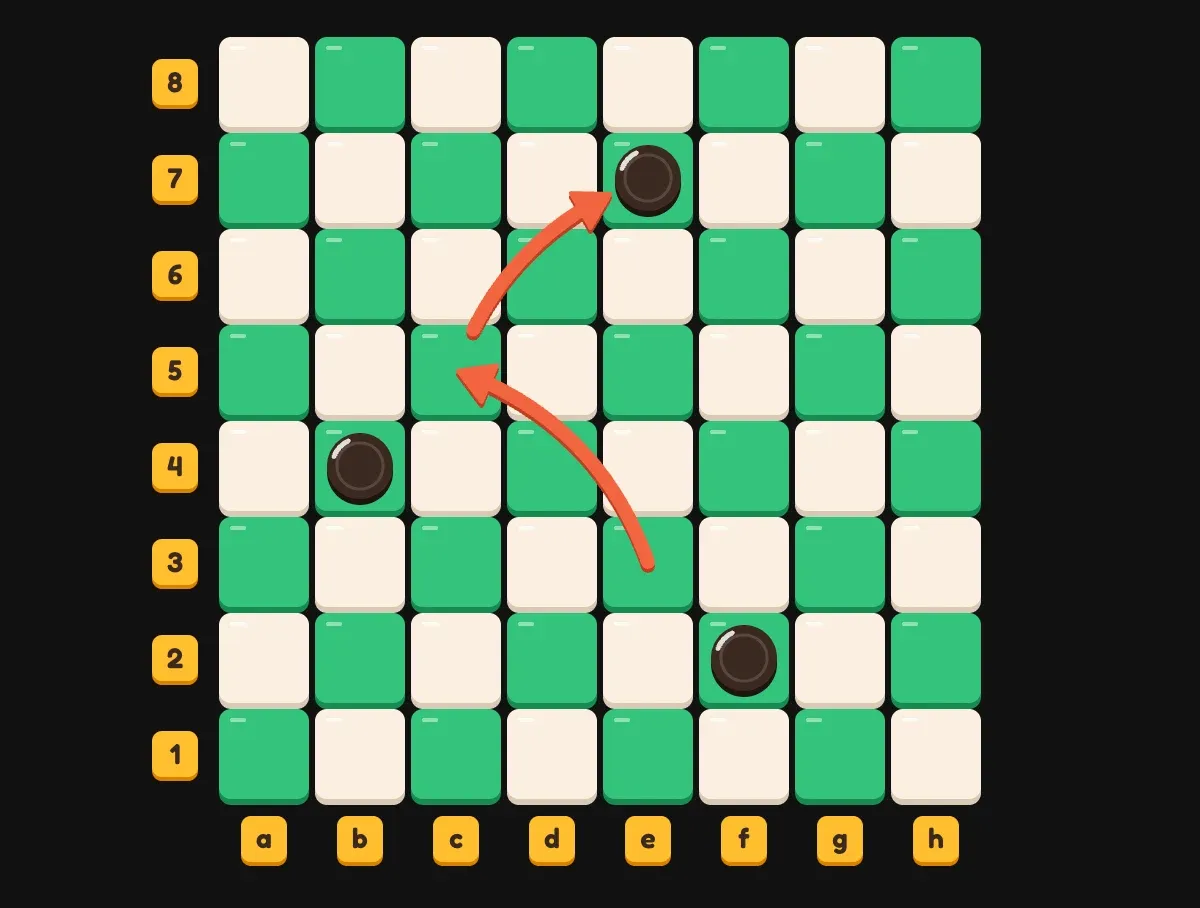
Here is a worked example. Dark has men on b4, d4, e3 and f2. Light has men on b6 and d6. It is dark’s turn.
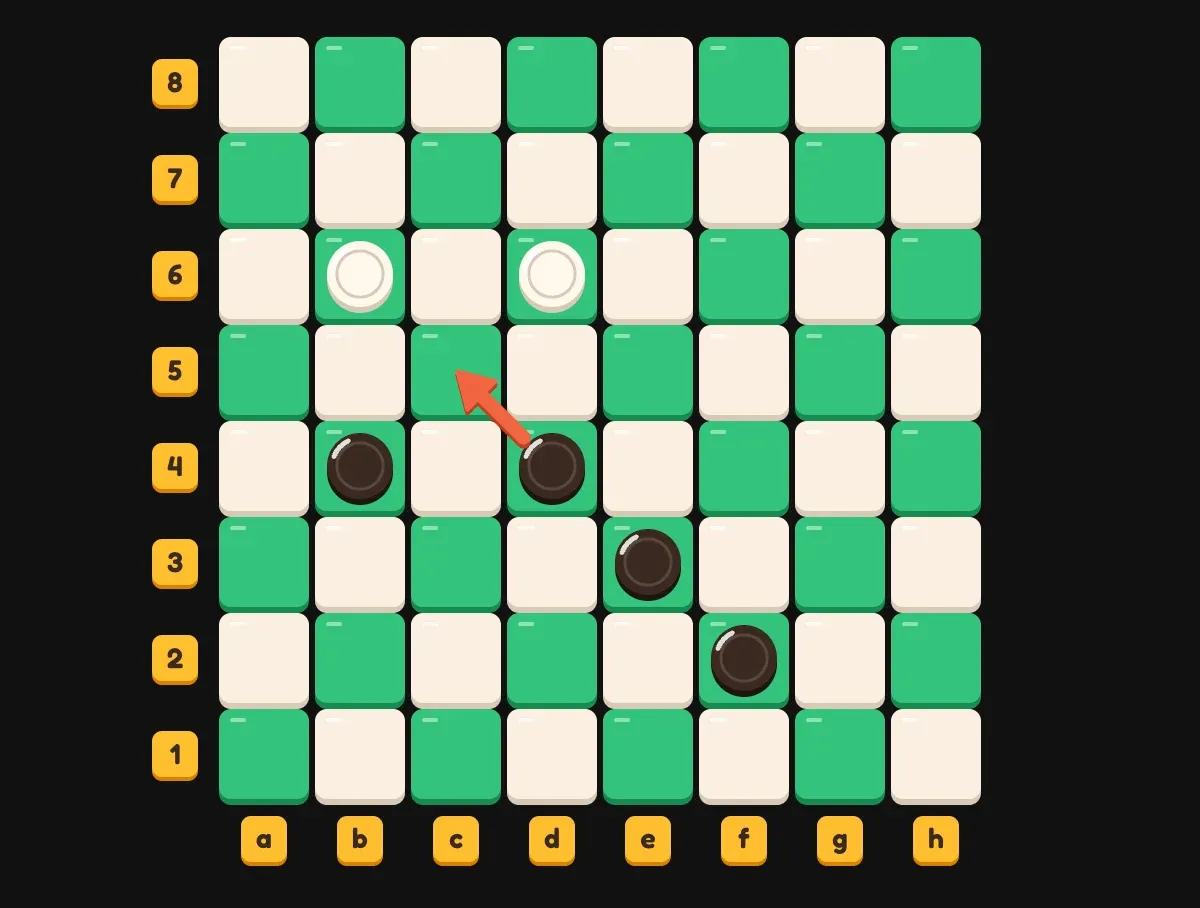
Dark plays d4 to c5. Light must jump, and it has only one jump: b6 over c5 to d4. The light man on d6 cannot jump c5, because b4 is full. The light man on d4 cannot jump on, because f2 is full.
Now dark’s e3 jumps over d4 to c5, and then over d6 to e7. Dark has given up one man and taken two. In this small example light is left with no men, but in a real game it is still two for one.
Look for shots like this yourself, and watch for them from the other side. That is tip 3 again.
Put it into practice
Play a game with a friend using the American rules above. Agree on any rule that varies before you start, and try one of the tips in each game.
If you like games where looking ahead wins, try the dots and boxes strategy guide. It is another classic two-player game you play with a pencil and paper, where counting decides the winner.