Here’s how to play the Royal Game of Ur, a race game from Mesopotamia that is about 4,500 years old. You can play it today with paper, 14 small objects and four coins. Below you’ll find one clear set of rules, a worked first turn, a way to play without special dice and the story of the clay tablet that brought the rules back. A rules card at the end is yours to keep.
What the Royal Game of Ur is
The Royal Game of Ur is a two-player race game. Each player moves seven pieces along a path of 14 squares and then off the board. The first player to bring all seven off wins.
Sir Leonard Woolley found boards for the game in the Royal Cemetery at Ur, in what is now southern Iraq, between 1922 and 1934. The boards date from about 2600 to 2400 BC, which makes the game about 4,500 years old.
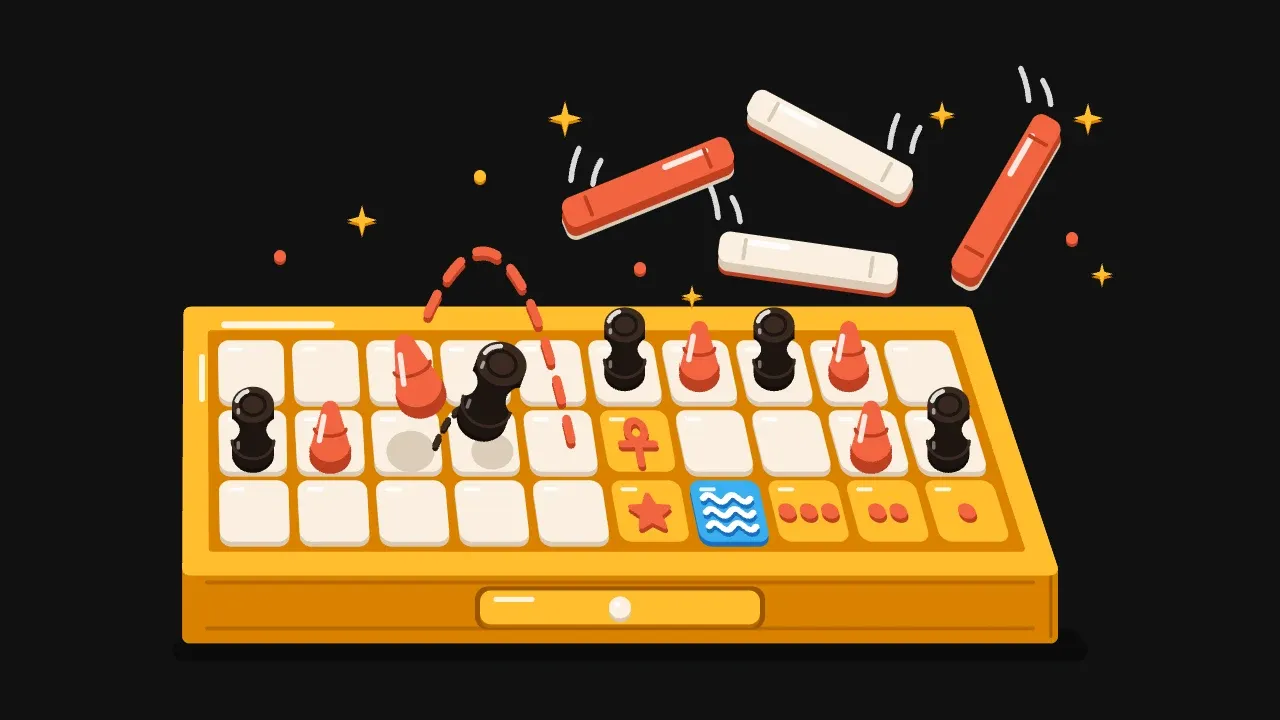
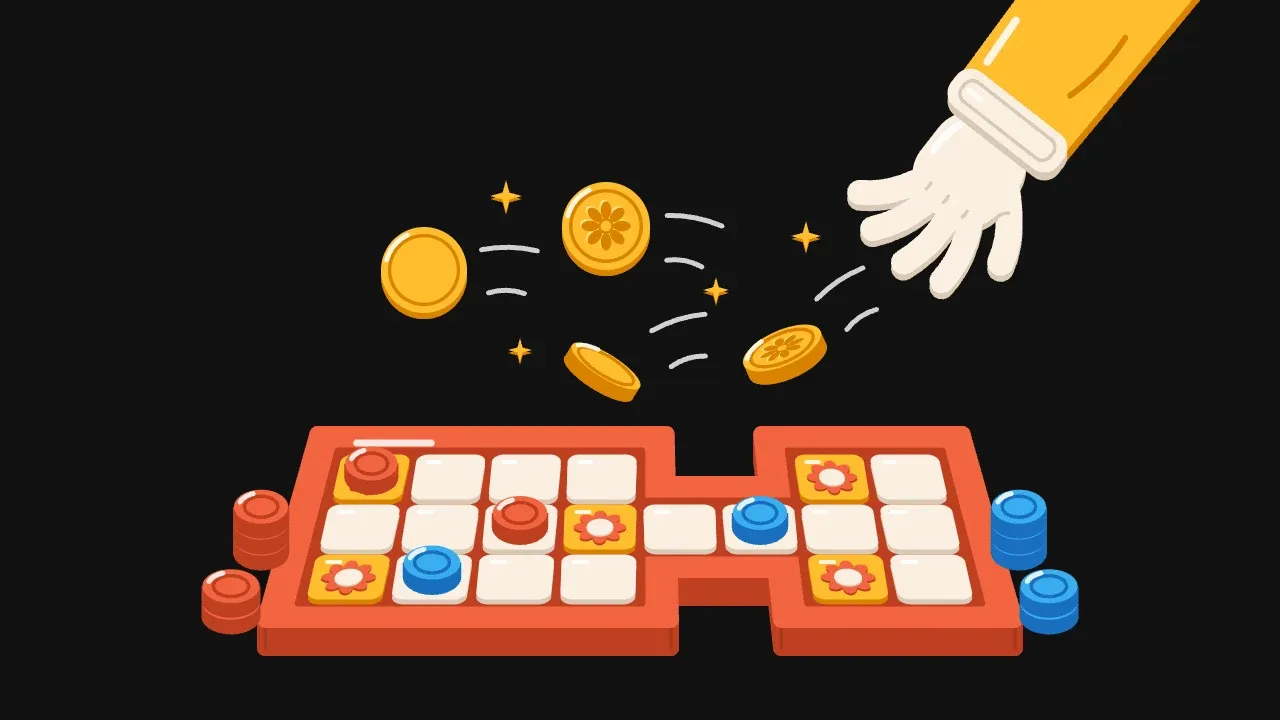
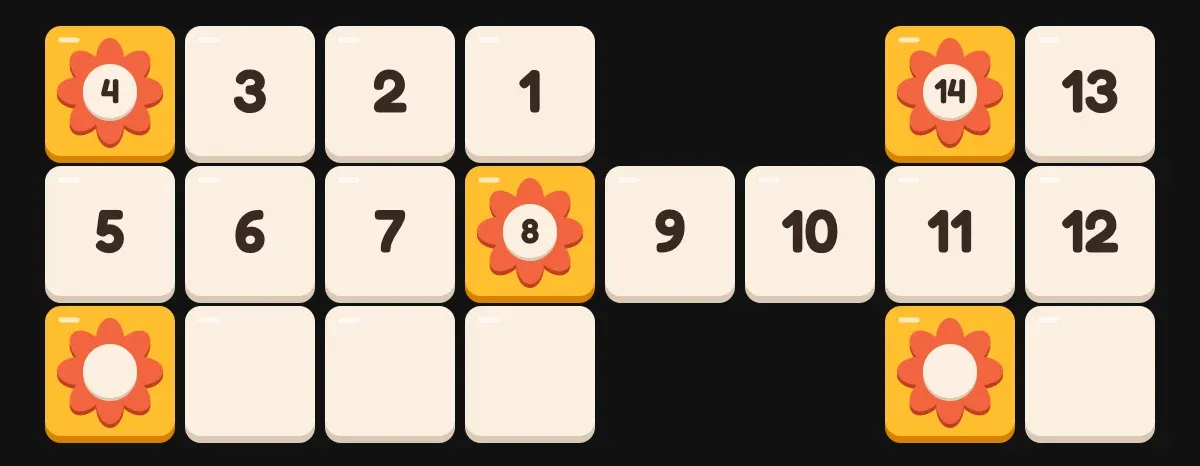
The board has 20 squares. A block of 12 squares on the left and a block of 6 on the right are joined by a bridge of 2 squares in the middle row. Five squares are marked with a rosette. The first figure shows the board, with one player’s path numbered from 1 to 14.
What you need
- A board: draw the 20-square board on paper, as in the first figure.
- Seven pieces each, in two colours: buttons, beads or pebbles.
- Four coins: these replace dice.
Count the heads on the four coins to get a roll of 0 to 4. How likely is each one? Of the 16 ways four coins can fall, 0 heads comes up in 1, 1 head in 4, 2 heads in 6, 3 heads in 4 and 4 heads in 1. So a roll of 2 is the most common and a roll of 4 is rare. The dice in the reconstruction are four-sided, with two corners marked on each, and four coins give the same odds.
How to play the Royal Game of Ur: the rules
Here’s one rule set, the version based on Irving Finkel’s reconstruction. Other versions differ in the dice, the path and the rosettes, so house rules are fine as long as everyone agrees before the first toss.
- The path. Each player’s path has 14 squares: 4 on their own side (squares 1 to 4), the 8 squares of the middle row (5 to 12), which both players share, and 2 more on their own side (13 and 14). After square 14, a piece leaves the board.
- Your turn. Toss the four coins. With no heads, your turn passes. Otherwise, move one piece that many squares, or enter a new piece from off the board onto the square with that number. You must move if you can.
- One piece per square. You can’t land on a square that holds your own piece.
- Capture. On a shared square (5 to 12), landing on an opponent’s piece sends it back to start. A capture is a normal move, so if it’s your only move, you must make it.
- Rosettes. Landing on a rosette (squares 4, 8 and 14) gives you another toss. The middle rosette, square 8, is safe: a piece there can’t be captured, and an opponent can’t land on it.
- Leaving the board. A piece leaves only with the exact roll that takes it one past square 14: a 1 from 14, a 2 from 13, a 3 from 12, a 4 from 11. A bigger roll can’t be used for that piece.
A first turn, step by step
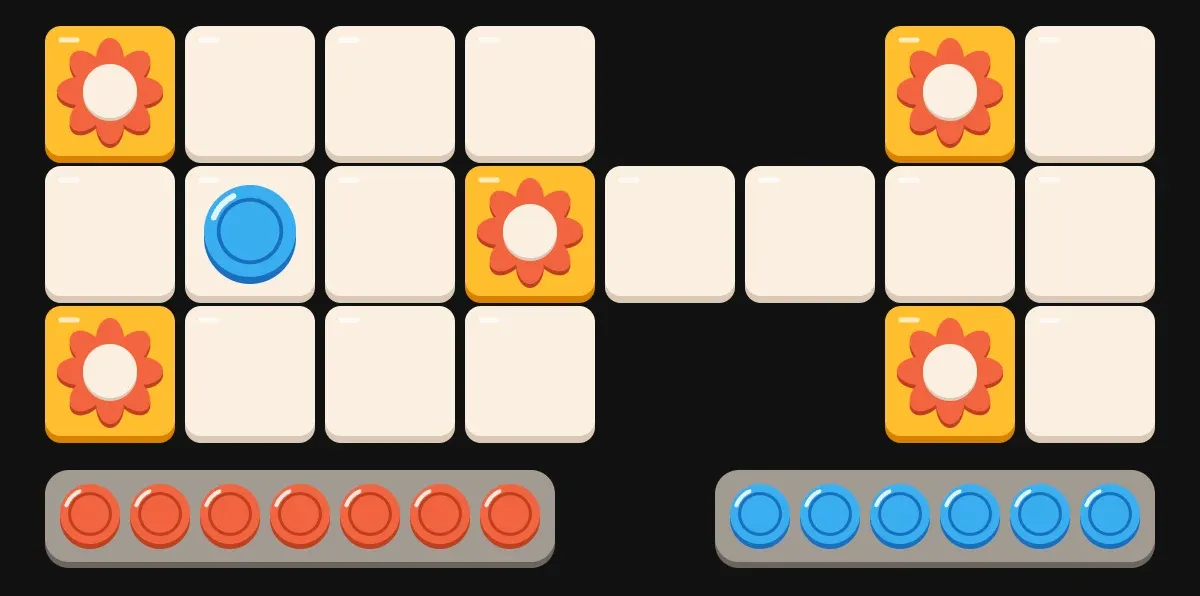
Red tosses 4 heads and enters a piece on square 4, which has a rosette, so Red tosses again. A 2 this time. Red can enter a second piece on square 2, or move the first piece from square 4 to square 6, a shared square where it can be captured. Red moves to square 6.
Blue tosses 3 and enters a piece on square 3. Red tosses no heads, so the turn passes.
Blue tosses 3 again. A new piece can’t enter on square 3, where Blue’s own piece stands, so Blue’s only move is from square 3 to square 6. That lands on Red’s piece, which is captured and goes back off the board.
The lesson: a piece on a shared square is in danger. An opponent’s piece 1 to 4 squares behind it can capture it with the right toss. The middle rosette is safe, and a piece on it blocks the opponent from that square.
Simple tactics
- Use the first rosette. Square 4 gives a free extra toss. Keep your pieces on your own side until a toss can take one there.
- Hold the middle rosette. It’s safe, and it blocks your opponent from using square 8.
- Capture a piece that has travelled far. Don’t leave a piece 1 to 4 squares in front of an opponent’s piece on the shared row: the right toss captures it.
- Do not hurry the last pieces. Bearing off needs an exact roll, so a piece waiting on 13 or 14 gives you a move for a 2 or a 1 when you need one.
The tablet that brought the rules back
Woolley found the boards, but no rules came with them. Those came back through a clay tablet from Babylon, now in the British Museum. The Babylonian scribe Itti-Marduk-balatu wrote it about 177 BC. Irving Finkel, a curator at the British Museum, deciphered it in the 1980s.
What is known, and what is guessed? According to Finkel’s reading, the tablet describes a later form of the game, with its path and rosette rules. The dice and some details are reconstructed, and other scholars have proposed different paths.
Rules card to keep
Save or print this card for your next game.
- Goal: bring all seven of your pieces off the board first.
- Equipment: a board of 20 squares, seven pieces each in two colours, and four coins.
- Toss: count the heads; with none, your turn passes.
- Path: move one piece by the count, or enter a new one on that numbered square; you must move if you can.
- Capture: landing on an opponent’s piece on squares 5 to 12 sends it back to the start.
- Rosettes: squares 4, 8 and 14 give another toss, and square 8 is safe.
- Bearing off: a piece leaves only with the exact count: 1 from square 14, 2 from 13, 3 from 12, 4 from 11.
Ready to play?
Play one game with someone this week, and keep the card by the board. Want another game to try? Read our guide to checkers, or learn cat’s cradle, a string game you can play with a loop of string.