This is how to play Senet, one of the oldest board games in the world, played in Egypt for about 2,000 years. You can play it tonight with paper, ten counters and four sticks or coins. The original rules are lost. What follows is one simple modern version, with a worked turn, a board to draw by hand and a plain note on what is known.
What Senet is
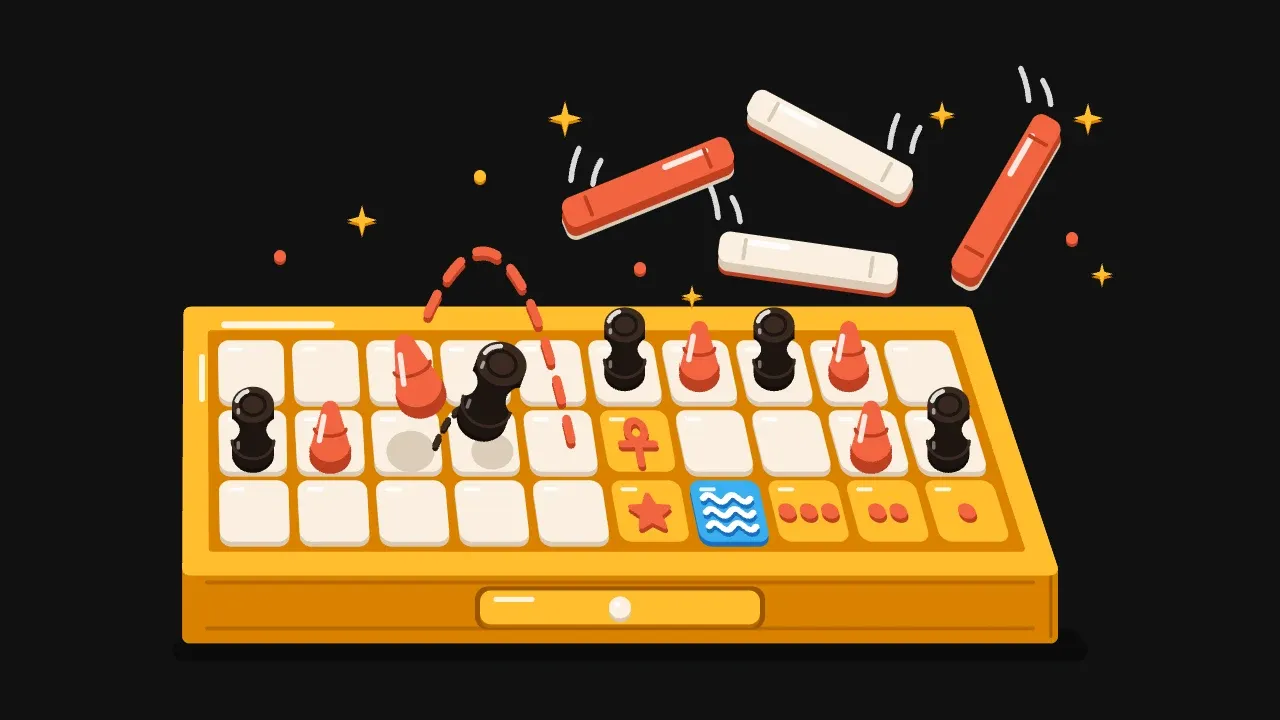
Senet is a two-player race game on a board of 30 squares, called houses, in three rows of ten. Each player has five counters. The first player to bring all five off the board wins.
The earliest clear picture of the game is in the tomb of Hesy-Re, about 2620 BCE. Some fragments that may be Senet boards date to about 3100 BCE, but they’re less certain. A Senet set was found in Tutankhamun’s tomb, and Chapter 17 of the Book of the Dead shows the dead playing Senet against an unseen opponent.
No complete ancient rules survive. Modern rule sets, such as those by Timothy Kendall and R. C. Bell, are reconstructions, and they differ, so here’s one simple modern version.
What you need and how to draw the board
- Paper, a ruler and a pen.
- Ten counters in two colours, five each: buttons, coins or pebbles.
- Four throwing sticks, or four coins. A throwing stick is a lolly stick coloured on one side.
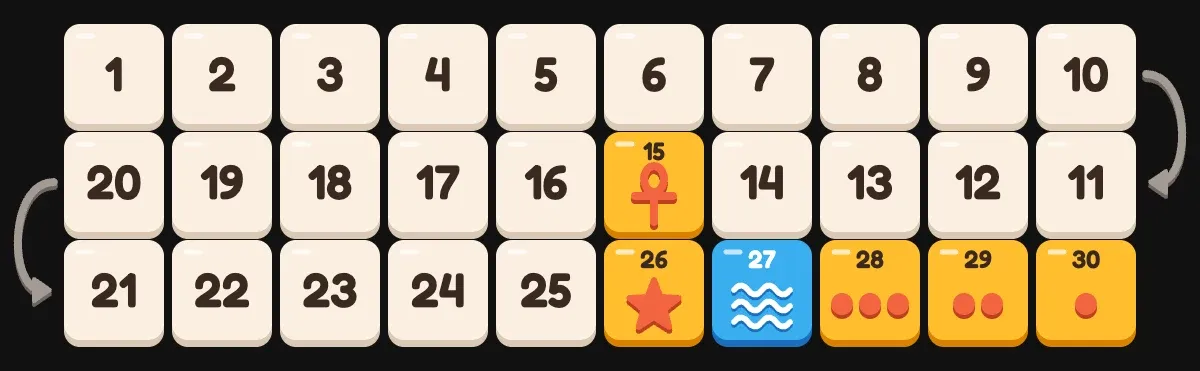
Draw three rows of ten squares and number them as a snake, so every counter follows one line:
- The top row is 1 to 10, left to right.
- The middle row is 11 to 20, right to left.
- The bottom row is 21 to 30, left to right.
Square 10 sits above 11, and 20 above 21. Mark the six special squares as the figure shows: a circle or ankh on 15, a star on 26, wavy lines on 27, and dots on 28 to 30.
How to play Senet: the modern rules
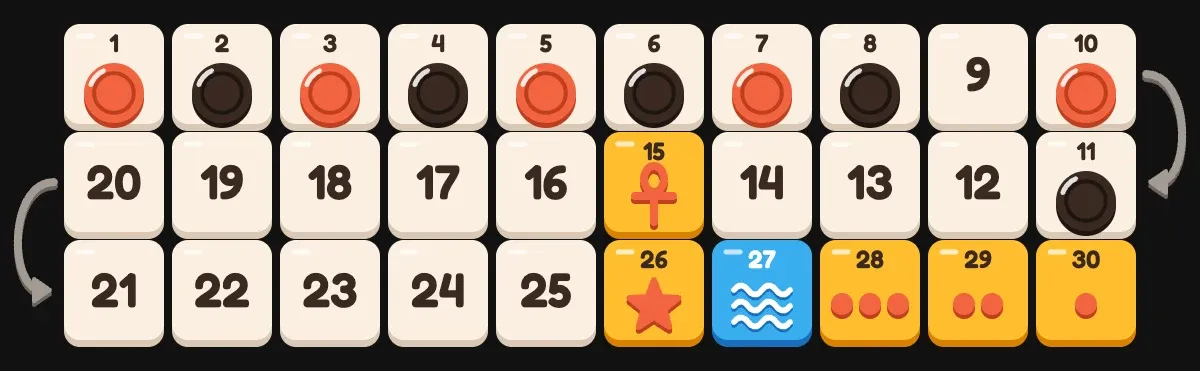
Setup. The counters start on squares 1 to 10, alternately. One player takes the odd squares (1, 3, 5, 7, 9) and the other the even squares (2, 4, 6, 8, 10). The player on the odd squares goes first.
Throwing. Throw the four sticks and count the coloured sides facing up. If none is up, your throw is 5. Of the 16 ways the sticks can fall, a throw of 2 comes up 6 times, a throw of 1 or 3 comes up 4 times each, and a throw of 4 or 5 comes up once each. Which throw is the most common? 2.
Moving. Move one counter forward by the full throw. You may jump over other counters. You must move if any move is possible, and if none is, you lose the turn. You may never land on your own counter.
Swapping. If you land on a single opposing counter, you swap places with it, so it moves back to the square you left. A counter with one of its own counters next to it can’t be swapped, and three counters in a row can’t be jumped.
Extra throws. A throw of 1, 4 or 5 earns another throw. A throw of 2 or 3 ends your turn. Most sources give extra throws on 1, 4 and 5, so that’s the version used here.
Winning. The first player to bring all five counters off the board wins.
The special squares
- 15, House of Rebirth. A counter that falls into the water comes back here. A counter standing on 15 can’t be swapped.
- 26, House of Happiness. Every counter must land here exactly before it can move on or leave. Nothing can be jumped or swapped on it. Sources differ on how a counter leaves, so this version uses a throw of 5.
- 27, House of Water. A counter that lands here goes back to 15, or to the nearest empty square before 15 if 15 is taken.
- 28, 29 and 30. Safe squares, where counters can’t be swapped. A counter leaves from 28 with a throw of 3, from 29 with a 2 and from 30 with a 1. Leaving needs the exact throw. From 29, a throw of 1 moves the counter on to 30.
A worked turn
The first player (odd squares) throws 2 and moves the counter from 9 to 11. Square 11 is empty, so it’s a plain move, and the throw of 2 ends the turn.
The second player (even squares) throws 1 and moves the counter from 10 to 11. Square 11 holds a single counter of the first player’s. Is it protected? Its neighbours, 10 and 12, hold no counter of the first player’s, so no: it can be swapped. The swap puts the second player’s counter on 11 and the first player’s back on 10.
A throw of 1 earns another throw, so the second player throws again.
Simple tips
- Keep two counters side by side: they can’t be swapped.
- Avoid stopping on 27: plan a throw that takes you past it.
- Get a counter to 26 early: every counter must land there exactly.
- Spread your last counters across 28, 29 and 30, so more throws can take one off.
Playing it with children, and the paper-board version
Playing with younger children? Use three counters each and leave out the rule protecting counters side by side.
Colouring the board and special squares makes a good family or classroom craft. Paper, cardboard or a drawn grid all work, with lolly sticks or coins in place of the sticks.
The original rules are lost, so house rules are fine if everyone agrees before the first throw.
Rules card to keep
- Goal: all five counters off first.
- Setup: alternate on squares 1 to 10.
- Throw: coloured sides up; none up is 5.
- Move: the full throw, one counter. You must move if you can.
- Swap: a single opposing counter. Counters side by side are safe.
- Extra throw: on 1, 4 or 5.
- Special squares: land on 26 exactly; 27 sends you back to 15.
- Leaving: from 26 with a 5, 28 with a 3, 29 with a 2, 30 with a 1.
Ready to play?
Play one game this week and keep the card by the board. Want another ancient race game to try? Read the Royal Game of Ur. Prefer a classic with a different feel? Read how to play checkers.