Want to know how to play dominoes? You have a box of 28 tiles, and the guides you find disagree on how many tiles to take, who starts and what a double does. Below is one clear rule set for two to four players. It explains block and draw, shows how to score, walks through a full round with pictures and ends with three tips for choosing tiles. Block and draw share every rule except one: what you do when you can’t play.
1. The tiles and the goal
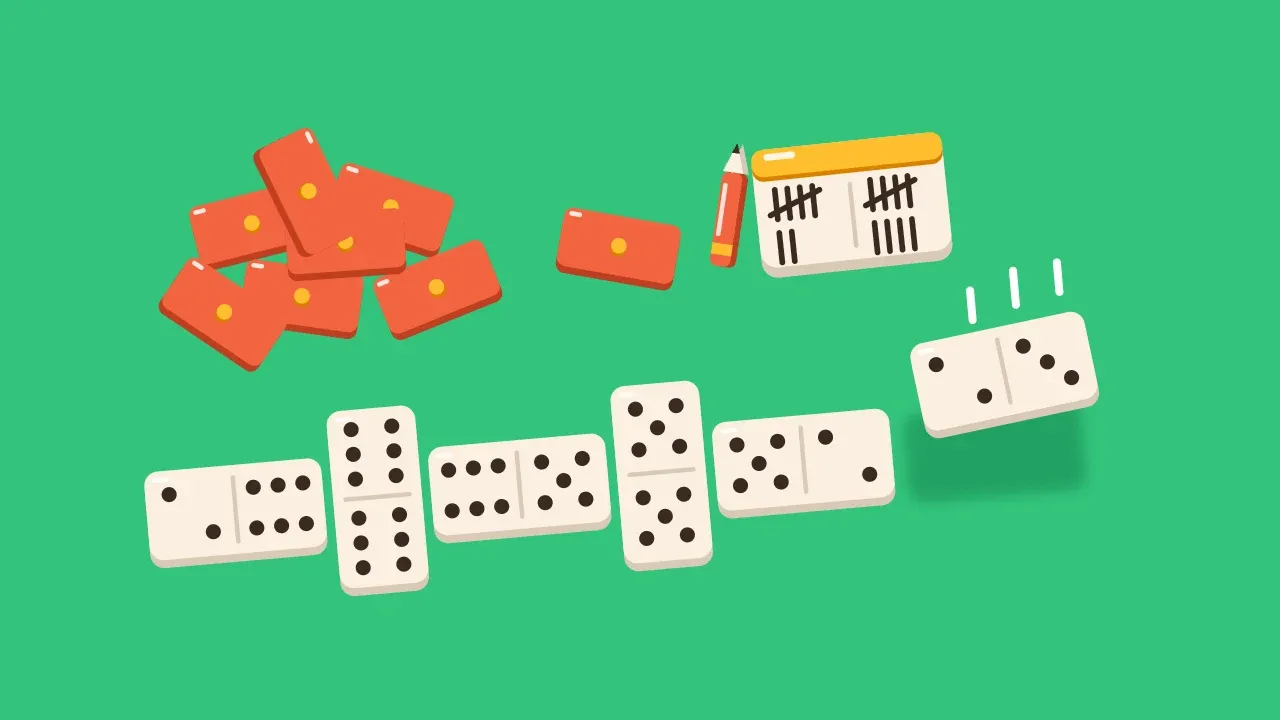
A double-six set has 28 tiles. Each tile is split into two halves, and each half shows 0 to 6 dots (pips). A tile with the same number on both halves is a double. A half with no dots is a blank, which counts as 0.
The set holds 168 pips in all. Each number from 0 to 6 appears on 8 halves, and 8 x 21 = 168.
The goal? Be first to play all your tiles. That’s called going out, and you say “Domino!” when you do. Tiles are matched end to end, like a chain.
Mix the tiles face down, then deal them. The tiles nobody’s dealt stay face down in a pile called the boneyard (or stock).
Here’s one rule set. The last section lists the variants people play.
2. Dealing and who starts
Keep your tiles hidden from the other players. The number you deal depends on how many are playing:
- 2 players: 7 tiles each, with 14 left in the boneyard.
- 3 or 4 players: 5 tiles each, with 13 or 8 left in the boneyard.
Who starts? The player with the highest double plays it first: 6-6, then 5-5, and so on. Nobody holds a double? The player with the heaviest tile (the most pips, such as 6-5) starts. Play then goes clockwise.
3. How to play dominoes: your turn
On your turn, match one end of one of your tiles to an open end of the line. A 4 goes next to a 4. You play one tile per turn.
A double goes down crosswise, across the line, so it’s easy to spot. In this basic game a double counts only as its number: the line still has just two ends, and the next tile must match that number. The sample round below shows one.
No tile that matches? What you do depends on the version you play. The next section explains.
4. Block or draw: when you cannot play
Block and draw are the same game except for this one rule.
Draw: take tiles from the boneyard one at a time until you can play one. If the boneyard is empty, you pass.
Block: nobody draws. The tiles left after dealing stay face down and aren’t used. If you can’t play, you pass. Block is more tactical, because each hand matters more. Why? You can’t draw your way out of a bad one.
The deal is the same in both versions, as in section 2.
5. A sample round, turn by turn
Ana and Ben play a draw game with 7 tiles each:
- Ana: 6-6, 5-5, 2-5, 0-3, 1-2, 1-5, 1-4
- Ben: 0-6, 1-6, 2-3, 2-6, 3-4, 4-4, 5-6
The first tile in the boneyard is 3-5. Ana has the highest double, 6-6, so Ana starts. After each turn, the two open ends of the line are:
- Ana plays 6-6. Ends: 6 and 6.
- Ben plays 5-6 on a 6. Ends: 6 and 5.
- Ana plays 5-5 crosswise on the 5. Ends: 6 and 5.
- Ben plays 2-6 on the 6 at the left. Ends: 2 and 5.
- Ana plays 2-5 on the 5. Ends: 2 and 2.
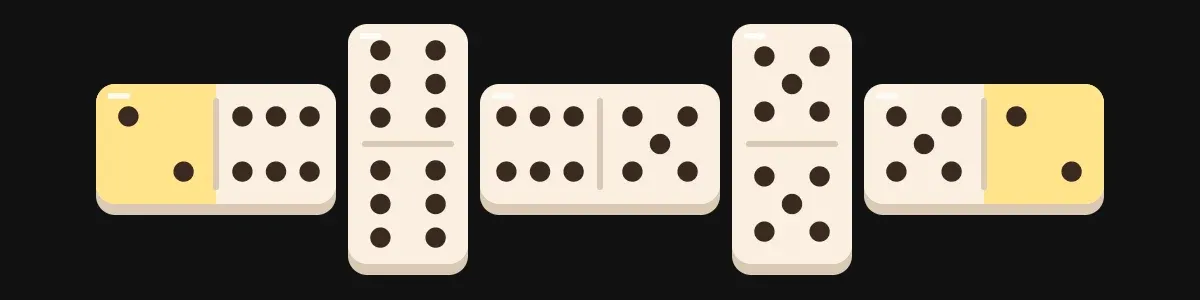
- Ben plays 2-3 on the 2 at the right. Ends: 2 and 3.
- Ana plays 0-3 on the 3. Ends: 2 and 0.
- Ben plays 0-6 on the 0. Ends: 2 and 6.
- Ana plays 1-2 on the 2 at the left. Ends: 1 and 6.
- Ben plays 1-6 on the 6. Ends: 1 and 1.
- Ana plays 1-5 on a 1. Ends: 5 and 1.
- Ben only has 3-4 and 4-4, with no 5 and no 1. Ben draws the boneyard tile, 3-5, and plays it on the 5. Ends: 3 and 1.
- Ana plays 1-4 on the 1. Ends: 3 and 4. Ana has no tiles left, so Ana goes out: “Domino!”
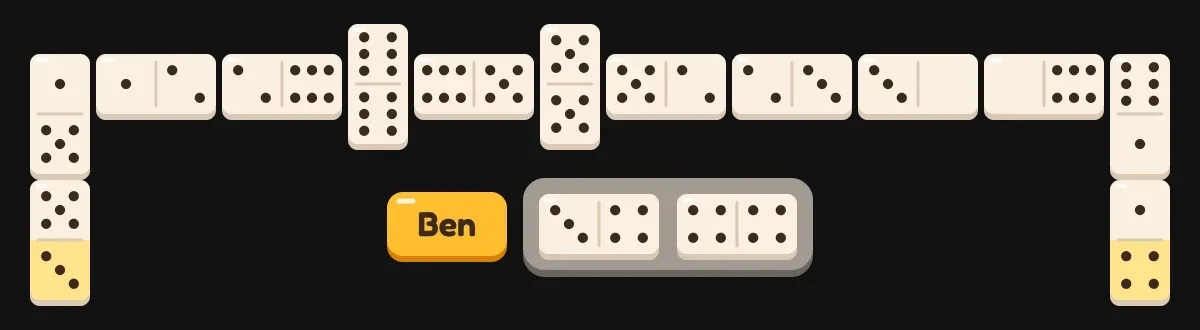
Ben is left with 3-4 and 4-4: 7 + 8 = 15 pips. Ana scores 15.
6. How to score dominoes
Going out. The winner scores the total pips in the other players’ hands. In the sample round, Ben holds 15 pips, so Ana scores 15.
Blocked round. A round is blocked when nobody can play. In a draw game, the boneyard must be empty too. The player with the fewest pips wins and scores the difference between their pips and the other player’s. For example, Ana holds 2-4 and 0-1 (7 pips), and Ben holds 5-5 (10 pips). Ben has more, so Ana scores 3.
Target score. Groups often play several rounds to a target score, such as 100 or 150. The first player to reach it wins. For a quick game, play to 50.
7. Three tips for choosing tiles
- Play your heavy tiles early, such as 6-6 or 5-6. If the other player goes out first, you’ll have fewer pips left in your hand.
- Get rid of doubles early. A double matches only its own number, so it’s playable only when that number is open at an end.
- Count the numbers. Each number appears on 7 tiles. If you hold several tiles with one number and many of the others are already on the table, the other player has few of that number left. Open that number at an end, and they may not have a tile to match it.
8. Rules people play differently
Groups differ on these rules. Agree on them before the first tile:
- Who starts a later round. Some groups let the winner of the last round start, instead of the highest double.
- Hand size. Some groups deal a different number of tiles from the ones in section 2.
- Last two tiles. In a draw game, some groups keep the last 2 tiles in the boneyard.
- Blocked-game scoring. Some groups score the whole leftover total, or count the boneyard too.
- Doubles as branches. Some games let a double open a side branch from the line instead of two single ends.
Agree the rules, then play a round to learn how the line grows. Want another classic with clear turn-by-turn rules? Read how to play checkers.