Dominoes solitaire is for the days when nobody is around to play. A double-six set of 28 tiles is all you need to play dominoes by yourself. Here are three solo dominoes games, each with one clear rule set and a worked example or puzzle.
Before you start: the set and the basics
A double-six set has 28 tiles, from 0-0 to 6-6. The rules for matching ends are in how to play dominoes, and they aren’t repeated here.
These are home rules, not an official rulebook, so change any rule you like. Shuffle the tiles face down first.
1. Draw and build: one line, one hand
Goal: play all 28 tiles into a single line.
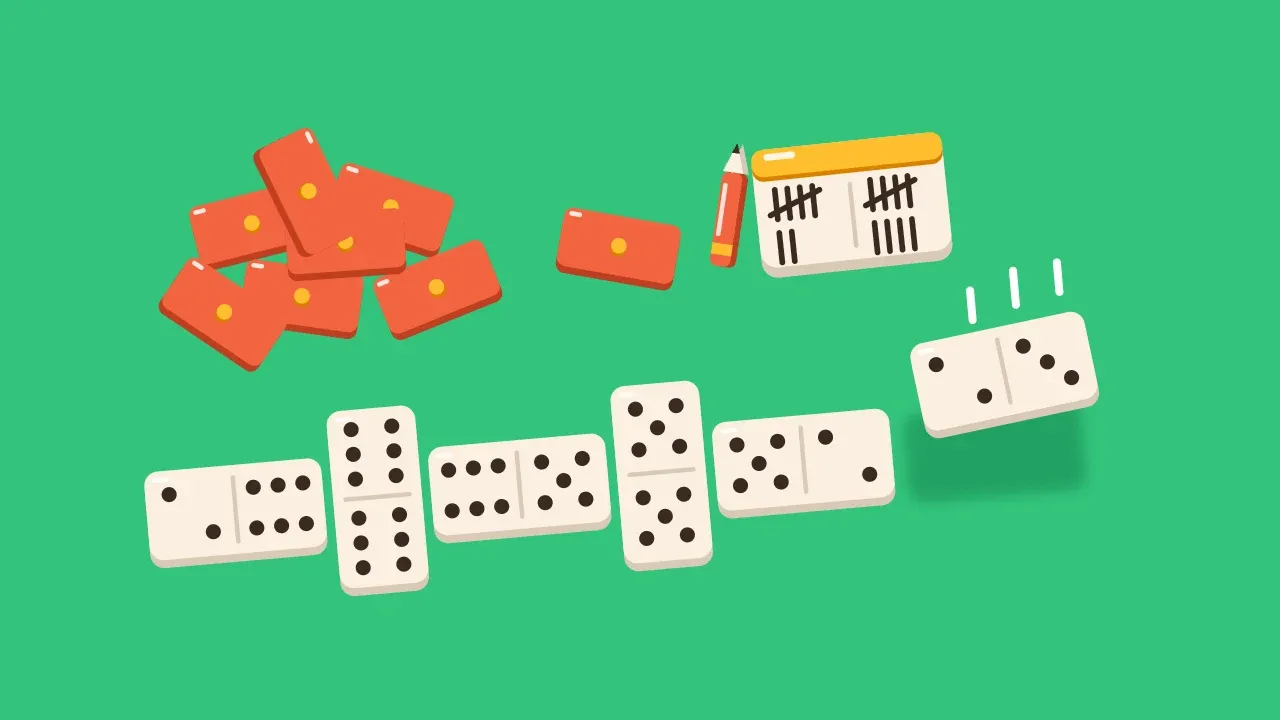
Setup: shuffle, take 7 tiles as your hand and leave 21 face down as the stock. Start with the highest double in your hand. No double? Start with the heaviest tile. A double is laid crosswise, and only its number counts.
How it works:
- Play a tile from your hand onto either open end, if one matches.
- If none matches, draw one tile. If it fits, play it. If not, keep it and draw again.
- You lose if you can’t play and the stock is empty. You win when all 28 tiles are in the line.
Odds: a player who always plays the heaviest tile that fits wins about 1 deal in 6 (16% in a computer simulation over 20,000 deals). That’s for this simple rule only.
Worked example, using the heaviest-tile rule. The hand is 0-0, 0-3, 0-5, 1-1, 1-4, 2-3 and 2-6. Start with 1-1, so the open ends are 1 and 1.
- Play 1-4 on the left, with its 4 at the left end. Ends 4 and 1.
- Stuck. Draw 6-6: no fit. Draw 1-6: it fits the 1. Ends 4 and 6.
- Play 6-6 on the 6. Ends 4 and 6.
- Play 2-6 on the 6. Ends 4 and 2.
- Play 2-3 on the 2. Ends 4 and 3.
- Play 0-3 on the 3. Ends 4 and 0.
- Play 0-5 on the 0. Ends 4 and 5.
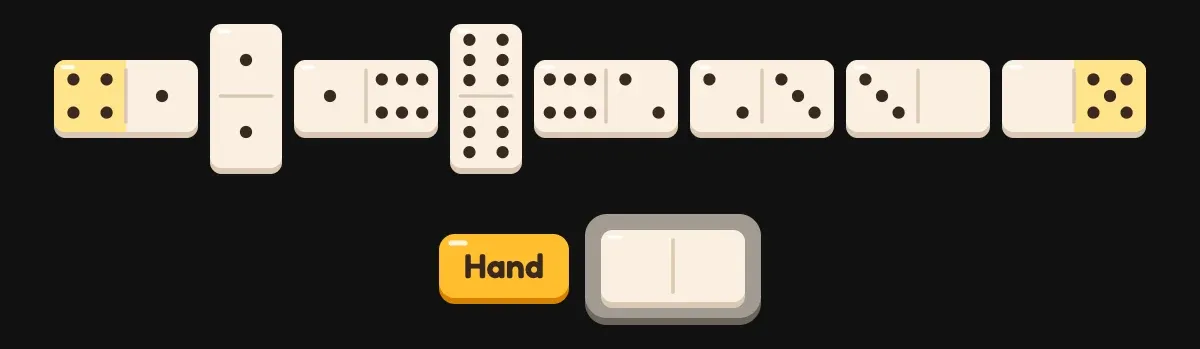
The example stops after step 7. 0-0 is the only tile left in hand, and it fits neither 4 nor 5, so your next move would be to draw.
Make it harder: deal a hand of 5 tiles instead of 7. Fewer tiles to choose from, so it’s harder.
2. Pairs to twelve: a memory game
Goal: take all 28 tiles, in pairs whose pips add up to 12.
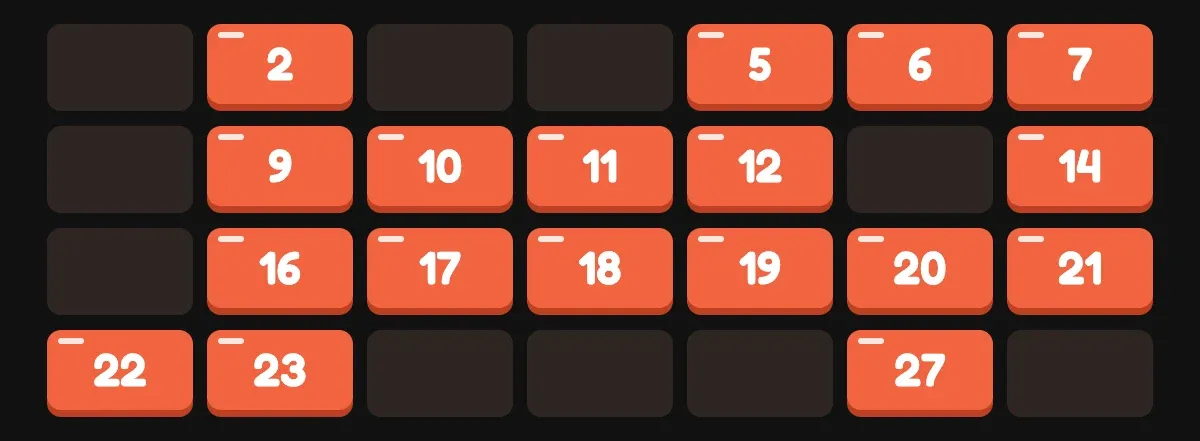
Setup: shuffle and lay the tiles face down in four rows of seven, numbered 1 to 28 row by row.
How it works:
- Turn over any two tiles.
- If their pips add up to 12, take them. (A tile’s pips are its two halves added.)
- If not, turn both back and remember them.
- Your score is the number of turns. Fewer is better.
Why it can always be cleared: each tile needs a partner whose total is 12 minus its own:
- 0 (0-0) needs 12 (6-6).
- 1 (0-1) needs 11 (5-6).
- 2 (0-2, 1-1) needs 10 (4-6, 5-5).
- 3 (0-3, 1-2) needs 9 (3-6, 4-5).
- 4 (0-4, 1-3, 2-2) needs 8 (2-6, 3-5, 4-4).
- 5 (0-5, 1-4, 2-3) needs 7 (1-6, 2-5, 3-4).
- 6 (0-6, 1-5, 2-4, 3-3) needs another 6, so these pair among themselves.
That’s 14 pairs with no tile left over.
Memory tip: work out a tile’s partner total as soon as you see it. The easiest to remember are the tiles with only one partner: 0-0 needs 6-6, and 0-1 needs 5-6.
Par: a computer simulation of a perfect-memory player over 5,000 deals averaged about 22 turns, between 18 and 25. The best possible is 14. Is under 25 a good target? Yes.
Worked example, the first eight turns of one layout, row by row:
- Row 1: 0-6, 5-5, 4-4, 4-6, 0-1, 0-5, 1-6
- Row 2: 1-4, 1-3, 2-3, 6-6, 4-5, 2-2, 0-3
- Row 3: 2-5, 1-2, 3-6, 0-0, 0-2, 5-6, 3-5
- Row 4: 2-4, 3-4, 1-5, 0-4, 2-6, 3-3, 1-1
- 28 (1-1) and 17 (3-6): 2 + 9 = 11. No match.
- 13 (2-2) and 26 (2-6): 4 + 8 = 12. Take them.
- 1 (0-6) and 25 (0-4): 6 + 4 = 10. No match.
- 4 (4-6) and remembered 28 (1-1): 10 + 2 = 12. Take them.
- 8 (1-4) and 24 (1-5): 5 + 6 = 11. No match.
- 1 (0-6) and 24 (1-5), both remembered: 6 + 6 = 12. Take them.
- 3 (4-4) and remembered 25 (0-4): 8 + 4 = 12. Take them.
- 15 (2-5) and remembered 8 (1-4): 7 + 5 = 12. Take them.
After eight turns, five pairs are gone and 18 tiles remain. Turns 4, 6, 7 and 8 each used a tile seen on an earlier turn.
Make it harder: aim to finish in under 24 turns.
3. The ring: one loop of all 28 tiles
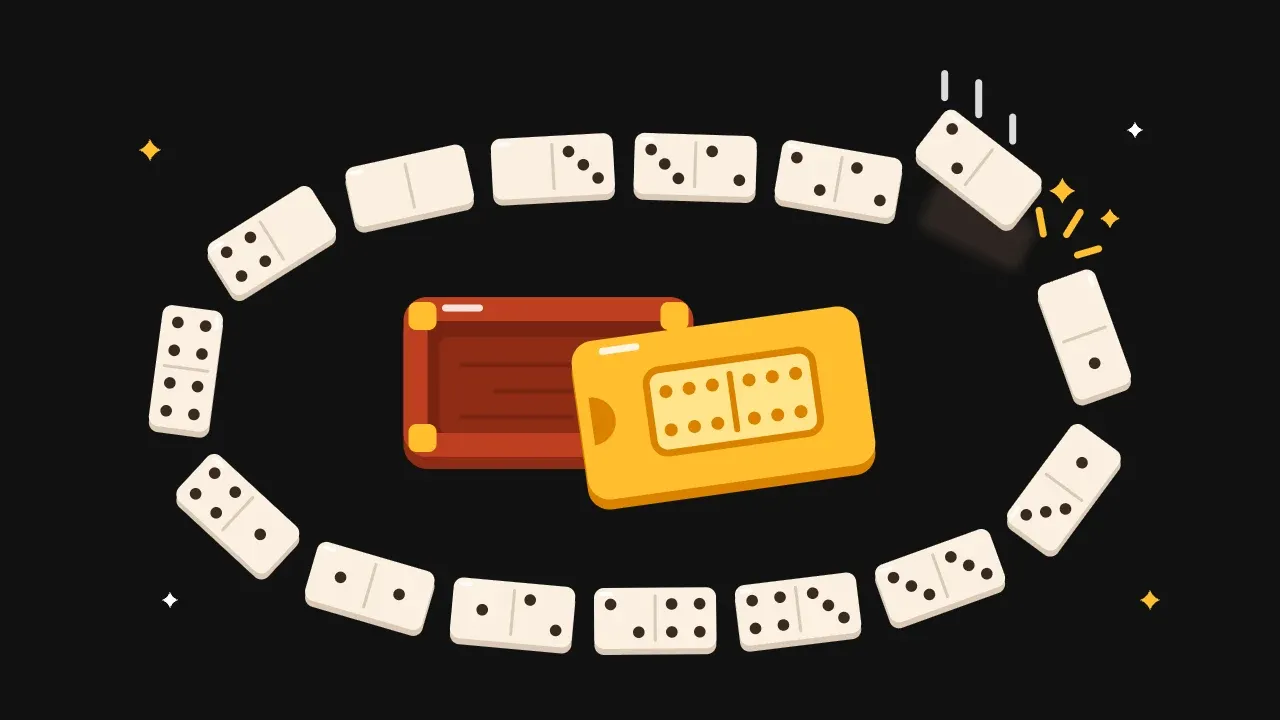
Goal: a puzzle, not a game of chance. Lay the tiles face up and join them into one closed loop: each tile touches the next with matching halves, and the last touches the first. Doubles sit in the loop like any other tile.
Why it can be done: in the full set, each number from 0 to 6 sits on 8 halves. A loop uses two halves each time it passes a number, so every count must be even. What about the double-three set? It has an odd count of 5 for each number, so no loop is possible there. The double-two and double-four sets both have even counts.
Start small: the double-two set (0-0, 0-1, 0-2, 1-1, 1-2, 2-2). Try a line first: 0-0, 0-1, 1-1, 1-2, then 0-2 turned round so it reads 2-0. Both ends are 0, so the line closes into a loop, but 2-2 isn’t in it.
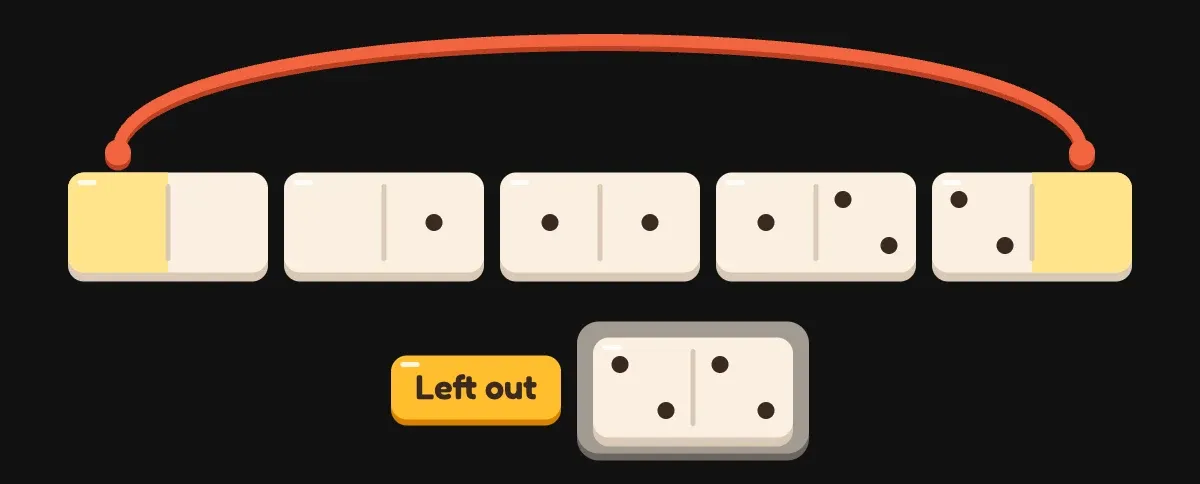
A loop that closes early is a dead end. Undo back to your last choice. Here, the fix goes round by way of the 2s.
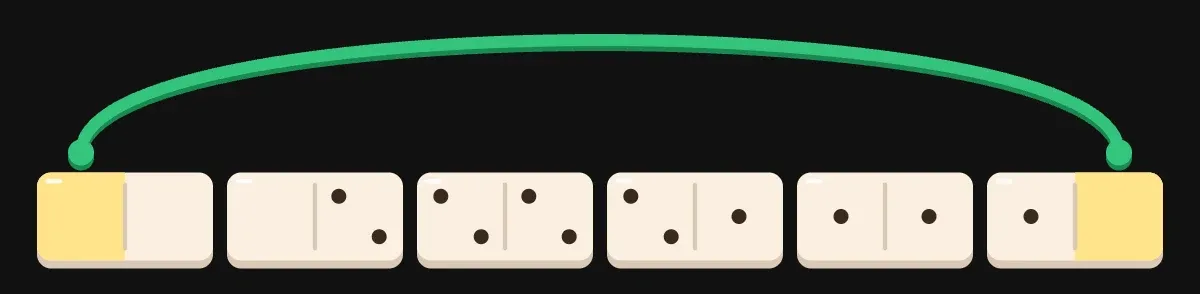
Hint: a double can go in whenever its number is at an end, so use each double as soon as its number comes up.
Try it yourself: the double-four set. Its 15 tiles are all the pairs from 0 to 4: 0-0, 0-1, 0-2, 0-3, 0-4, 1-1, 1-2, 1-3, 1-4, 2-2, 2-3, 2-4, 3-3, 3-4 and 4-4. Build one closed loop from all 15.
Show the answer
One valid ring: 0-1, 1-3, 3-3, 3-4, 4-2, 2-1, 1-1, 1-4, 4-4, 4-0, 0-0, 0-3, 3-2, 2-2, 2-0. The last 0 meets the first 0 of 0-1. Other correct rings exist.
The full challenge: the whole 28-tile set. Build one closed loop from all 28 tiles.
Show the answer
One valid ring: 0-1, 1-6, 6-4, 4-2, 2-3, 3-5, 5-5, 5-1, 1-3, 3-3, 3-4, 4-0, 0-0, 0-2, 2-6, 6-3, 3-0, 0-5, 5-2, 2-2, 2-1, 1-1, 1-4, 4-4, 4-5, 5-6, 6-6, 6-0. The last 0 meets the first 0 of 0-1. Other correct rings exist too.
Make it harder: set a timer, or build the ring without writing anything down.
Which dominoes solitaire game should you try first?
- Draw and build: quick, and a little lucky.
- Pairs to twelve: a memory game for a coffee break.
- The ring: a real puzzle, for when you have time to think.
Pick the one that suits your mood now.
Put it into practice
Pick one game and play a round now. When someone joins you, send them to how to play dominoes for two to four players. For more memory games at home that need no cards, try memory games for adults. How many turns did your pairs-to-twelve game take?