Looking for memory games for adults that need no cards? You can play good ones at home with nothing but people and a few things from a drawer. Here are eight, each with its rules, a harder version and what it asks of the player. A few need a pen and paper, and the first needs a tray of household items; the rest need only people. They’re for fun, not training.
1. Kim’s Game: the tray you cover up
Named after Rudyard Kipling’s novel Kim (about 1901), where the hero plays it as spy training. Baden-Powell later brought it into Scouting.
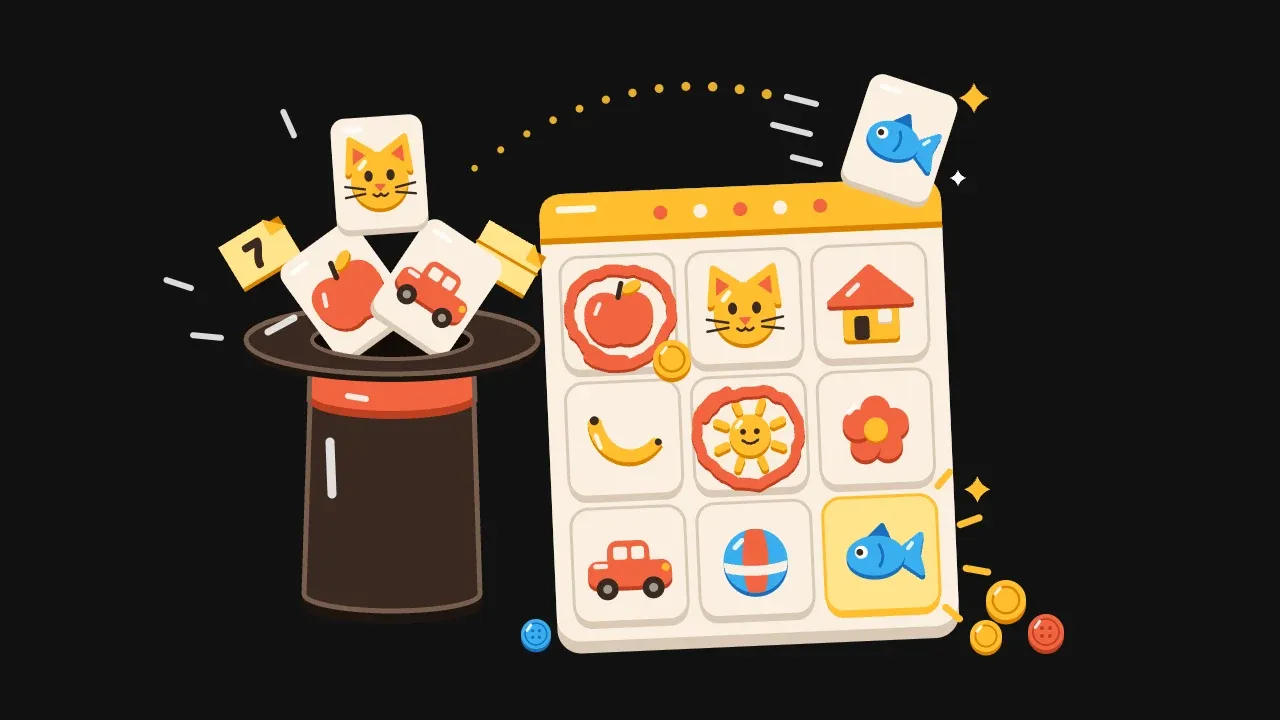
Rules. Put 12 small household items on a tray: a key, a spoon, a coin, a pen, a sock. Everyone studies the tray for 60 seconds. Then someone covers it with a towel, and everyone writes down what they remember in 2 minutes. Score one point per correct item. Compare lists, then lift the towel.
Make it harder. Use 20 items and 30 seconds. Or skip the writing: players name items out loud in turn, and anyone who repeats an item or hesitates is out for the round.
What it asks of you. Attention to many small things at once. As you look, sort the items into groups in your head, such as kitchen things and desk things. Those groups give you a way in when you write the list.
2. Spot the change
Rules. One person leaves the room, or turns round, for 30 seconds. The others change one thing: move a cushion, swap two books, turn a photo round. When the guesser comes back, they have 30 seconds to say what changed. They score one point if they’re right. Rotate so everyone guesses once.
Make it harder. Change three small things instead of one, or change only things on one shelf. The guesser must name them all.
What it asks of you. Visual detail, and remembering how a place looked a moment ago.
3. The packing-list chain
Rules. The first player says, “I am packing a bag and I put in a torch.” The next player repeats the whole list and adds one item. Go round the table. Forget an item or get the order wrong? You’re out of the round, or you lose a point if you agree that first. With only two players, stop at 10 items and start a new chain.
Make it harder. Items must go in alphabetical order (A, B, C…), or every item must fit one theme, such as a beach trip.
What it asks of you. Order. Picture each item in a place, a torch in your hand and then a hat on your head, to hold the list in sequence.
4. Guess the tune, tapped or hummed
Rules. One player hums a song everyone knows, or taps out only its rhythm. The others guess the title. Who takes the next turn? The player who guesses it. Start with the chorus.
Make it harder. Tap only the first line, hum only the first four notes, or choose a theme first, such as a decade or a film’s soundtrack.
What it asks of you. Sound and tune memory. You don’t need any devices. If the group can’t agree on songs, agree on the theme before you start.
5. Draw the map from memory
Rules. Each player takes paper and a pen and has 3 minutes to draw either the floor plan of their home or the route from their door to the nearest shop. Include as many details as you can: doors, windows, big furniture, landmarks. Then swap and check each drawing against the real place. Score one point per correct detail.
Make it harder. Draw a place you visited only once. Or draw a friend’s home, and let someone else check it.
What it asks of you. Space, and the layout of places. It also works well as a game for one.
6. Digit echo
Rules. One player reads out a string of digits, one digit per second, starting with 4 digits. The other player repeats it back. Each correct repeat adds one digit to the next string. A miss? The turn ends, and the number of digits reached is the score. The reader writes each string down to check the answer.
Make it harder. Repeat the digits backwards, or use a list of words instead of digits.
What it asks of you. Short-term order. Group the digits in 2s or 3s as you hear them (48-27-91, for example), not one at a time. People differ, and the score is only for fun.
7. Eyes closed: what is in the room?
Rules. Look around a room for 10 seconds, then step out or close your eyes. List everything you saw. Or answer five questions someone asks you: “What colour is the sofa? How many chairs are there?”
Make it harder. Cut the look to 5 seconds, or go to a room you rarely visit. Or ask about a person instead: what’s the person next to you wearing?
What it asks of you. Looking carefully. It’s a close cousin of Kim’s Game, with no setup at all.
8. Same-category chain
Rules. Pick a category, such as fruit, cities or film titles. In turn, each player says one item in the category that nobody has said yet, within 5 seconds. Items already said can’t be repeated. The group counts the items aloud. At the end of the round, one player tries to list as many of the items said as they can.
Make it harder. Cut the time to 3 seconds, or narrow the category to something smaller, such as kitchen tools.
What it asks of you. Remembering what has been said, and searching your memory for new items. It works best with three or more players.
Memory games for adults tonight: a 20-minute routine
Pick three games that ask for different things: Kim’s Game for attention, the packing-list chain for order, and draw the map for place. Play five minutes of each, and keep a running score on one piece of paper. When anyone gets more than 80% right, switch that game to its harder level.
They’re games for fun together, not brain training. If you want another game that needs no props, try how to play charades. For a game that leans on remembering what has already been ruled out, see the 20 questions strategy.
Which one did you play first, and what was the highest number of items on the tray?