You ask “Is it a dog?”, hear no, and ten questions later you’re still lost. A 20 questions strategy would have stopped that. The idea is simple: make every question split the choices in half. Below are the strategy, a full worked example, 10 strong opening questions and a version for kids.
How to play 20 questions in one minute
- One player, the thinker, picks something in secret. If you agree a category first, such as animals, the thing has to be in it.
- The others take turns asking questions that can be answered yes or no, up to 20 in all.
- Guess right within 20 questions and the guesser wins. If nobody does, the thinker wins and picks the next thing.
- The thinker may open with “animal, vegetable or mineral” to narrow the field. For the quiet table version, see 10 games to play at a restaurant.
1. The 20 questions strategy: split the options in half
The one idea: a good question is one where yes and no are about equally likely, so about half the choices go whatever the answer.
If every question halves the choices, 20 questions can tell apart 2 to the power of 20 things: 1,048,576 in all. Ten questions already cover 1,024 (2 to the power of 10). That’s why a good question beats a lucky guess.
Compare “Is it a dog?” It’s a yes-or-no question, but a poor split. If the answer is no, you’ve removed one thing out of many.
2. A worked example: 16 animals, 4 questions
The thinker picks one of these 16 animals. Here it is the dog, so every answer is about the dog.
-
Mammals that live with people: dog, cat, cow, horse.
-
Wild mammals: elephant, lion, monkey, giraffe.
-
Birds: eagle, penguin, owl, duck.
-
Other animals: shark, goldfish, frog, snake.
-
Q1: “Is it a mammal?” Yes. The 16 options become 8: the mammals.
-
Q2: “Do people keep it at home or on a farm?” Yes. The 8 become 4: dog, cat, cow, horse.
-
Q3: “Does it usually live inside the house?” Yes. The 4 become 2: dog, cat.
-
Q4: “Does it bark?” Yes. The 2 become 1: dog. Then the guess: “Is it a dog?” Four questions plus the final guess.
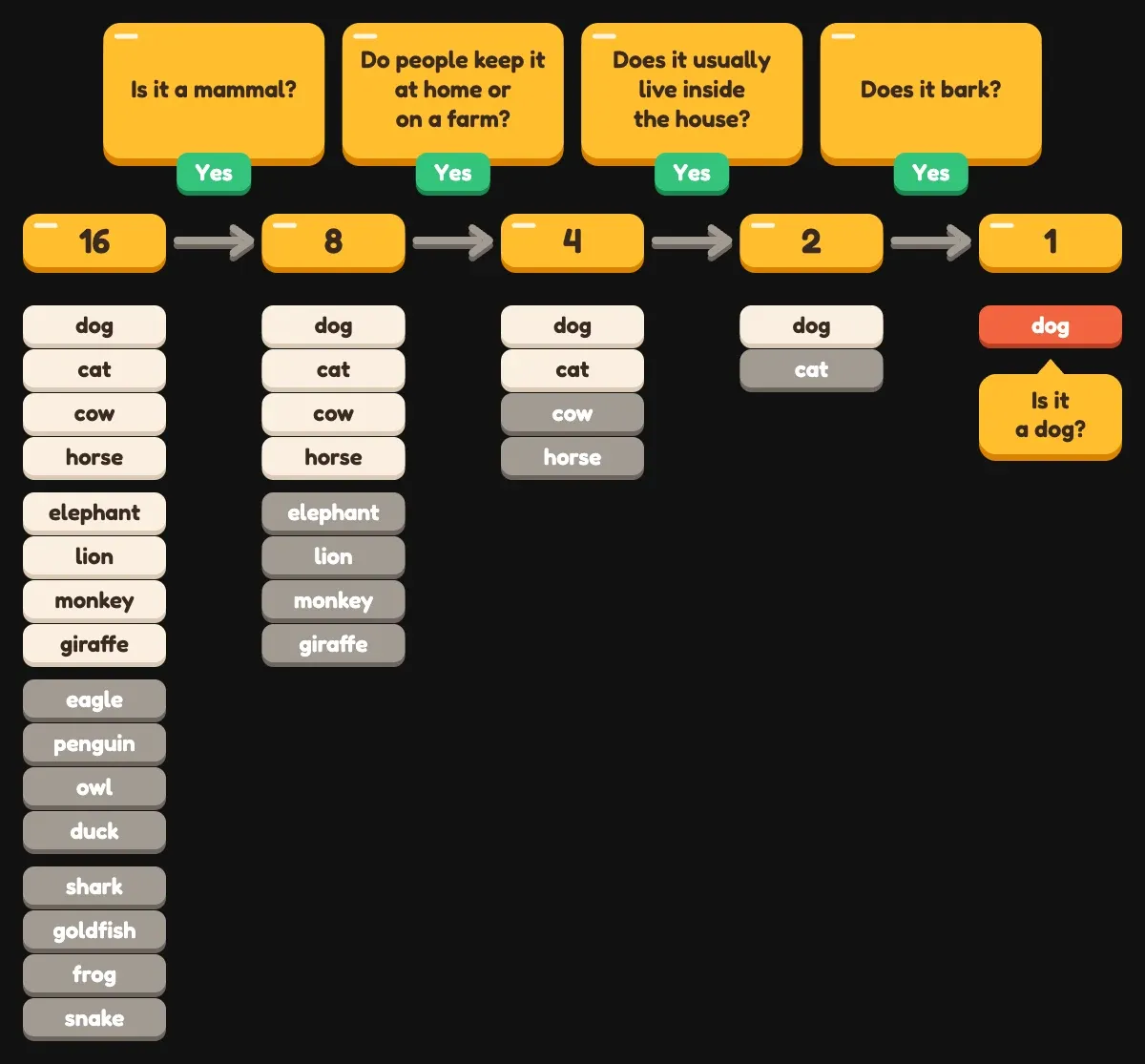
In a game with a million things you need all 20 questions. A list of 16 needs only 4.
3. When the answer surprises you
Now let the thinker pick an eagle, and the first question gets a no. “Is it a mammal?” leaves 8 animals: eagle, penguin, owl, duck, shark, goldfish, frog, snake.
The next question, “Does it have feathers?”, still splits them 4 and 4. Yes leaves eagle, penguin, owl and duck; no leaves shark, goldfish, frog and snake. A no isn’t a setback. It’s as useful as a yes, when the question was a good split.
Stuck? Go back to a broad question about size, where it is found, or what it is made of. Don’t guess until about 2 or 3 things are left.
4. 10 strong opening questions, in order
Use these when the thing could be anything. Each is a broad split; later questions get narrower, such as colour or exact size.
- Is it alive, or was it once alive? Splits living things from rocks and metal.
- Is it an animal? Narrows the living things down.
- Is it a real thing (not from a story or a game)? Removes dragons and game characters.
- Is it man-made? Splits what people built from what nature made.
- Could you hold it in your hands? Splits small things from large.
- Is it bigger than a bread basket? A size split, and the classic restaurant question.
- Would you find it in a house? A place split.
- Do people eat it or drink it? Splits food and drink from the rest.
- Does it move or have a motor? Splits moving things from still ones.
- Is it used every day? Splits everyday things from rare ones.
The order is a guide. Skip a question the earlier answers already settled: if it’s an animal, you already know it’s not man-made, so skip question 4. Change the order if you have a clue.
Tips for the thinker
- Pick something both players know. A banana or a bicycle beats an obscure town: too rare, and the game becomes all guessing.
- If the players are new or young, agree on the category first: animals, food, things in the room.
- Answer honestly and fast, with yes, no or “sometimes”. If the honest answer is “sort of”, agree before you start whether that counts as a yes.
- Don’t change your mind mid-game.
20 questions for kids
- Shrink the target list: use 10 to 16 things in the room, or animals on a page. Sixteen needs only 4 questions.
- Lift the limit to 20 or more, or let little ones ask any question, then count them together. A hint for a stuck player is fine.
- Let the youngest be the thinker first, and whisper the secret to a grown-up so the game stays fair.
- Teach the halving idea in kid words: “Ask a question where you don’t know the answer.”
Put it into practice
Play one round today. The guesser counts how many questions it took, then tries to beat that number next time.
Want more games that need nothing? Read 10 games to play at a restaurant. Another guessing game has its own strategy: read hangman strategy.