The best Minesweeper strategy for beginners is to read each number as a count of the mines in the eight squares around it, flag the squares that must be mines, open the squares that must be safe, and guess only when logic has nothing left. Two simple rules are where to start, and four edge patterns, a whole board solved move by move and a plain rule for when a guess is fair build on them.
Minesweeper strategy in one minute
You win by opening every square that has no mine, and that’s all. Flags are only your notes, so you don’t need to flag every mine to finish.
Each board size comes with a fixed number of mines. Microsoft’s 2001 support article lists 8x8 with 10 mines, 16x16 with 40 and 16x30 with 99. Current versions use 9x9 for Beginner, and minesweepergame.com gives it as “8x8 or 9x9 with 10 mines”. So Beginner is usually 9x9 with 10 mines, Intermediate is 16x16 with 40, and Expert is 30x16 with 99.
How the numbers work
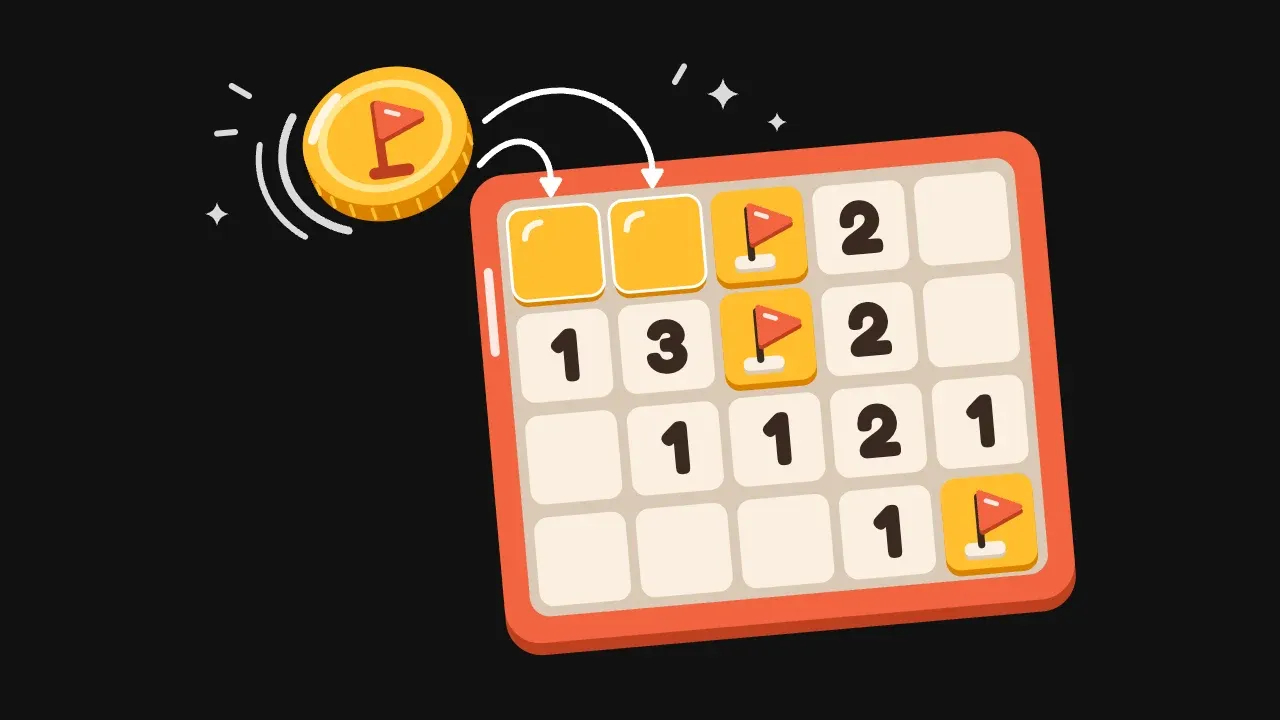
A number tells you how many of the eight squares touching it hold a mine: up, down, sideways and diagonal. The Microsoft article says exactly that, and so does an Australian National University project report on solving the game.
The count of neighbours matters: a corner square touches 3 others, an edge square 5, and a middle square 8. The fewer covered squares a number touches, the more it tells you.
Here’s a small corner of a board (? is covered, . is a 0 that opened by itself):
. . .
. 1 1
. 1 ?
Look at the 1 in the middle. Seven of its eight neighbours are open, so the one covered square, the bottom right, has to be the mine. Picture the same 1 with three covered squares around it instead. One of the three is a mine, but which? Nothing says, so you can’t act yet. Leave it and look elsewhere.
On a computer you right-click a covered square to plant a flag, and a counter shows the mines you haven’t flagged yet (Microsoft). Flag only the mines you’ve proved. A flag you’re unsure about will mislead you later, so skip it.
Your first click
Click anywhere. In Windows Minesweeper the first click is always safe: if it lands on a mine, the game moves that mine to the first empty square counting from the top-left corner, according to minesweepergame.com’s write-up of leaked Windows NT 4.0 source code. Wikipedia says that in some variants the first click is guaranteed to be safe, so don’t count on it in every version.
Why start in a corner? It touches only 3 squares, so there are fewer chances of a mine next to it, and it tends to open a blank. A blank, a square showing 0, opens all of its neighbours by itself, and that can spread over a wide area (Tatham’s Mines manual). There’s no promise of a 0 on your first click, though. If you get a number, that’s fine: start reading.
The two rules to learn first
The ANU report calls them “Single Point” rules and says they’re reminiscent of how beginners play. They’re where to start.
Rule 1: if a number equals its covered neighbours, they’re all mines. A 2 with exactly two covered squares around it means both are mines. Flag them, since they won’t move.
Rule 2: if a number already has its flags, every other neighbour is safe. A 3 with three flags next to it means the rest of its covered neighbours can be opened. Pressing both mouse buttons on that number does it in one go. This is called chording, and it opens the other squares around the number (minesweepergame.com). It also sets off a mine if one of your flags was wrong, so flag only what you’ve proved.
Then it’s a loop: scan for Rule 1, flag, scan for Rule 2, open, and repeat. Each opened square shows a new number, and new numbers give new answers.
Patterns worth knowing
Some shapes come up again and again along the edge of the board, and they’re just the two rules with a bit of counting. In each diagram below, the pattern sits along the top edge. ? is a covered square and o is an open square whose number doesn’t matter here. The same shapes work away from an edge if the squares on the far side are already open (Minesweeper.now and Rare Pike both list them).
The covered squares are numbered 1, 2, 3 from the left. Try each one before you open the answer.
The 1-1 pattern
o 1 1 o o
o ? ? ? o
Which covered square is safe?
Show the answer
Square 3. The first 1 sees only squares 1 and 2, so one mine sits in one of those two. The second 1 sees squares 1, 2 and 3 and also needs just one mine. The first 1’s mine already covers it, so square 3 is safe. You don’t yet know which of 1 and 2 is the mine.
The 1-2 pattern
o 1 2 o o
o ? ? ? o
Which square is a mine for sure?
Show the answer
Square 3. One mine is in squares 1 and 2, because of the 1. The 2 sees squares 1, 2 and 3, so it needs one more mine than the 1 can supply. That mine has to be square 3.
The 1-2-1 pattern
o 1 2 1 o
o ? ? ? o
Which squares are mines, and which is safe?
Show the answer
Mines under the two 1s (squares 1 and 3), safe under the 2 (square 2). The 2 sees all three squares and needs two mines. If square 2 were a mine, each 1 would already be satisfied by it, which would leave squares 1 and 3 empty and the 2 one mine short. So square 2 is safe, and the other two must be the mines. Minesweeper Blast has a page on this pattern.
The 1-2-2-1 pattern
o 1 2 2 1 o
o ? ? ? ? o
Same idea, one square wider. Which two squares are mines?
Show the answer
Mines under the two 2s (squares 2 and 3), safe under the two 1s (squares 1 and 4). Read it from the left as a 1-2: square 3 is a mine. Read it from the right: square 2 is a mine. Each 1 now has its mine, so squares 1 and 4 are safe.
Subtract the flags you know
The 1-2-1 and 1-2-2-1 are one idea: count what each number still needs after the squares it shares with its neighbour. Once flags touch the numbers, a bigger pattern shrinks to a smaller one. Minesweeper Blast gives an example: a 2-3-2 with one flag next to each number reduces to a 1-2-1. When a number looks too big to read, take its flags off and read what’s left.
A short board solved move by move
Here’s a 6x6 board with 6 mines. Every step uses only the two rules, and no guess is needed. A square is written “r2c3” for row 2, column 3, counting from the top left. F is a flag and ? is covered.
Your first click, in the top-left corner, opens a small area:
. 2 ? ? ? ?
2 4 ? ? ? ?
? ? ? ? ? ?
? ? ? ? ? ?
? ? ? ? ? ?
? ? ? ? ? ?
Step 1, Rule 1. The 2 at r1c2 has only two covered neighbours, r1c3 and r2c3, so both are mines. The 2 at r2c1 has only r3c1 and r3c2 covered, so those are mines too. Flag all four.
Step 2, Rule 2. The 4 at r2c2 now has four flags around it, so its last covered neighbour, r3c3, is safe. Open it and it shows a 2.
Step 3, Rule 2. That 2 touches the flags at r2c3 and r3c2, so its other neighbours are safe: r2c4, r3c4, r4c2, r4c3 and r4c4. Open them. You get 3, 2, 2, 1 and 1.
Step 4, Rule 2. The 2 at r4c2 is met by the flags at r3c1 and r3c2, so r4c1, r5c1, r5c2 and r5c3 are safe. The 1 at r4c3 touches the flag at r3c2, so r5c4 is safe too. Open them. Several are blanks, so the opening spreads along the bottom:
. 2 F ? ? ?
2 4 F 3 ? ?
F F 2 2 ? ?
2 2 1 1 1 1
1 1 1 . . .
? ? 1 . . .
Step 5, Rule 1. The 1 at r4c4 has one covered neighbour, r3c5, so that’s a mine. The 1 at r5c3 has one covered neighbour, r6c2: also a mine. Flag both.
Step 6, Rule 2. The 3 at r2c4 touches the flags at r1c3, r2c3 and r3c5, so r1c4, r1c5 and r2c5 are safe. The 1 at r4c6 is met by the flag at r3c5, so r3c6 is safe. The 1 at r5c1 is met by the flag at r6c2, so r6c1 is safe. Open them, and the blanks open up the rest of the top right.
. 2 F 2 . .
2 4 F 3 1 1
F F 2 2 F 1
2 2 1 1 1 1
1 1 1 . . .
1 F 1 . . .
All 30 safe squares are open and all 6 mines are flagged. It took six rounds, and you never had to guess. Reading one number at a time, instead of the whole grid, is how you get there.
When you have to guess
Guess only when no square can be settled by logic. That’s habit 6 in these habits for logic puzzles: don’t guess while a deduction exists. Before you give up, check every number touching the square you’re doubting and the mine counter. Minesweeper.now says many apparent 50-50s hide a clue you missed.
Really stuck? Pick the covered square with the lowest chance of a mine. Two ways to estimate it:
- Squares touching no number share the leftover mine density: the mines the numbers don’t account for, divided by the number of those squares (Rare Pike). Say the counter shows 6 mines left and the numbers account for 3 of them in the squares they touch. If 15 covered squares touch no number, that leaves 3 mines among 15 squares: 3 / 15 = 20%. At the very start of a Beginner game, it’s 10 mines in 81 squares, about 12.3%.
- Squares next to numbers carry the risk of those numbers. Rare Pike says that in many positions squares touching no number are safer than squares next to one, because the numbers can concentrate mines along the border. Compare the two estimates and choose the lowest, so a 20% square beats a 35% one.
The ANU report has a small case where square A is a mine in 25% of the possible layouts, B in 50% and C in 75%, so A is the educated guess. It adds that you should also look at what a safe guess would reveal.
It’s the same habit as in Battleship strategy, where you fire where ships fit most often.
Some guesses are true 50/50s
A true 50/50 is two squares that are equally likely to hold a mine, where every layout satisfies every number, so logic can’t separate them (Minesweeper.now). Typical shapes aren’t hard to spot: two corner squares, the last two squares at the end of a wall segment, and small sealed pockets. The ANU report gives the cleanest case: the last mine could be in either of two unknown squares, but not both, and nothing else on the board says which.
If you lose one of these, that isn’t a skill failure. Wikipedia says most mines can be found by deduction, but some squares need a guess, usually at 50-50 odds, and Minesweeper.now says you can’t win every standard game. Tatham’s Mines shows you can build boards where you never need to guess (it’s the default setting, and you can switch it off), but standard Minesweeper boards can force one.
Mistakes beginners make
- Flagging by hunch. A wrong flag turns a safe square into a trap, and chording on it can set off a mine. Flag only what you’ve proved.
- Clicking next to a number you haven’t read. If you can’t say why a square is safe, don’t open it.
- Ignoring the mine counter. It tells you how many mines are left, and it can settle a spot that looks like a 50/50.
- Rushing for the timer. A loss costs more than the seconds you’ve saved. Speed comes once the patterns don’t need a second look.
Put it into practice
Open a game, click a corner, and run the loop: Rule 1, Rule 2, then the edge patterns. Don’t guess until you’ve run out of sure moves.
Try it with Loopaway, a free arrow puzzle in your browser, where you tap arrows off the board. For more like it, see our free puzzle games.
If you enjoy working out a hidden answer from clues, the Bulls and Cows strategy post solves a whole game move by move. Number clues on a grid are also the heart of how to solve nonograms, with a 5x5 example.
Frequently asked questions
How do you win Minesweeper every time?
You can't in standard Minesweeper, because some boards end in a spot where two layouts fit every number and only a guess can settle it. Wikipedia says most mines can be found by logical deduction. Flag the squares that must be mines, open the ones that must be safe, and guess only when nothing is certain.
Where should you click first in Minesweeper?
Anywhere works, because Windows Minesweeper always makes the first click safe; Wikipedia says some other variants do too. A corner or an edge touches fewer squares than the middle, so it can open a blank area that clears itself.
Is Minesweeper luck or logic?
Mostly logic. Wikipedia says most mines can be found by deduction, but some squares need a guess, usually at 50-50 odds. So the game is logic with an occasional forced guess.
What does the 1-2-1 pattern mean in Minesweeper?
It's three numbers in a row along an edge, shown as 1, 2, 1, with covered squares on the open side. The squares under the two 1s are mines and the square under the 2 is safe.
What do you do when you have to guess in Minesweeper?
First recheck every number and the mine counter, because many apparent 50-50s have a clue you missed. If nothing is certain, open the covered square with the lowest chance of a mine, and compare the leftover mine density with the risk next to the numbers.
Sources
- Description of Minesweeper in Windows Entertainment Pack (Microsoft KB Q66352)
- Mines | Simon Tatham's Portable Puzzle Collection
- Graphical Models for Minesweeper | Kamenetsky and Teo, ANU
- How To Play Minesweeper | minesweepergame.com
- One Click Bug | minesweepergame.com
- The 1-2-1 Minesweeper Pattern | Minesweeper Blast
- Minesweeper Patterns Every Player Should Know | Minesweeper.now
- Common Minesweeper Patterns | Rare Pike
- Minesweeper Probability & Logic | Rare Pike
- What is a 50/50 in Minesweeper? | Minesweeper.now
- Can you win Minesweeper every time? | Minesweeper.now
- Microsoft Minesweeper | Wikipedia
- Minesweeper (video game) | Wikipedia