How to do cat’s cradle is simpler than it looks once you know the order of the moves. Below are the first five shapes in short numbered steps, each with a picture.
1. How to do cat’s cradle: what you need
You need one loop of string, tied with no twists, about 1 m (40 in) all round. That length is a practical tip, not a rule: on your fingers the loop should be neither tight nor baggy. If it feels too tight or floppy, tie a longer or shorter loop.
You need two players, though one of you can make the Cradle alone to practise. Call the players A and B. Sit facing each other with your hands up in front, palms facing.
The shape always passes from one player’s hands to the other’s. The taker pinches the strings the steps name and pulls the hands apart, which makes the next shape.
2. How the game passes from player to player
Each shape is made from the one before, in this order:
| Shape | Who makes it | Taken from |
|---|---|---|
| 1. Cradle | A | the loop |
| 2. Soldier’s Bed | B | A |
| 3. Candles | A | B |
| 4. Manger | B | A |
| 5. Diamonds | A | B |
This is the order of the “Real Cat’s-Cradle” in Caroline Furness Jayne’s String Figures and How to Make Them (1906). Her book goes on to Cat’s Eye, Fish in a Dish and Clock.
Near, far, left and right name the strings as the player the shape is being taken from sees them (Jayne’s own rule). “The left thumb” and so on are the hands of the player doing the step. A cross is where two strings meet.
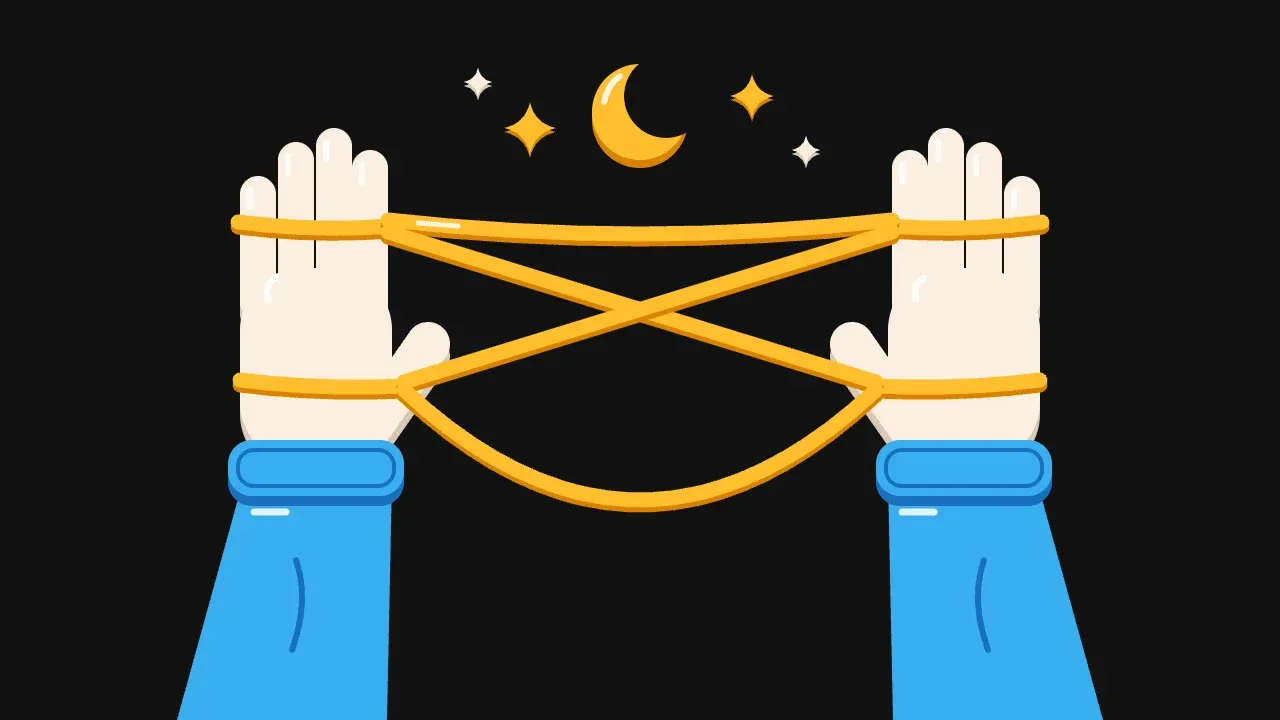
3. Step 1: the Cradle (A makes it)
- Put the four fingers of each hand through the loop.
- Spread the hands until the string is taut.
- With the right thumb and index, turn the left hand’s near string away from you across the left palm.
- Bring it back over the back of the left hand, then between the left thumb and index.
- Do the same on the right hand.
- Each hand now has two strings across its back and one across its palm.
- With each middle finger, pick up the string across the palm.
- Pull the hands apart. The Cradle is on your hands.
Check for a loop on each middle finger.
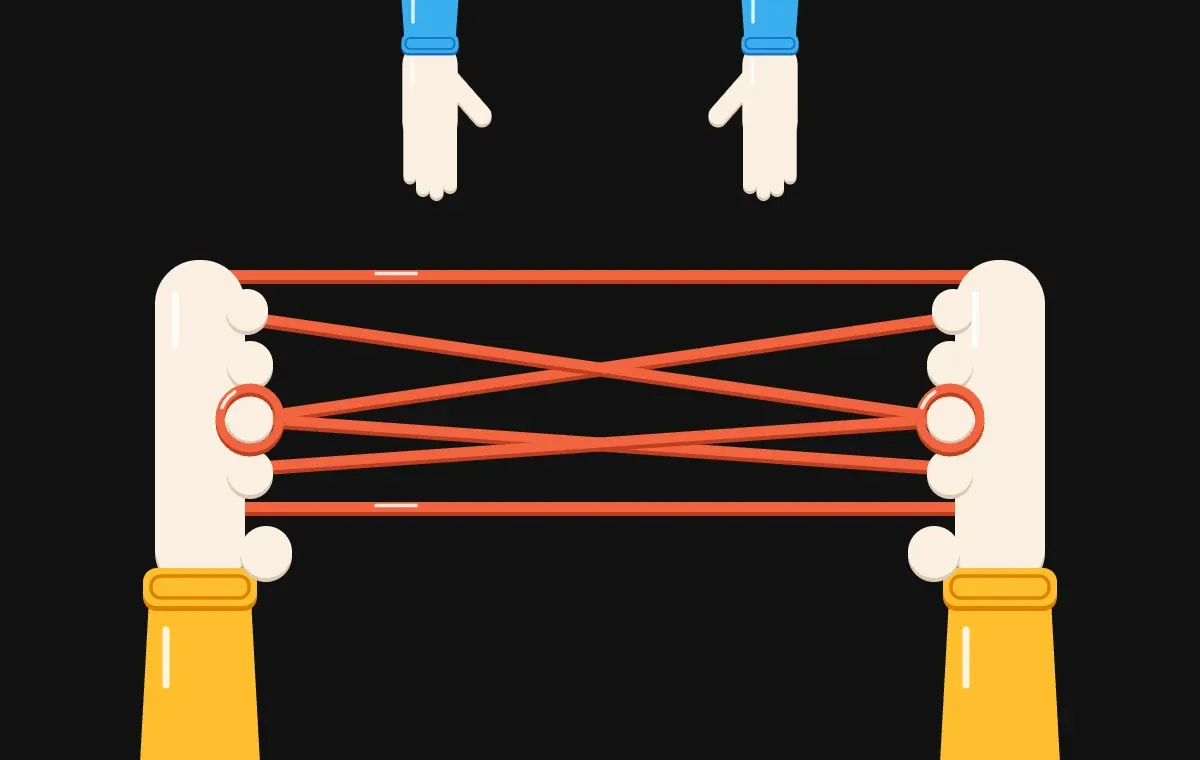
4. Step 2: Soldier’s Bed (B makes it)
- B’s left thumb goes away from A, under the near string of A’s right middle finger.
- B’s left index goes away from A, under the near string of A’s left middle finger.
- Bring the left thumb and index together to pinch the two near strings where they cross.
- B’s right thumb goes towards A, under the far string of A’s right middle finger.
- B’s right index goes towards A, under the far string of A’s left middle finger.
- Bring the right thumb and index together to pinch the two far strings where they cross.
- Pull the hands apart: the right hand away from A, the left hand towards A.
- Take the thumb and index of each hand around the side string on that side, and up into the middle.
- Draw the hands apart and spread each index away from its thumb. A lets go, and B holds Soldier’s Bed.
Jayne also gives Church Window (England) and Fish Pond (America) as names.

5. Step 3: Candles (A makes it)
- A’s left index goes from above into the left thumb loop, near the centre of the figure.
- A’s left thumb goes from above into the right thumb loop.
- Bring the left thumb and index together to pinch the two near thumb strings where they cross.
- A’s right thumb goes from above into the right index loop.
- A’s right index goes from above into the left index loop.
- Bring the right thumb and index together to pinch the two far index strings where they cross.
- Spread the hands: the right hand away from B, past the far straight string; the left hand towards B, past the near straight string.
- Pass each thumb and index, still holding its strings, under the side string on that side, then bring it up from below into the centre.
- Draw the hands apart and spread each index wide from its thumb. B lets go, and A holds Candles.

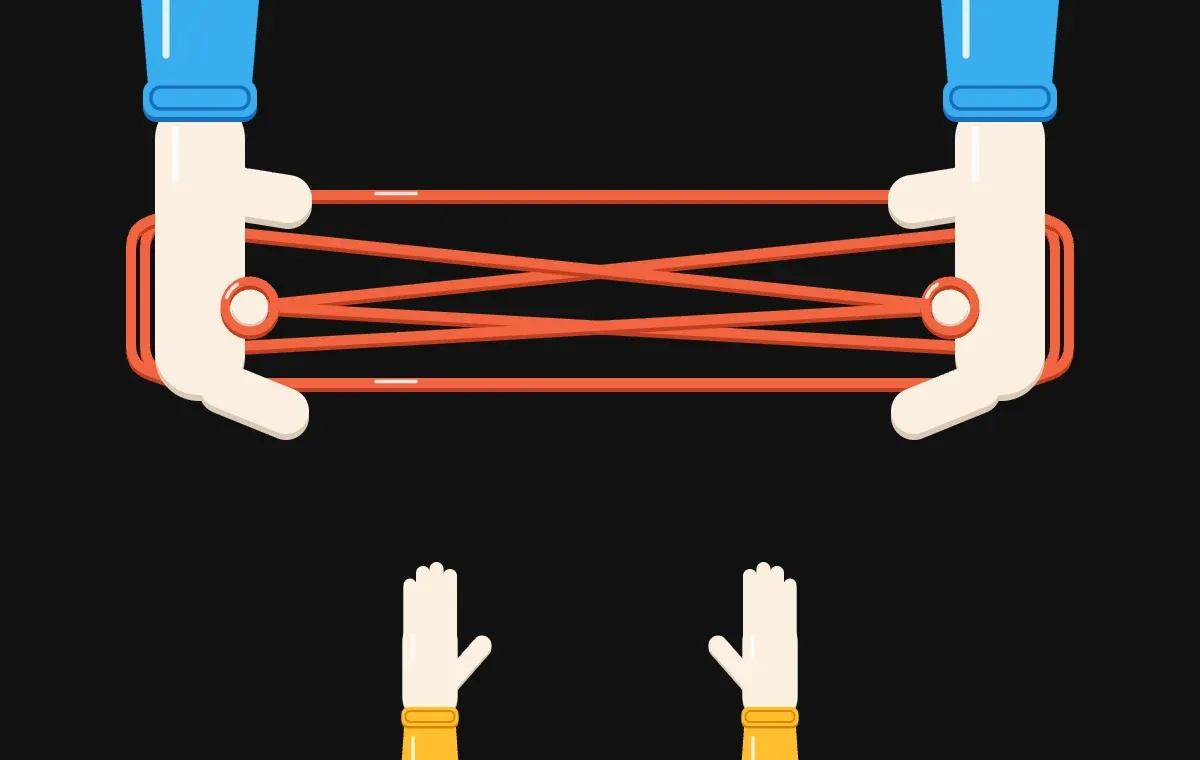
6. Step 4: Manger (B makes it)
- Turn B’s left hand palm up. Hook the near index string into the bend of the left little finger and draw it over the other strings towards A.
- Turn B’s right hand palm up. Hook the far thumb string into the bend of the right little finger and draw it over the other strings away from A.
- Close both little fingers onto the palms to hold the strings.
- Pass the left thumb and index from the near side under the two near thumb strings, and up on their far side.
- At the same time, pass the right thumb and index from the far side under the two far index strings, and up on their near side.
- Draw the hands apart and spread the indexes wide. A lets go, and B holds Manger.
Manger is the Cradle turned upside down. Jayne gives “the inverted cradle” as one of its names in England.
7. Step 5: Diamonds (A makes it)
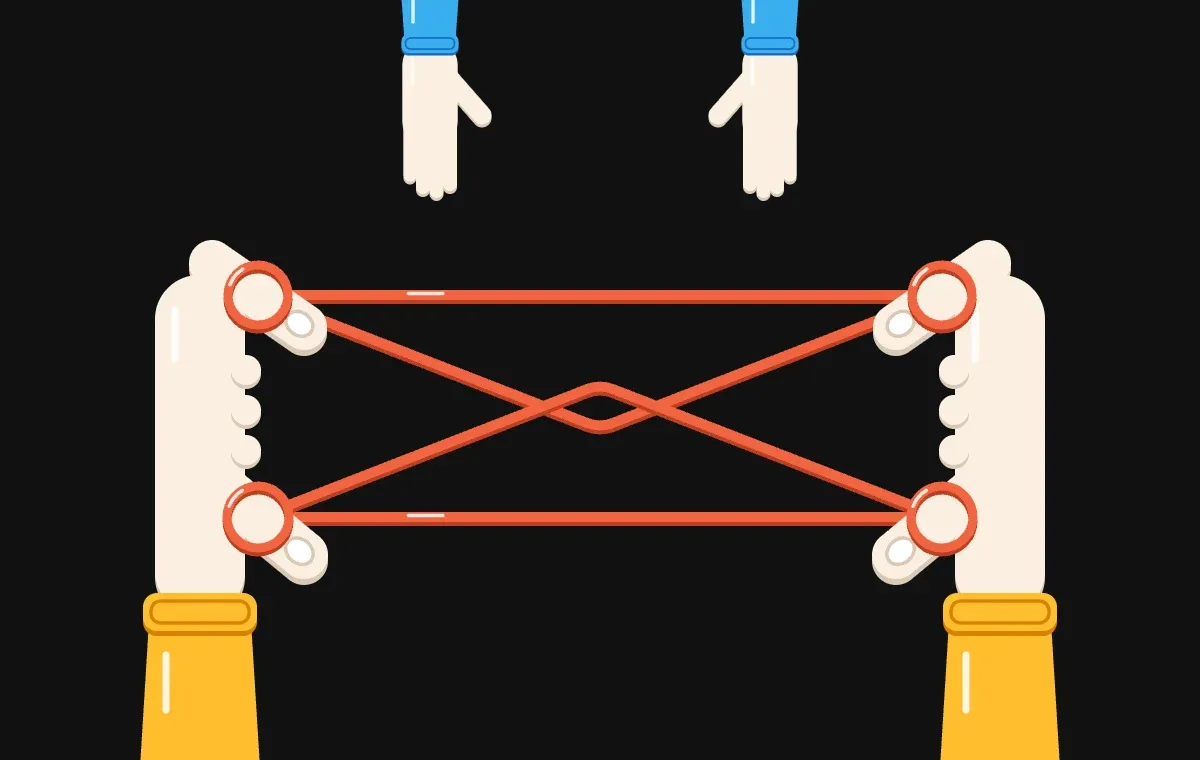
- Take the Manger from B the way B took the Cradle in Step 2: pinch both pairs of crossings, then pull the hands apart.
- Bring the thumb and index of each hand up around the side string on that side, then down into the middle. This is the one change from Step 2.
- Draw the hands apart and spread each thumb wide from its index. B lets go, and A holds Diamonds.
Diamonds is the Soldier’s Bed pattern with the fingers pointing the other way. Jayne calls it “Soldier’s Bed again” in England.
8. If the string tangles: quick fixes
- A twisted loop at the start: retie it with no twists.
- Fingers go in from the wrong side: the shape comes out tangled. Go back one step and check “from above” and “from below”.
- The giver lets go too early: keep your hands still and apart until the taker has pulled.
- A loop too short or too long: retie it, as in section 1.
Practise the Cradle alone until it comes in under ten seconds.
9. Where string games come from
String figures are known in the Pacific, the Americas, Africa, Asia and Europe, and were passed on by hand. A 2024 study of 826 string figures from societies across the globe found some spread very widely and others in one region only.
The first known English mention is in Abraham Tucker’s The Light of Nature Pursued (1768), which calls it “an ingenious play they call cat’s cradle”.
Jayne’s 1906 book gives eight named figures for two players, and the order in this post follows it. She notes that no satisfactory explanation of the name has been given.
10. Try it now
Grab a loop of string, a friend and five minutes, and see how far you get before the string tangles. For a game that needs no props, try how to play charades or I spy on a road trip.