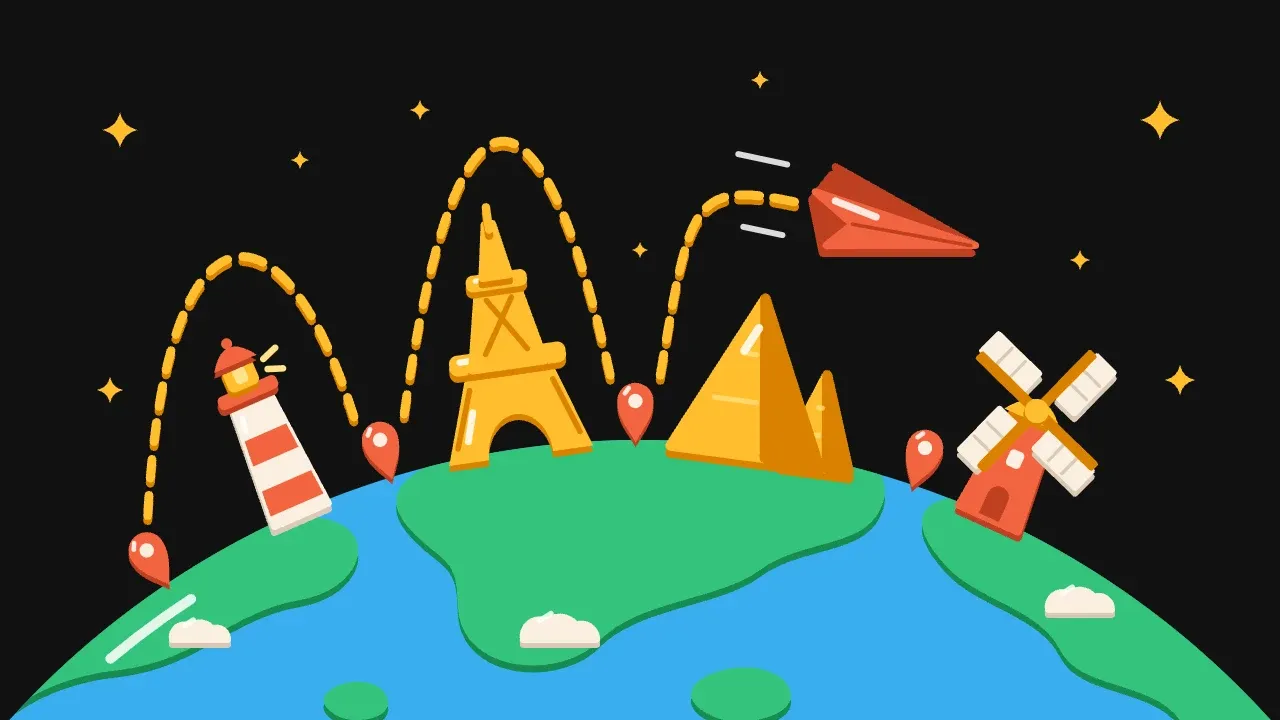
Geography games for kids need no map, no screen and no signal, so they’re handy when someone in the back seat says “I’m bored”. The five games here are played with voices and maybe a pencil. Each has full rules and a sample round, plus a way to make it easier or harder for ages 6 to 12.
Geography games for kids: three house rules before you start
- Agree the source of truth. Nobody looks anything up during a round. Doubts are written down and checked at the end, in an atlas or on a globe.
- Accept common spellings. Czechia or Czech Republic, Ivory Coast or Côte d’Ivoire: decide before you play which names count.
- Pick a scoring style. Either no score (everyone just keeps the chain going) or one point per correct answer. The youngest players can have a hint instead: a first letter, or the continent.
1. Country Alphabet (ages 6 and up)
Rule. Go through the alphabet in order. Each player in turn names a country that starts with the current letter, then the group moves to the next letter. If nobody can name one, anyone may say “pass” and the letter is skipped.
Hard letters. Q has Qatar, Y has Yemen, and Z has Zambia and Zimbabwe. X has no country, so skip it.
Sample round. Argentina, Brazil, Chile, Denmark, Egypt, France, Ghana, Hungary. A country can come back in the next round, but not twice in one round.
Easier (age 6): allow a continent name or any place. Harder (age 12): say the country and its continent, or play the second lap with capitals instead of countries.
2. Capital Chain (ages 7 and up)
Rule. The first player names a capital city. The next player names a capital that starts with the last letter of the one just said. No repeats. Stuck for 10 seconds? Drop out or take a hint.
Sample chain. Paris, Santiago, Oslo, Ottawa, Accra, Ankara, Athens, Stockholm, Madrid, Dublin, Nairobi, Islamabad, Dakar, Riga, Amman. The next player needs a capital starting with N.
Easier: chain countries instead (Spain, Norway, Yemen), or let the youngest player say the capital’s country. Harder: add the country of every capital named.
3. Mystery Place: yes or no questions (ages 8 and up)
Rule. One player thinks of a country or famous place. The others have 20 questions, and each question can only be answered yes or no. The player who guesses right picks the next place. Asking “Is it Japan?” counts as one of the questions, so a wrong guess uses one up.
Sample round, secret country Japan. Is it in Asia? Yes. Is it south of the equator? No. Is it an island country? Yes. Is it in East Asia? Yes. Is it Japan? Yes. Four questions narrow it down, and the fifth is the guess.
Asking well. Begin with the continent, then the hemisphere, then whether it’s an island or on a coast, then a neighbour. The 20 questions strategy post has the full method.
Easier: limit the secret to countries on one continent, or give a first letter. Harder: use capitals, rivers or mountains.
4. Border Buddies (ages 8 and up)
Rule. Players take turns naming a country that shares a land border with the one before. No repeats. Chain at a dead end? That player is stuck, and the next round starts with a new country.
Sample chain. Germany, Poland, Czechia, Austria, Hungary, Serbia, Bulgaria, Greece, Turkey. Each country shares a land border with the one before it.
Dead ends. Portugal’s only land neighbour is Spain, so after Portugal the next name must be Spain. Spain already in the chain? Then it stops at Portugal. Islands such as Japan or Australia have no land border with any country. Nobody can name one after another country, and a chain that starts with one stops at once.
Easier: use a single continent. Harder: keep the chain going for 12 countries, or name two neighbours each turn.
5. Which Is Bigger? (ages 6 to 12)
Rule. The leader says two places and the measure, such as area, length or height. Everyone points or shouts which one is bigger, then the leader gives the answer. One point per right answer, five pairs per round.
Five pairs. Each answer is hidden until you want it.
Russia or Canada, by area?
Show the answer
Russia. It’s about 17 million square km, against about 10 million for Canada.
Brazil or Argentina, by area?
Show the answer
Brazil. It’s much larger than Argentina.
Mount Everest or Kilimanjaro, which is taller?
Show the answer
Everest. Kilimanjaro is a very tall mountain, but Everest is taller.
Pacific or Atlantic Ocean, by area?
Show the answer
Pacific. It’s the larger of the two oceans.
Sahara or Gobi, by area?
Show the answer
Sahara. It’s much bigger than the Gobi.
Easier: use only very different pairs. Harder: ask players to guess the size order of three places, then check. Invite each child to write a pair of their own and ask the table.
Which game for which age?
| Ages | Games to start with |
|---|---|
| 6 to 7 | Country Alphabet and Which Is Bigger |
| 8 to 9 | Capital Chain and Border Buddies |
| 10 to 12 | Mystery Place, and every game in its harder form |
Mixed ages: pair a younger player with an older one as a team, or give the younger player a first-letter hint. In the car? Country Alphabet and Mystery Place. Around a table, try Capital Chain. For a class warm-up, a short round of Which Is Bigger works well.
Keep playing
Pick one game and play it for five minutes tonight. Write down every place you were unsure of, and look those up together afterwards.
Want another quick pen-and-paper game? Try the category word game. Playing with the youngest on a long drive? The I spy road-trip guide works well.