Dots and boxes strategy is mostly counting, not luck. You keep drawing lines, the boxes get taken, and the other player always seems to scoop the last big run. This post gives you the rules in a few lines, the counting rule that wins games, and a worked endgame you can play on paper. By the end, you’ll know which number you want at the start of a game, and how to keep control of it.
1. The rules in 30 seconds
Dots and boxes is played on a grid of dots. Players take turns drawing one line between two neighbouring dots. Whoever draws the fourth side of a box takes that box, scores 1 and must move again. The player with the most boxes at the end wins.
To use the numbers later: a board of 3x3 boxes has 16 dots and 24 lines. In general, a board of m x n boxes has (m+1) × (n+1) dots.
Completing a box means you move again. That one rule is where all the strategy comes from.
2. The early game: nobody wants to give the first box
A move that puts a third side on a box gives that box away, because your opponent can take it at once. Call these giving moves. Every other move is safe.
Both players draw safe moves until none are left. Then whoever must make the first giving move is on the back foot. That’s why counting matters: you want to know who will be forced to move first.
A chain is a row of boxes, each with two sides drawn, joined one after another, so a single line gives away the whole run. A chain of 1 or 2 boxes is short. A chain of 3 or more is long. A loop is a closed ring of boxes, and it counts separately, as section 4 explains.
3. Why the opener of a long chain loses: the double-cross trick
Here’s the trick. Say your opponent opens a long chain. You don’t have to take every box. Take all but the last two, then draw the line at the far end. That leaves the final two boxes as a pair, sharing one undrawn line. This is the double-deal.
Your opponent takes the pair with one line. That’s a double-cross: two boxes with one line. But now they must move again, and they have to open the next chain.
The cost to you is two boxes for each chain. The gain is that your opponent has to open every chain after that one. Keep doing this and you have control.
Rule of thumb: while chains are left, take all but two and decline the last two. With the last chain, take everything.
Don’t use this on 1- and 2-chains. Those short runs are the sacrifices fought over in the early game.
4. The long-chain rule: the dots and boxes strategy that wins
Here is the rule that wins games. Count the dots, count the long chains, and add them together:
The first player wants the number of dots plus the number of long chains to be even. The second player wants it to be odd.
| Board (boxes) | Dots | Long chains the first player wants |
|---|---|---|
| 2 × 2 | 9 | odd (for example, one) |
| 3 × 3 | 16 | even (zero or two) |
| 4 × 4 | 25 | odd |
| 5 × 5 | 36 | even |
The second player wants the other parity in each row.
Why it works, in short: the player who takes the last box keeps control, and the number of turns in a game is set by the dots and the double-crosses. The controller declines every long chain but the last, so there is one double-cross fewer than there are long chains.
You don’t have to avoid chains, you have to build or break them. If you want fewer long chains, join them together, or cut them down to length 2 by sacrifices. If you want more, split the board into separate long runs.
Loops work differently: a loop costs 4 boxes to keep control instead of 2, and it does not count as a long chain in the rule.
5. A worked endgame on a 3x3-box board
Here is a position on a board of 3x3 boxes, with 13 of the 24 lines drawn. It’s the second player’s turn. Two long chains are on the board: the top row is a 3-chain, and rows 2 and 3 form a 6-chain that snakes from the left edge of row 2 to the left edge of row 3.
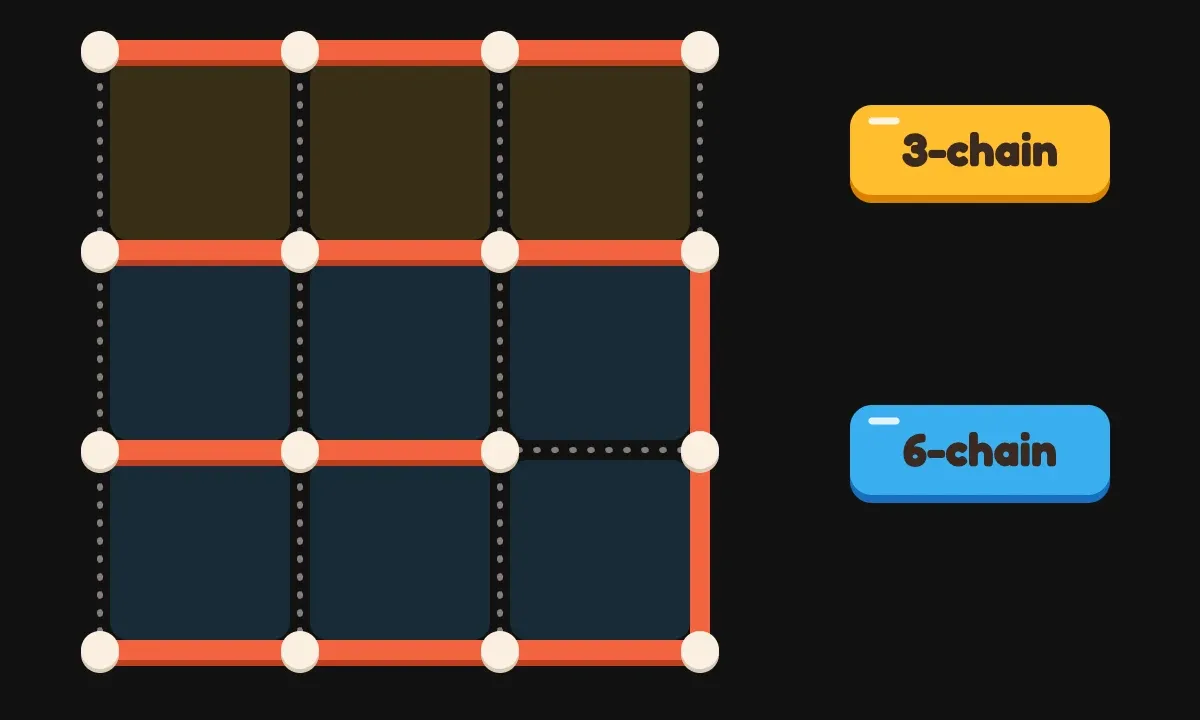
Every line still undrawn gives a box away, so the second player has to open a chain. The dots plus the long chains make 16 + 2 = 18, which is even, so the first player is the one who wants this position.
Say the second player opens the 3-chain. The first player can take all 3, but then has to open the 6-chain, which the second player takes whole: 3 boxes to 6. That greedy reply loses.
The better reply is to take 1 box, then decline the last 2 with the double-deal. The second player takes the pair and has to open the 6-chain, which you take in full: 7 boxes to 2.
One decision, to take all 3 or to take 1 and decline 2, is worth 4 boxes: 7 instead of 3. Whichever line the second player draws, the first player can still win 7 boxes to 2.
Try it yourself. Draw the 4 × 4 dots on paper, add the same 13 lines, and play it from both sides.
6. Try it: three quick questions
1. The 2 × 2 board
On a board of 2 × 2 boxes (9 dots), does the first player want an even or an odd number of long chains?
Show the answer
Odd. 9 dots plus an odd number of chains makes an even total, for example one 3-box or 4-box chain.
2. The 4 × 4 board
On a board of 4 × 4 boxes (25 dots), does the second player want an even or an odd number of long chains?
Show the answer
Even. The second player wants 25 plus the chains to be odd, so the chains must be even. The first player wants odd.
3. The last chain
A 5-box chain is opened, and it is the only chain left. Do you take all 5, or decline the last 2?
Show the answer
Take all 5. It’s the last chain, so declining would only give 2 boxes away for nothing.
Put it into practice
Three habits to take to the table: count the dots before the first line is drawn, count the chains as the board fills up, and never open a long chain if you can give away a short one instead.
Play a full game on paper with a friend, and switch sides halfway through. For the habits behind any puzzle, read how to get better at logic puzzles. For more strategy, try bulls and cows strategy.