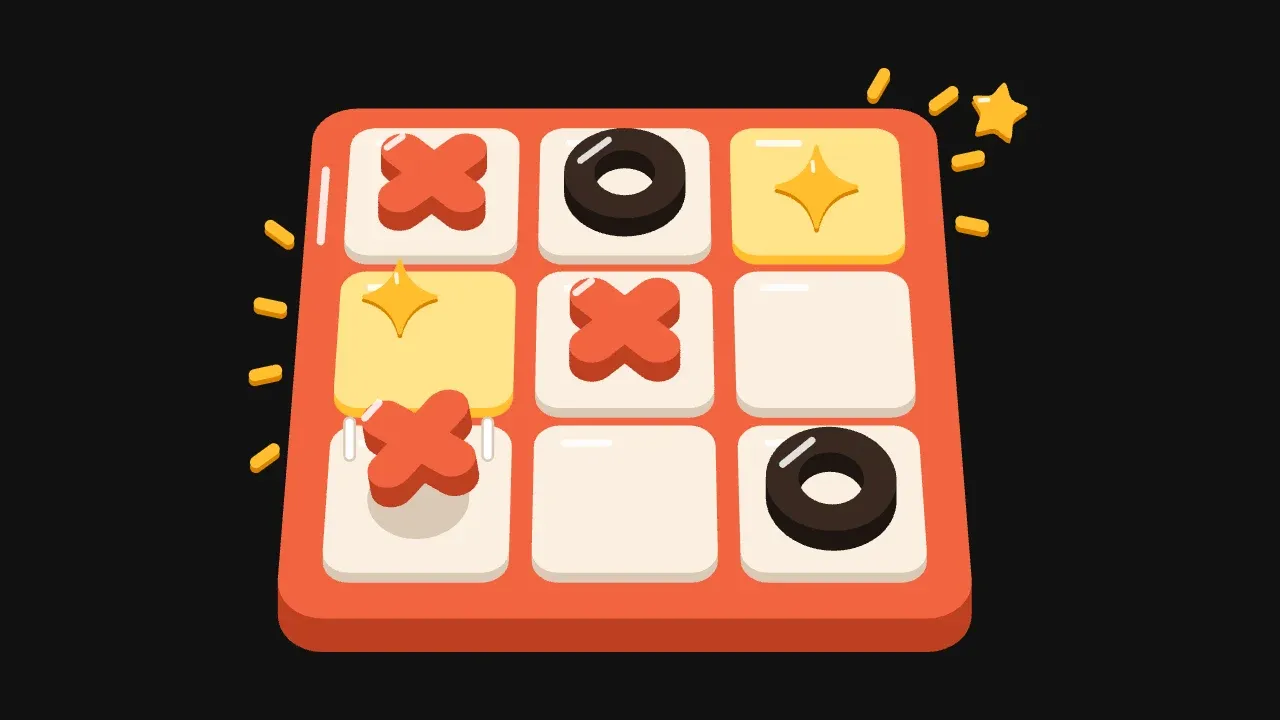
Lost at tic-tac-toe to a friend or a kid and not sure where it went wrong? Below you’ll find how to never lose tic-tac-toe, whoever goes first: a short checklist, the right reply to every opening, and the traps that win when the other player slips. Remember one thing: against perfect play the game is always a draw, so never losing is the goal, and winning means catching a mistake.
1. The honest truth: perfect play is a draw
If both players never make a mistake, every game ends in a draw, whichever square X opens on. So you can always avoid losing, but you can only win when the other player errs.
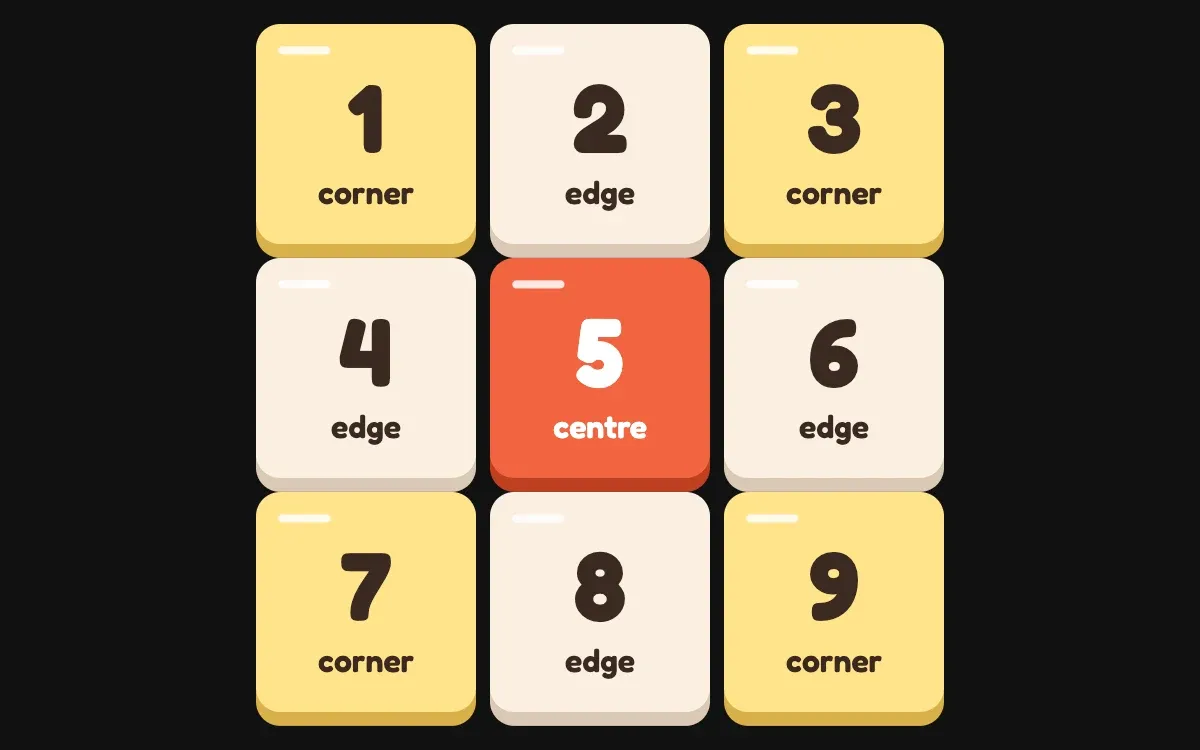
Number the squares 1 to 9 in reading order: the top row is 1, 2, 3, the middle row 4, 5, 6, and the bottom row 7, 8, 9. X always moves first and O second. Every line below uses these numbers.
2. How to never lose tic-tac-toe: win, block, fork, centre, corner
Run this from the top every turn and play the first step that applies. Print it and keep it beside the board.
- Win. Two in a row with the third square empty? Take it.
- Block. The other player has two in a row? Take the third square.
- Fork. If one move makes two threats at once, make it. They can block only one.
- Stop their fork. A fork square is one where their move would make two threats. With one fork square, take it. With two or more, play an edge if you hold the centre, otherwise take a corner among them.
- Centre. Take 5 if it’s free.
- Corner. Take a free corner, preferably the one opposite theirs.
- Edge. Take any free edge.
Two examples of step 4. Say X takes 1, you take 5, X takes 9: their fork squares are 3 and 7, and taking either one loses, so play an edge, such as 2. Or X takes 5, you take 1, X takes 9: their fork squares are 3, 6, 7 and 8, and the edges 6 and 8 lose, so take corner 3 or 7.
Why do edges come last? They sit on only two lines; the centre sits on four.
3. What is a fork? Two classic traps
A fork is one move that makes two threats: two lines with two of your marks and an empty third. The other player can block only one.
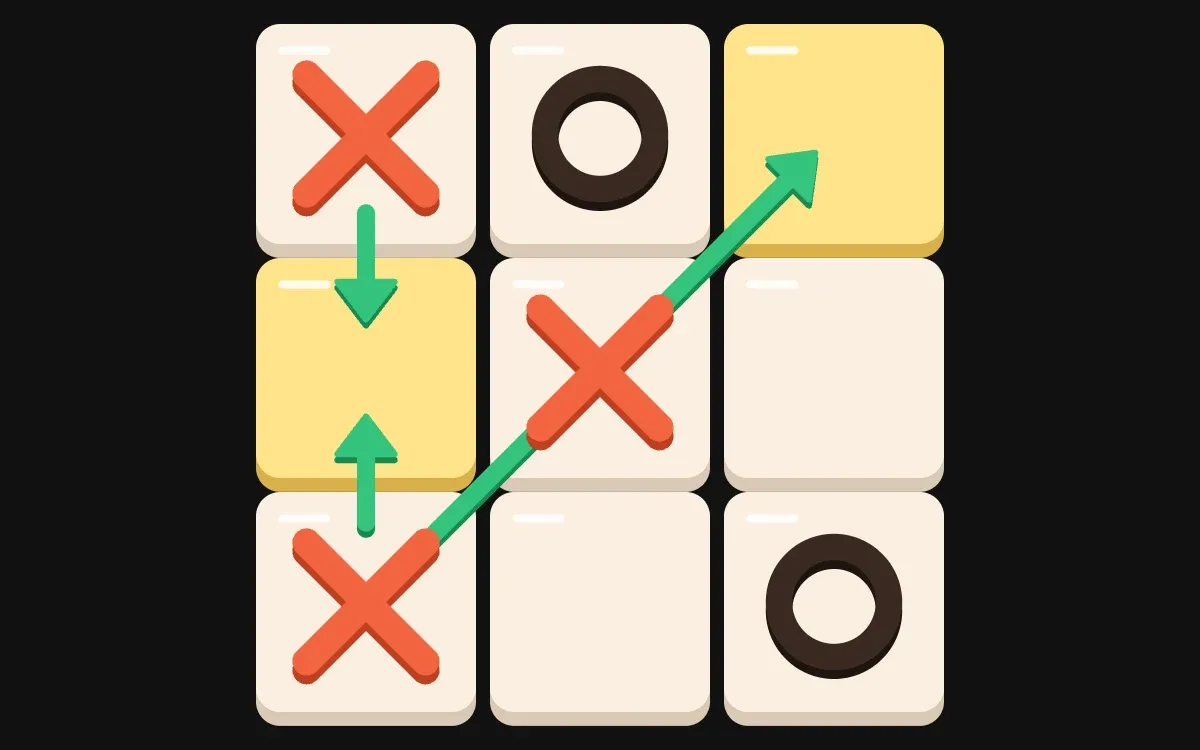
Trap 1 (X wins). X takes corner 1, and O replies with the edge 2, which loses. Then X takes 5, threatening 9, so O must block 9. X takes corner 7, threatening 4 (the column 1, 4, 7) and 3 (the diagonal 3, 5, 7). That’s a fork, and X wins.
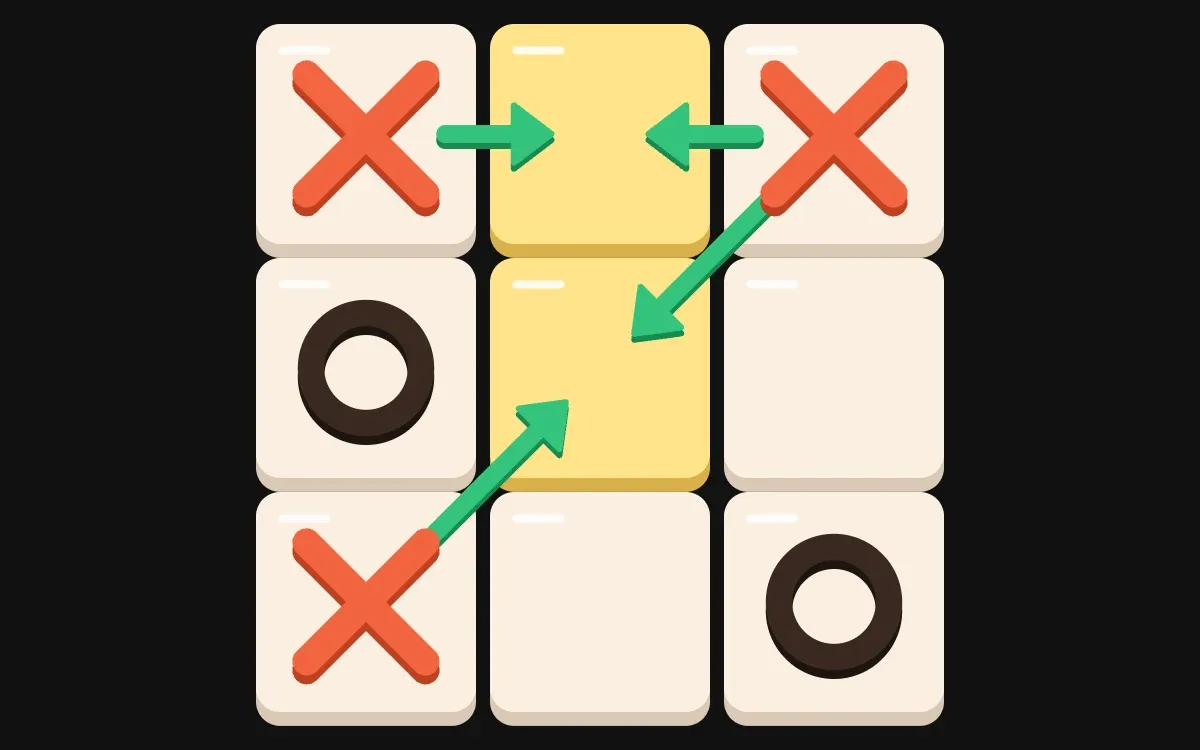
Trap 2 (X wins). X takes corner 1, and O replies with the opposite corner, 9. X takes corner 7, threatening 4, so O must block 4. Then X takes corner 3, threatening 2 (the top row) and 5 (the diagonal 3, 5, 7). That’s a fork, and X wins.
4. The best first move for X
A corner is the best first move for X. Why? It won’t win by force, but it leaves O the fewest ways to hold the draw. After a corner opening, only the centre holds (1 of O’s 8 replies), and the other 7 lose. Against a centre or edge opening, 4 of O’s 8 replies lose.
If X opens in corner 1 and O takes the centre, X plays the opposite corner, 9. O must take an edge to draw: if O takes a corner, X forks and wins.
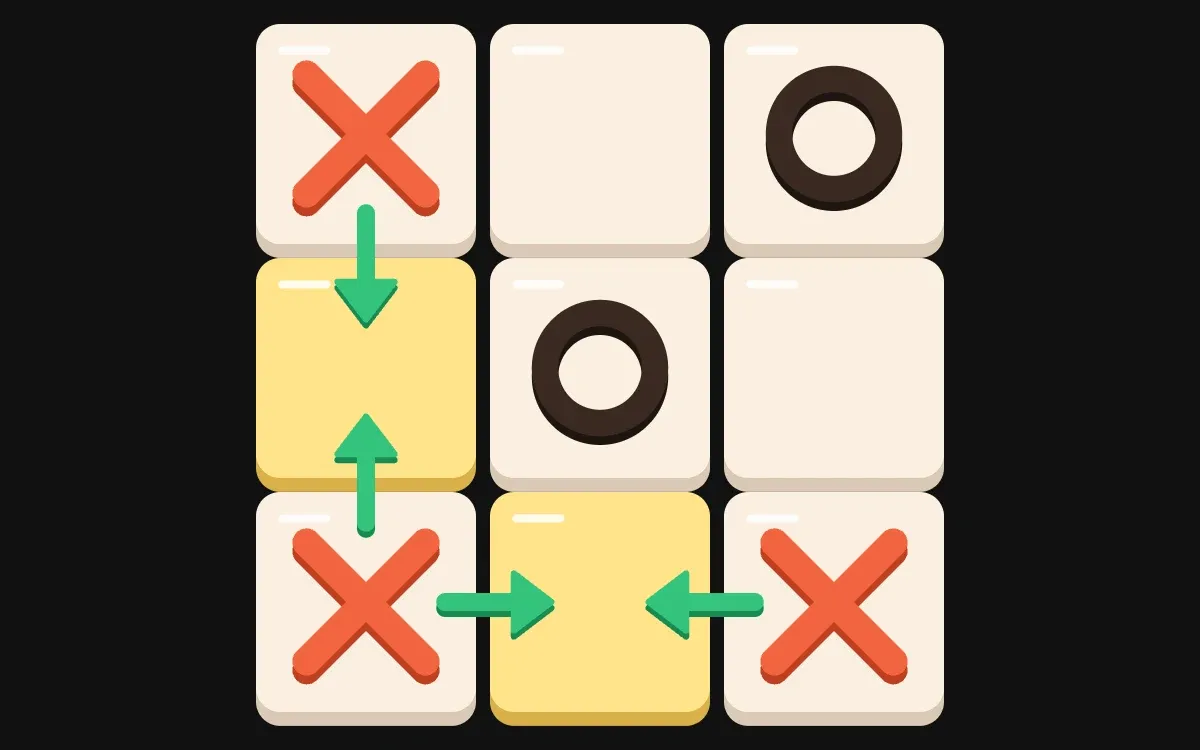
Trap 3 (X wins). X takes 1, O takes 5, X takes 9, O takes 3, and X takes 7. That blocks O’s diagonal 3, 5, 7 and threatens 4 and 8. It’s a fork, and X wins.
5. Playing second: the exact reply to every opening
If X moves first, reply like this:
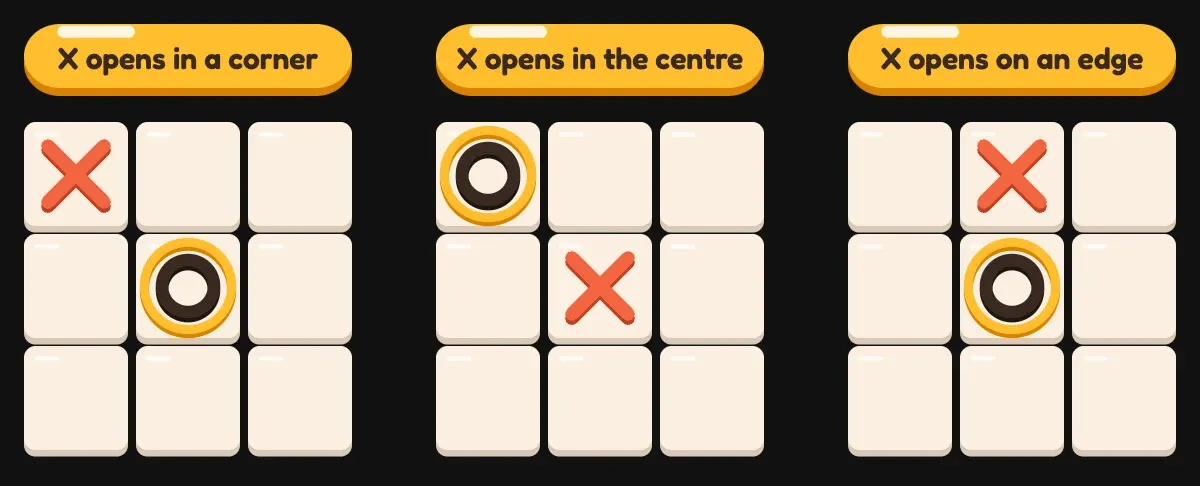
- X opens in a corner: reply in the centre, 5. Every other reply loses by force.
- X opens in the centre: reply in any corner. Every edge reply loses.
- X opens on an edge, say 2: reply in the centre, 5. The corners beside that edge (1 or 3) and the opposite edge (8) also hold. The other edges, 4 and 6, and the far corners, 7 and 9, lose.
After that, the checklist keeps you safe. One case to watch: when X holds two opposite corners and you hold the centre, play an edge, never a corner. After X takes 1, you take 5, and X takes 9, the corners lose and every edge holds.
6. How to win: three mistakes to catch
You can’t force a win against good play, but these three slips give you one.
- Mistake 1: O answers your corner with an edge, say X1, O2. The centre, 5, wins: O must block 9, then corner 7 forks, as in trap 1. Edge 4 and corner 7 win too.
- Mistake 2: O answers your corner with the opposite corner, 9. Then 3 or 7 wins, as in trap 2.
- Mistake 3: O answers your centre with an edge, say X5, O2. Take corner 1, threatening 9, so O must block. Then corner 7 forks, threatening 3 and 4.
If you opened and the reply isn’t a drawing one from section 5, you have a forced win: look for the fork.
7. Put it into practice
Play three games against a friend or a child: open in a corner once, answer as O with the centre or a corner once, and once try to set a trap.
Did you draw every time? Then you’ve mastered never losing. Want a bigger challenge? Try dots and boxes strategy. For more games on paper, see restaurant table games.