Word ladder games for two need only a pencil and paper, and a friend turns the puzzle into a race. You may know the word ladder as a solo puzzle, where you turn TIME into GAME one letter at a time. Here are three ways to play it against a friend, each with one clear rule and an example.
What you need for word ladder games for two
You need two players and a timer, plus a pencil and paper each.
A word ladder is a chain of words from a start word to a target word. Each step changes one letter, and every word must be a real everyday word. CAT to DOG takes 3 steps: CAT, COT, DOT, DOG.
Agree these house rules first: both words the same length, no names or abbreviations, no word used twice in one ladder, and a dictionary check for any disputed word.
New to ladders? How to solve a word ladder covers the basics and the shortest route, and word ladder puzzles has ready-made ladders to practise on.
According to Lewis Carroll, who wrote Alice’s Adventures in Wonderland, he invented the game on Christmas Day 1877 and meant it for two players. His diary first mentions it in March 1878, as “word-links”. It ran in the magazine Vanity Fair as “Doublets” from 1879.
Game 1: Set-a-Ladder Duel (fewest steps wins)
Each player secretly picks a start word and a target word of the same length, four letters being best. They write their own ladder on a folded slip, and its number of steps is the par. Swap the word pairs, not the slips. Each player then has three minutes to solve the other’s pair.
The score for a round is your steps minus the setter’s par. Lower is better:
| Your result | Score |
|---|---|
| Same as the par | 0 |
| One step longer | +1 |
| Two steps longer | +2 |
| One step shorter | -1 |
| No ladder in 3 minutes, or a broken rule | +3 |
If a setter’s slip has a wrong word or a broken step, the solver scores 0 for that pair and the setter takes the +3 penalty.
Play three rounds each. The lowest total wins. Totals tied? Play one sudden-death pair, chosen by a coin flip. The lower score wins, and if it’s still tied, play another.
Round 1. Ana sets POOL to MILL with par 4: POOL, POLL, TOLL, TILL, MILL. Ben also takes 4 steps. A quicker solver could find POOL, POLL, PILL, MILL in 3 steps and score -1. Ben sets TAIL to MILE with par 4, and Ana takes 5 steps.
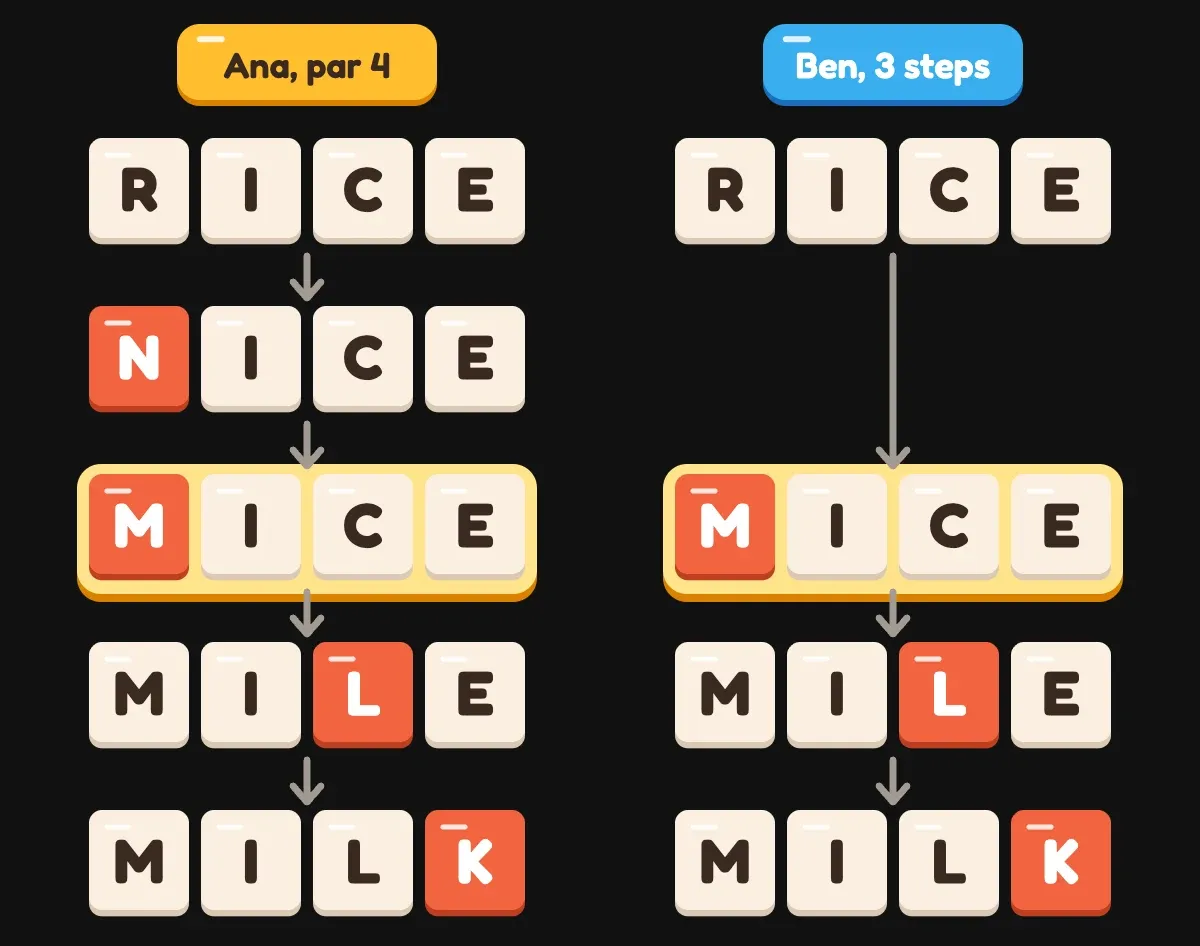
Round 2. Ana sets RICE to MILK and thinks it takes 4 steps: RICE, NICE, MICE, MILE, MILK. Ben finds a shorter one, RICE, MICE, MILE, MILK, in 3 steps.
| Round | Pair (set by) | Solved by | Steps | Score |
|---|---|---|---|---|
| 1 | POOL to MILL (Ana) | Ben | 4 | 0 |
| 1 | TAIL to MILE (Ben) | Ana | 5 | +1 |
| 2 | RICE to MILK (Ana) | Ben | 3 | -1 |
Totals after these three solves: Ana +1, Ben -1.
Game 2: Name the Link (the ‘on three’ game)
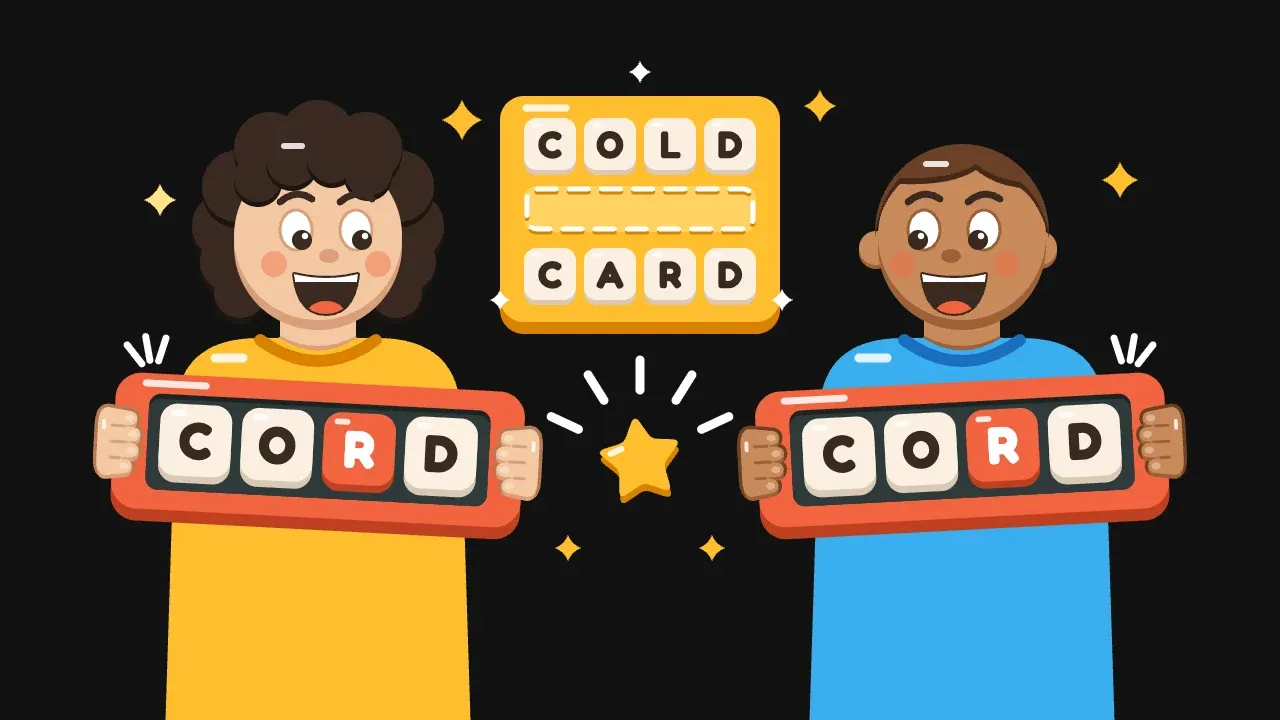
One player gives a start word and a target word that differ in exactly two letters, such as COLD and CARD. Both players write the one word between them on a slip, then show it on a count of three.
A real everyday word that links the two earns 1 point. A wrong or missing link earns 0. The first to 5 points wins. Players take turns setting the pairs.
Some pairs have one link: COLD to CARD has only CORD, and BIKE to LIME has only LIKE. Others have two good links: HOSE to ROPE takes HOPE or ROSE, and POOL to TOLL takes POLL or TOOL. The setter must accept either.
Three pairs:
- COLD and CARD: both write CORD, 1 point each.
- HOSE and ROPE: Ana writes HOPE and Ben writes ROSE. Both are right, 1 point each.
- BIKE and LIME: Ana writes LIKE and scores 1. Ben writes LINE, which is one step from LIME but not from BIKE, so it scores 0.
After three pairs, Ana has 3 points and Ben has 2.
Want a harder game? Pick a pair that differs in three letters. Each player writes both middle words, in order. Get both right and you score 2 points.
Work out each pair’s link yourself before you call it. A pair with no link? The round is void.
Game 3: Last Word Standing (last one to move wins)
Pick a start word. Players take turns changing one letter to make a new everyday word, and each word goes on a shared page. No word may be used twice. A player who can’t name a new word within 30 seconds loses.
Who wins? The last player to move, so the ladder grows as long as both can find words. Play best of five, alternating who moves first. Each game won scores 1 point. Steps don’t count.
Some words have only one neighbour. POEM connects only to POET, so if POET is already used, whoever moves from POET onto POEM leaves the other player stuck. Before you move, check the word you land on: if it touches a dead end like POEM, your opponent can move there and you’re stuck.
A played game, from COAT: Ana plays COST and Ben plays POST. Ana plays POET. That was the mistake. Ben plays POEM, and Ana has no new word, because POEM’s only neighbour, POET, is already used.
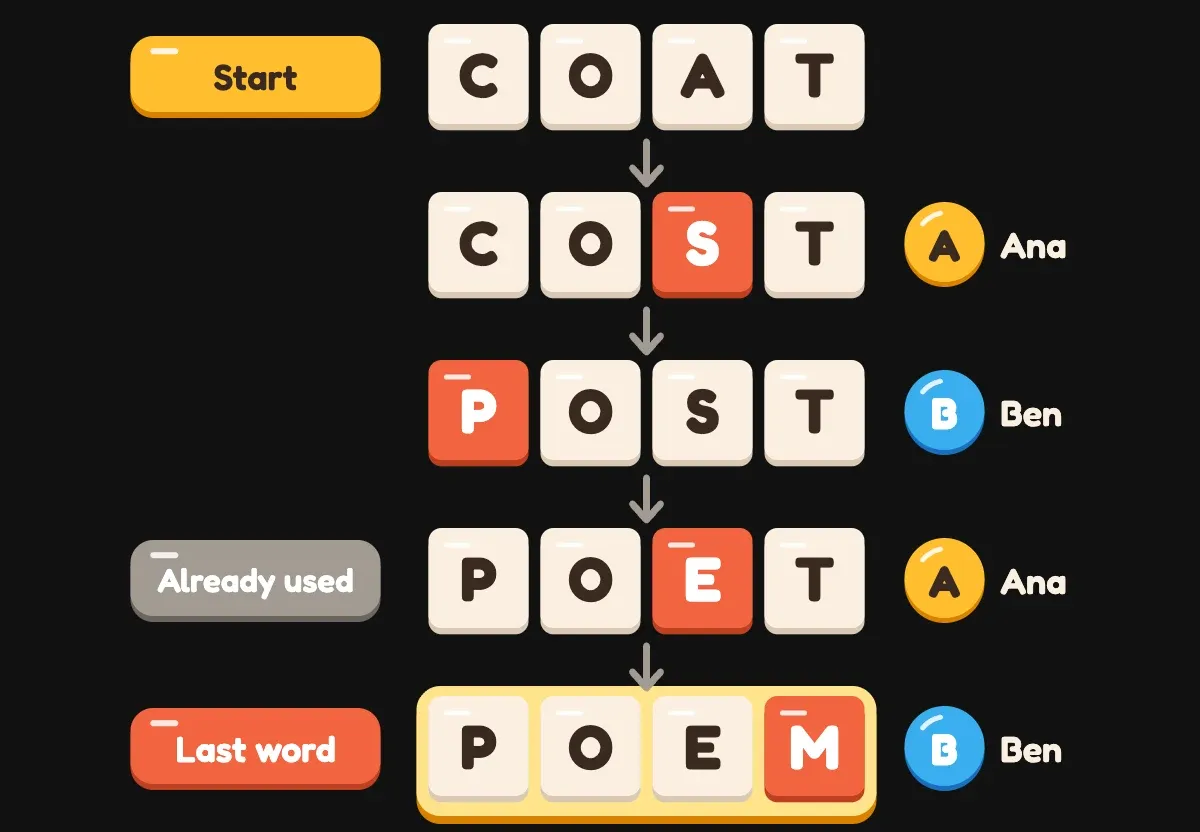
Some players prefer a longest-chain game: each builds a ladder alone for 2 minutes, and the longest chain with no repeated word wins.
How to pick fair start and target words
- Use the same length for both words: four letters suit new players, five suit experienced ones.
- Know a ladder of 4 to 6 steps before you set a pair, and write it down. Under 3 steps is over too fast; over 6 often gets stuck.
- Pick common, friendly words. Avoid words with few neighbours. OKAY and UPON have none, so no ladder can reach them.
- Check that your own ladder is the shortest you can find, using the method in how to solve a word ladder. Don’t reuse a pair from word ladder puzzles.
- Is one player much quicker? The setter gives the slower solver the pair with par 5 and the quicker solver par 3. A higher par helps the solver.
Which game should you play first?
- Game 1 for a long, thoughtful session of about 10 minutes.
- Game 2 for a quick game on a bus, about 2 minutes.
- Game 3 for a game with almost no setup: one start word.
Which one beat you? Try one today, and find ten ladders to practise on in word ladder puzzles.