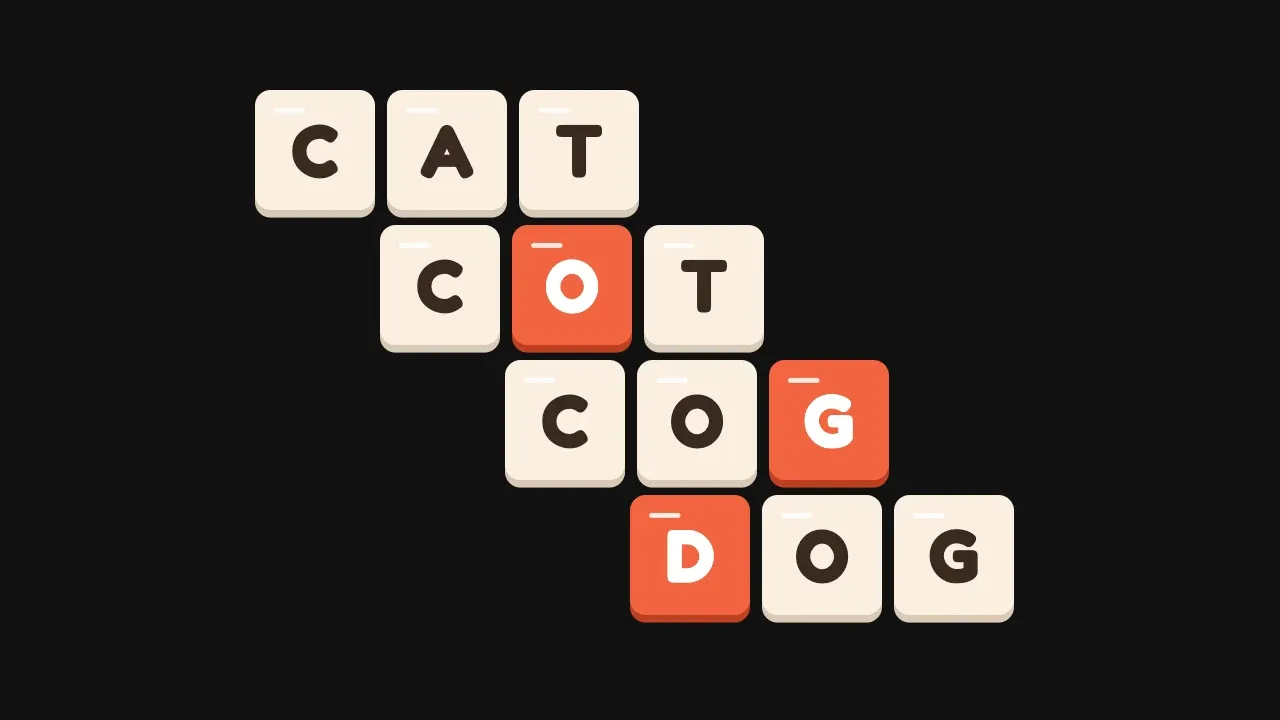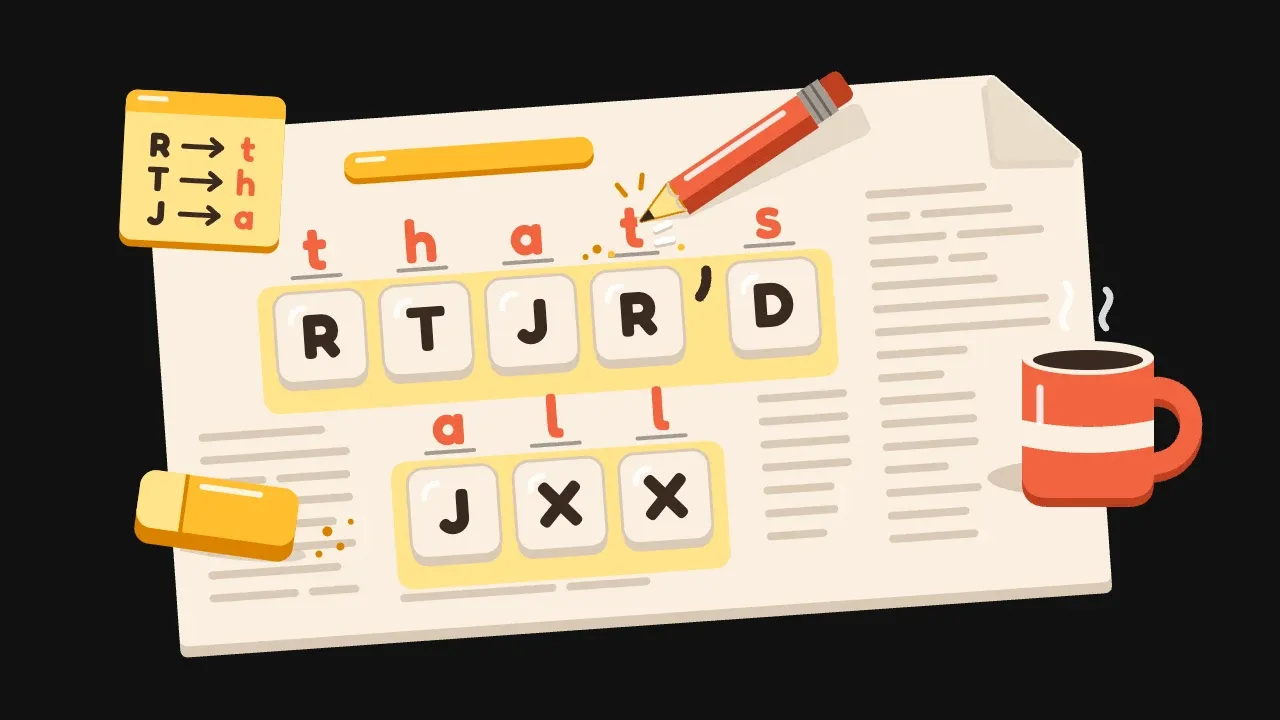
Learning how to solve a word ladder takes more than guessing letters. Guessing works for a while, then you hit a dead end and can’t tell whether your ladder is the shortest. Below is one repeatable method that finds the shortest ladder, using everyday words, with two worked examples and three ladders to try. For the rules and ten puzzles, see word ladder puzzles.
1. Count the letters that differ
Each step changes one letter, and every rung is a real everyday word. Every position where two words differ needs at least one step. So the number of differing letters is the fewest steps you could possibly need.
LAMP to FIRE differs in all four letters, so no ladder can be shorter than 4 steps. LAMP, LAME, FAME, FARE, FIRE takes exactly 4, so it’s as short as any. Match the count, and you can prove you’re done. No match? Read on.
2. How to solve a word ladder: neighbour lists from both ends
A neighbour is a word one letter away. Write the neighbours of the start word in one list, and the neighbours of the end word in another. Look for a word that’s in both lists, or a word in one list that is one letter away from a word in the other. If you find one, join the two halves: that’s your ladder.
No join? Grow one list by a level. Write the neighbours of its words, then check again. Keep going, one level at a time.
Why is this the shortest? You grow level by level and stop at the first join, so no shorter join was missed. Count the steps like this: steps out from the start + steps out from the end + 1 for the join. If the join word sits in both lists, leave out the +1.
By hand you only list words you’d recognise, so what you prove is the shortest ladder with everyday words.
3. Worked example: MILK to CAKE
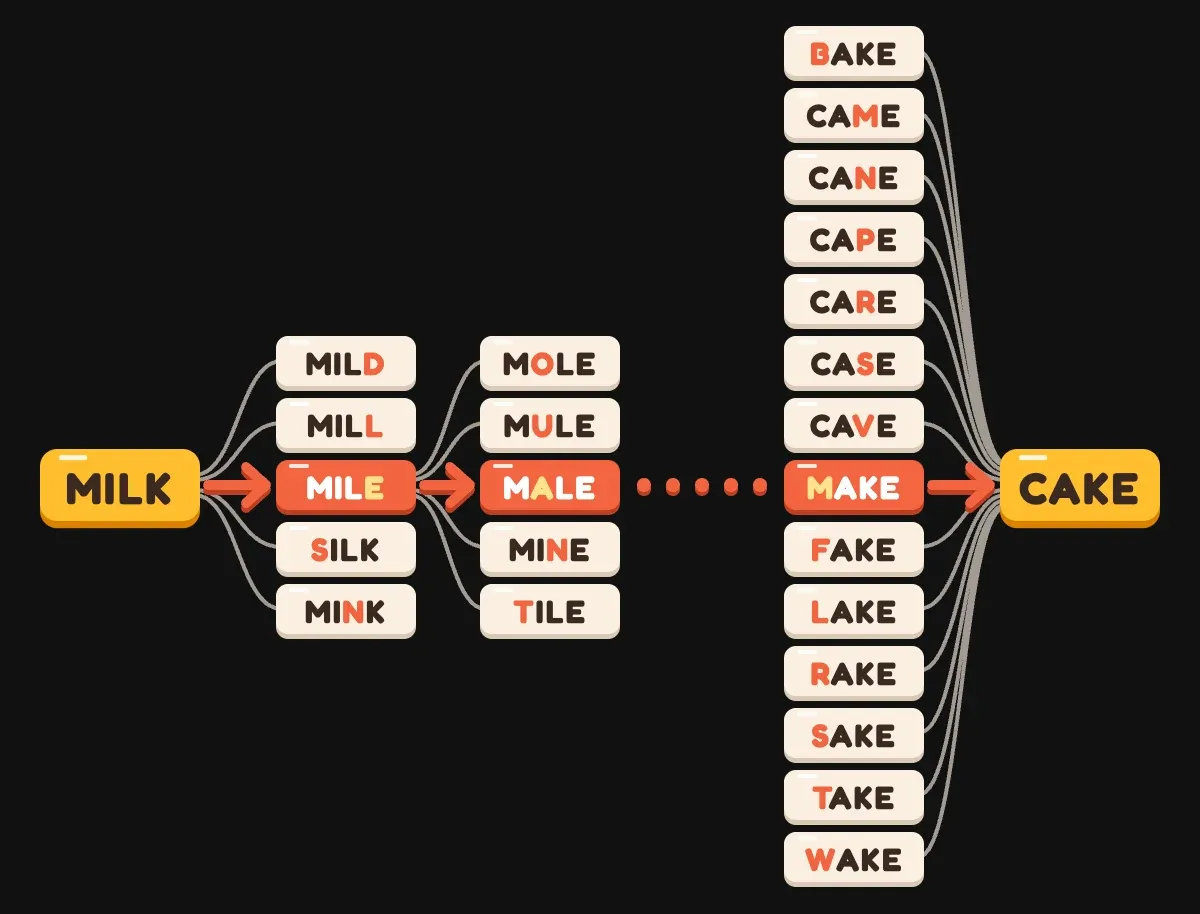
All four letters differ (M/C, I/A, L/K, K/E), so the count is 4 steps.
MILK has the neighbours MILD, MILE, MILL, SILK and MINK. CAKE has many more, among them BAKE, CAME, LAKE, MAKE and TAKE. No word in one list is in the other, and none is one letter from a word on the other side. So the join lies further out.
Grow MILK, the shorter list. MILE gives MALE, among others. MALE is one letter from MAKE, which is in the CAKE list. That gives the ladder MILK, MILE, MALE, MAKE, CAKE.
Check each step by its changed letter: K becomes E, I becomes A, L becomes K, M becomes C. MALE is two steps out from MILK, MAKE is one step out from CAKE, and the join adds one: 2 + 1 + 1 = 4. Four matches the count, so it’s the shortest.
4. Worked example: BIRD to NEST (when the count is not enough)
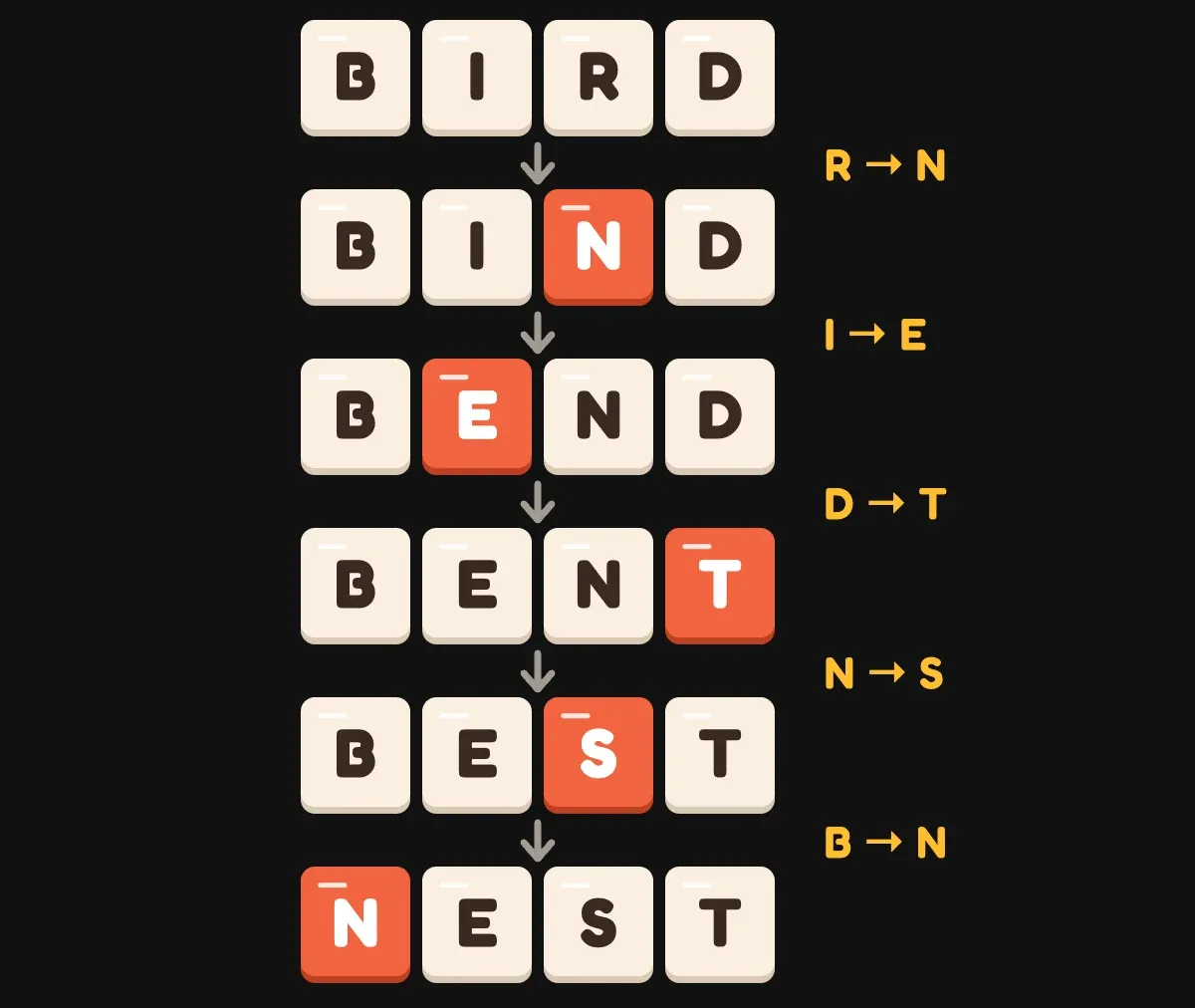
All four letters differ, so the count is 4. But the shortest ladder takes 5 steps. The count is a minimum, not a promise. The lists show why.
BIRD has two everyday neighbours, BARD and BIND. NEST has many, including BEST, NEAT, NEWT and REST. Is any word in both lists? No. Is any one letter from a word on the other side? No.
Grow BIRD one level: BIND gives BEND, KIND and WIND, among others. Still no join. Then grow NEST one level: BEST gives BENT, BEAT and BELT. Now BEND, from BIND, and BENT, from BEST, are one letter apart, so they join.
The ladder is BIRD, BIND, BEND, BENT, BEST, NEST. That’s two steps out from BIRD, two out from NEST, and one for the join: 5 steps. With everyday words, no 4-step ladder exists.
5. Tips that save time
- Grow the shorter list first. BIRD has two everyday neighbours and NEST has eleven, so grow BIRD.
- Drop dead ends. ICON has one neighbour, IRON, and UGLY has none you’d use. If a word leads nowhere, cross it out.
- Use blanks, not the whole alphabet. For MIL_, try the vowels and a few common consonants: MILD, MILE and MILL.
- Back up when stuck. Return to the last word that still had untried neighbours. Your lists show where.
- Agree the word list first. Use everyday words, not names, abbreviations or rare words. Agree before you start, and the shortest ladder is the same for everyone.
6. Three ladders to try
Write both lists and compare with the count before you open an answer. Each answer box shows the ladder and one line on why it is the shortest.
1. CARD to GAME (3 steps)
Change CARD into GAME, one letter at a time.
Show the answer
CARD, CARE, CAME, GAME. Three letters differ (C/G, R/M and D/E), so 3 is the least possible, and this ladder reaches it.
2. VASE to LAMP (4 steps)
Change VASE into LAMP, one letter at a time.
Show the answer
VASE, CASE, CAME, LAME, LAMP. Only 3 letters differ, but every 3-step route needs a rare word or a non-word, so 4 is the shortest with everyday words.
3. GOLD to RING (5 steps)
Change GOLD into RING, one letter at a time. Hint: GOLD has many neighbours, so try GILD first.
Show the answer
GOLD, GILD, WILD, WIND, WING, RING. All 4 letters differ, but every 4-step ladder needs a rare word, such as GOND, or a non-word, so with everyday words the shortest is 5.
Put it into practice
Pick two words of the same length and count the letters that differ. Then write both lists and see where they meet. Challenge a friend to find a ladder shorter than yours.
For ten more ladders, with answers, see the word ladder puzzles post. Want habits that work on any puzzle? Read how to get better at logic puzzles.