A cryptogram is a short message in which every letter has been swapped for another, always the same swap. Want to know how to solve a cryptogram? Find the small words and patterns first, then fill in every copy of each letter you’ve worked out. That takes six steps: count the one-letter words, find the short common words, use apostrophes and endings, use letter patterns, count letters (carefully), then fill in every copy and re-read. One whole puzzle solved from start to finish comes after them, then three for you to try.
What is a cryptogram (and what’s a cryptoquote)?
A cryptogram is a puzzle made of a short piece of encrypted text. Wikipedia says it’s usually a substitution cipher, where each letter is replaced by another letter, number or symbol, and that these days it’s mostly printed for fun in newspapers and magazines. You’ll also meet them in puzzle books and on puzzle sites and apps.
The rules come from the National Puzzlers’ League, whose cryptograms work like this:
- One plain letter becomes one cipher letter, every time. If X stands for E, then X stands for no other letter, and no other letter stands for E.
- A letter never stands for itself.
- Punctuation and the gaps between words stay where they are.
So if every A were written as Q, every A in the message would be a Q, and no other letter would be one. A cryptoquote is the same puzzle with a famous quote as the message. The method doesn’t change.
The simplest substitution is a shift, where every letter moves the same number of places. The Roman writer Suetonius says Julius Caesar wrote private letters by putting D for A and so on through the alphabet, a shift of three, and Wikipedia names the Caesar cipher after him. You can try an easier shift, of one place, in the one-step letter code of the escape-room post. A normal cryptogram uses a scrambled alphabet instead. Wondering where cryptograms sit among other word puzzles? See the types of word games.
1. Count the one-letter words
Look for one-letter words first, because in English a one-letter word is A or I. Puzzle Baron and Dummies both tell you to solve these first. Wikipedia adds “and sometimes O”, so keep that as a last resort.
Which is it? If the message is a quote in someone’s own voice, I is a good guess. In a statement about the world, A is likelier. That’s reasoning, not a rule, so write your guess in pencil.
2. Find the short common words
Short words give you whole letters at once. Dummies says two-letter words usually have one vowel and one consonant, and the most common are OF, TO, IN, IS and IT. The most common three-letter words are THE, AND, FOR, WAS and HIS, and the most common four-letter word is THAT.
THE is the most common word in English. Peter Norvig’s count of Google Books puts it at 7.14% of all word mentions, ahead of OF, AND, TO and IN. So a three-letter cipher word that shows up more than once is a good first guess for THE or AND. It’s a likelihood, not a certainty, and a short puzzle may not have one.
The American Cryptogram Association (ACA) adds another habit: read the puzzle’s title and think of words that might go with it.
3. Use apostrophes and word endings
An apostrophe narrows things a lot. According to Puzzle Baron, the letter after it is S, T, D, M, LL, RE or VE, and a possessive only ever uses S. If that letter is T, the one before it is almost always N, as in DON’T and CAN’T.
Endings help too. The ACA’s beginner guide lists common endings such as -ing, -ion, -tion, -ed and -ment, and beginnings such as re-, un-, in-, pre-, pro- and th-. A cipher word ending in a three-letter group that repeats elsewhere could well be -ing.
Watch for double letters as well. Doubles like LL, EE, SS, OO and TT turn up often, though the sources don’t agree on which comes first, so don’t lean on one.
4. Use letter patterns
A word’s pattern is which of its letters repeat. Give the first letter A, each new letter the next one up, and a repeated letter the one it already has. The ACA does this with numbers (that is 1231). Letters read easier:
| Word | Pattern |
|---|---|
| THAT | ABCA |
| ALL | ABB |
| DOOR | ABBC |
| THERE | ABCDC |
| LITTLE | ABCCAD |
| PEOPLE | ABCADB |
| LETTER | ABCCBD |
Different words can share a pattern. Wikipedia points out that TATER, NINTH and PAPER are all ABACD. Why use patterns as a test? A cipher word keeps the pattern of the plain word, so if a guess repeats a letter the cipher word doesn’t (or the other way round), the guess is wrong.
5. Count letters (but don’t trust it on short puzzles)
In long English text the commonest letters run E, T, A, O, I, N, then S, R and H. Three separate counts agree on the first six: Cornell’s Math Explorer’s Project gives E as 12.02%, Wikipedia quoting Lewand’s Cryptological Mathematics gives 12.7%, and Norvig gives 12.49%. The ACA says the same group, ETAONIRSH, can help you identify a letter. The rarest letters (X, Q, J and Z) sit at roughly 0.07 to 0.17% in the Cornell count, so save them for last.
There’s a catch. Wikipedia’s frequency analysis page notes that shorter messages show more variation, and Dummies says the commonest cipher letter is probably E, but T, A or O are possible, especially in short puzzles. A 40-letter quote may not follow the table. Use counts to break a tie between two guesses, never as your opening move. The worked example below shows one going wrong.
6. Fill in every copy, then re-read
After each guess, write that letter over every copy of the cipher letter, as puzzles-to-print.com advises. If a word turns into something impossible, back out of the guess.
A strip helps: write the alphabet in a row, and under each cipher letter you’ve solved, its plain letter. Wikipedia notes that this key form usually isn’t printed with a puzzle, but you can draw one yourself. Use it for two checks. No plain letter can come from two cipher letters, and no cipher letter equals its own plain letter.
How do you tell a good guess from a bad one? A good one makes other words readable. A bad one makes nonsense, so undo it and everything you built on it.
A worked example, start to finish
Here’s one original puzzle, 44 letters long. Cipher letters are in capitals and plain letters in lower case.
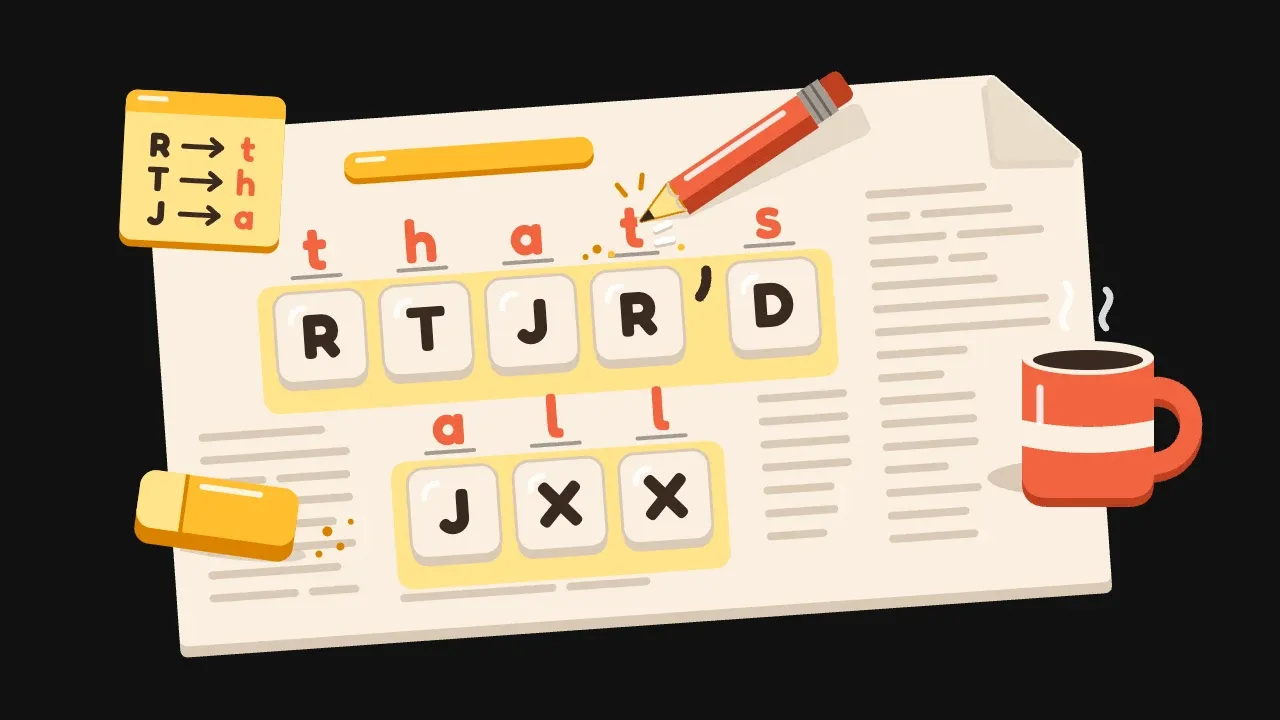
J RZQE UALI AYRHQ AGHQD RTH IAAL, JQI RTJR’D JXX ZR RJNHD.
The words and their patterns:
| Cipher | Pattern | Cipher | Pattern |
|---|---|---|---|
| J | A | RTH | ABC |
| RZQE | ABCD | IAAL | ABBC |
| UALI | ABCD | JQI | ABC |
| AYRHQ | ABCDE | RTJR’D | ABCA’D |
| AGHQD | ABCDE | JXX | ABB |
| ZR | AB | RJNHD | ABCDE |
Step 1: the one-letter word. J stands alone, so it’s a or I. Try J = a in pencil, and write a over every J.
Step 3: the apostrophe. RTJR’D has the pattern ABCA’D with one letter after the apostrophe. A four-letter word that starts and ends with the same letter, with a as its third letter, is that, so that’s fits. That gives R = t, T = h and D = s, and the a in the third place agrees with J = a. Fill in every R, T and D.
Step 2: a three-letter word. RTH is now t, h and one unknown. It’s the, so H = e. Fill in every H.
Step 4: patterns catch a wrong guess. JQI is a??, so and is the obvious guess for it. But look at JXX. It’s also a??, and its pattern is ABB. And has no repeat, so JXX can’t be and. JXX is all, so X = l. Then JQI can still be and, because its pattern is ABC. That gives Q = n and I = d.
Step 4 again. IAAL is d, then a double letter, then one more. The pattern is ABBC and the first letter is d, so it’s door: A = o and L = r.
Step 6: the small ones. ZR is ?t. No plain letter can come from two cipher letters, and a is taken by J, so it isn’t at. It’s it, so Z = i.
Step 6: the rest. AYRHQ reads o?ten, so it’s often and Y = f. AGHQD reads o?ens: opens, G = p. RJNHD reads ta?es: takes, N = k. RZQE reads tin?: tiny, E = y. UALI reads ?ord: word, U = w.
Step 5: why counting didn’t lead. The commonest cipher letter is R, seven of 44 letters (16%), so the table would have you try R = e. It’s t. The real e, H, appears only four times (9%), the same as Q. On a puzzle this short, counting would have misled you.
The finished message: A TINY WORD OFTEN OPENS THE DOOR, AND THAT’S ALL IT TAKES. The strip you’d have built:
| Cipher | A | D | E | G | H | I | J | L | N | Q | R | T | U | X | Y | Z |
|---|---|---|---|---|---|---|---|---|---|---|---|---|---|---|---|---|
| Plain | o | s | y | p | e | d | a | r | k | n | t | h | w | l | f | i |
You don’t have to take the steps in order, as this example shows. Take whatever the puzzle offers you.
Read the whole message aloud as a last check. Does it make sense? Then you’re done, though a very short cipher can read several ways. The Handbook of Applied Cryptography says about 28 letters is the theoretical amount a substitution cipher needs, and that as few as 25 letters is enough for a skilled cryptanalyst. Wikipedia says text longer than that is assumed to have one meaningful reading, and its substitution cipher page says “typically about 50 letters” in practice. Where does that leave this puzzle? It has 44 letters: above the theoretical amount, below the practical 50.
What to do when you’re stuck
- Switch words. Leave the stubborn one and go back to a short word you haven’t tried.
- Pick the longest word with the most known letters. Gaps like o?ten are easier than ??????.
- Check the endings. A word that finishes with a letter you know may end in -ed, -ing or -ly.
- Doubt a “solved” letter. If a guess seemed right but leaves an impossible word, it may be the guess. Back it out.
- Read it aloud, or take a break. Hearing the half-filled sentence can show the missing word. Stepping away is one of the habits for logic puzzles.
Cryptic crosswords are a different puzzle, so don’t mix them up. Their clues hide an answer in wordplay, and the cryptic crossword clues post covers them.
Three cryptograms to try
Write your guesses above the letters in pencil, and open an answer only when you’ve finished or you’re stuck. Each was checked by encrypting it and decoding it again.
1. Easy: a shift
Every letter here moves the same number of places, the kind of shift Caesar used. Once you find one pair, the rest follow.
ORRN IRU WKH VKRUW ZRUGV ILUVW.
Hint: WKH is a three-letter word that’s probably the, so W stands for t. Count how many places t is from W.
Show the answer
LOOK FOR THE SHORT WORDS FIRST. Each cipher letter is three places further on than its plain letter, so L becomes O, and you read back by counting three letters earlier.
2. Medium: a scrambled alphabet
P CPUV M OQPVL SQRRCV GPLD WF LVM, MEZ P EVYVT TQID.
Hint: P and M are one-letter words, so they’re a and I in some order. One of them also appears near the end. Then look at the double letters RR.
Show the answer
I LIKE A QUIET PUZZLE WITH MY TEA, AND I NEVER RUSH. P is i (it appears again before NEVER) and M is a. The double RR is the ZZ in PUZZLE.
3. Harder: no one-letter word
IQVTKJOK GKQVL LIKKF BCKJ HKVVKNL CTFK TJ IHQTJ LTRCV.
Hint: TJ is a two-letter word, and IN is a common one. KK is a double letter, and it’s the most frequent letter in the message.
Show the answer
PATIENCE BEATS SPEED WHEN LETTERS HIDE IN PLAIN SIGHT. The key is T = i and J = n, from the hint. Then IQVTKJOK is eight letters with the pattern ABCDEFGE, so it’s patience, with K = e.
Need a break from letters? Try the free puzzle games in your browser, with no download and no account. Or try another word puzzle, a word ladder.
Frequently asked questions
What is the trick to solving cryptograms?
Start with the pieces that give the most away: one-letter words, short common words like THE and AND, apostrophe endings, double letters and letter patterns. Pencil in each guess and fill in every copy of the letter, then undo any guess that makes an impossible word.
What are the most common letters in a cryptogram?
In long English text the order is E, T, A, O, I, N, then S, R and H, with E making up about 12 to 12.7% of letters. A short puzzle can break that order, so use it only as a tie-breaker.
Which single-letter words can you use to start?
In English a one-letter word is A or I. Wikipedia adds that it is sometimes O, so keep that as a last option.
Is a cryptogram the same as a cryptoquote?
A cryptoquote is a cryptogram whose hidden message is a famous quote. The code and the solving method are the same.
Can a cryptogram have more than one solution?
A cipher always decodes, and with enough text only one reading makes sense. The Handbook of Applied Cryptography puts that at about 28 letters in theory, and Wikipedia says about 50 in practice, so a very short cipher can read several ways.
Sources
- Cryptogram (Wikipedia)
- What is a cryptogram? (National Puzzlers' League)
- Beginner's Guide to the American Cryptogram Association (ACA)
- How to Solve a Cryptogram (puzzles-to-print.com)
- How to Solve a Cryptogram (Puzzle Baron)
- Cryptography 101: Basic Solving Techniques for Substitution Ciphers (Dummies)
- English Letter Frequency (Cornell Math Explorer's Project)
- English Letter Frequency Counts: Mayzner Revisited or ETAOIN SRHLDCU (Peter Norvig)
- Letter frequency (Wikipedia)
- Frequency analysis (Wikipedia)
- Substitution cipher (Wikipedia)
- Unicity distance (Wikipedia)
- Handbook of Applied Cryptography, chapter 7 (Menezes, van Oorschot, Vanstone)
- Caesar cipher (Wikipedia)
- Suetonius, Life of Julius Caesar (LacusCurtius)