There are many types of word games, and it’s hard to tell which ones you’d enjoy. Below are five main types and a sixth group of two close cousins. Each gets a rule, a tiny example, who it suits and a first step. A quick chooser comes at the end.
1. Anagrams: rearrange the letters
Rule: use every letter of a word once to make a different word. LISTEN becomes SILENT, because both use the same six letters: E, I, L, N, S, T. Another pair is LEMON and MELON.
Best for: quick puzzles, and anyone with a pencil to hand. Difficulty: easy to start, harder as the words get longer.
First step: write the letters in a circle instead of a line. The order then stops pulling you toward the scramble.
Try it: unscramble CIGRAL.
Show the answer
GARLIC. Every letter of CIGRAL is used once, and no other common word has the same letters.
Second try: unscramble LICPEN.
Show the answer
PENCIL. Every letter of LICPEN is used once, and no other common word has the same letters.
2. Word ladders: change one letter at a time
Rule: turn a start word into an end word by changing one letter per step. Every step must be a real word, and every word must have the same length.
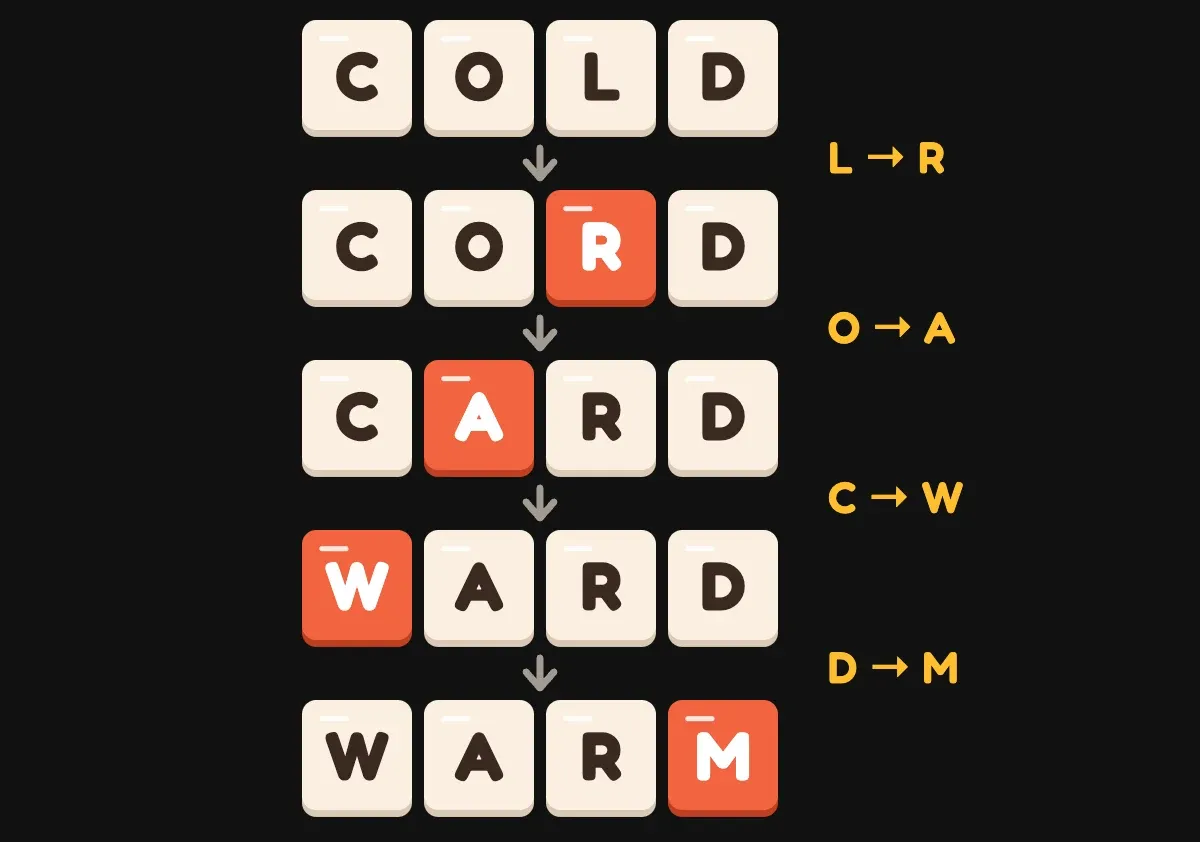
COLD becomes WARM in four steps. Each step changes one letter. COLD and WARM differ in all four letters, so four steps is the fewest possible.
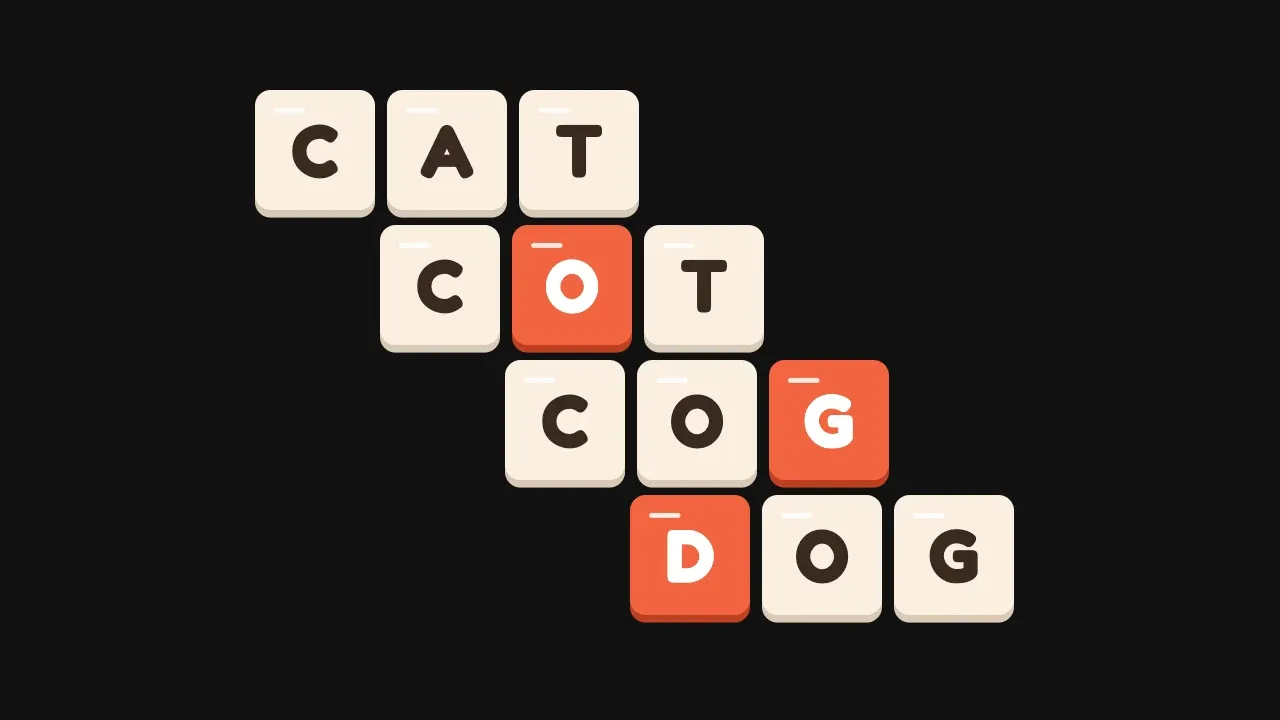
A shorter example: CAT, COT, DOT, DOG takes three steps.
The game is old. Lewis Carroll devised it about Christmas 1877 and first called it Word-Links. His puzzles ran as Doublets in the magazine Vanity Fair from 1879.
Best for: players who like a path to follow. Difficulty: easy to medium.
First step: work from both ends at once. Want more to try? See word ladder puzzles. For the method, see how to solve a word ladder.
3. Cryptograms: decode a secret message
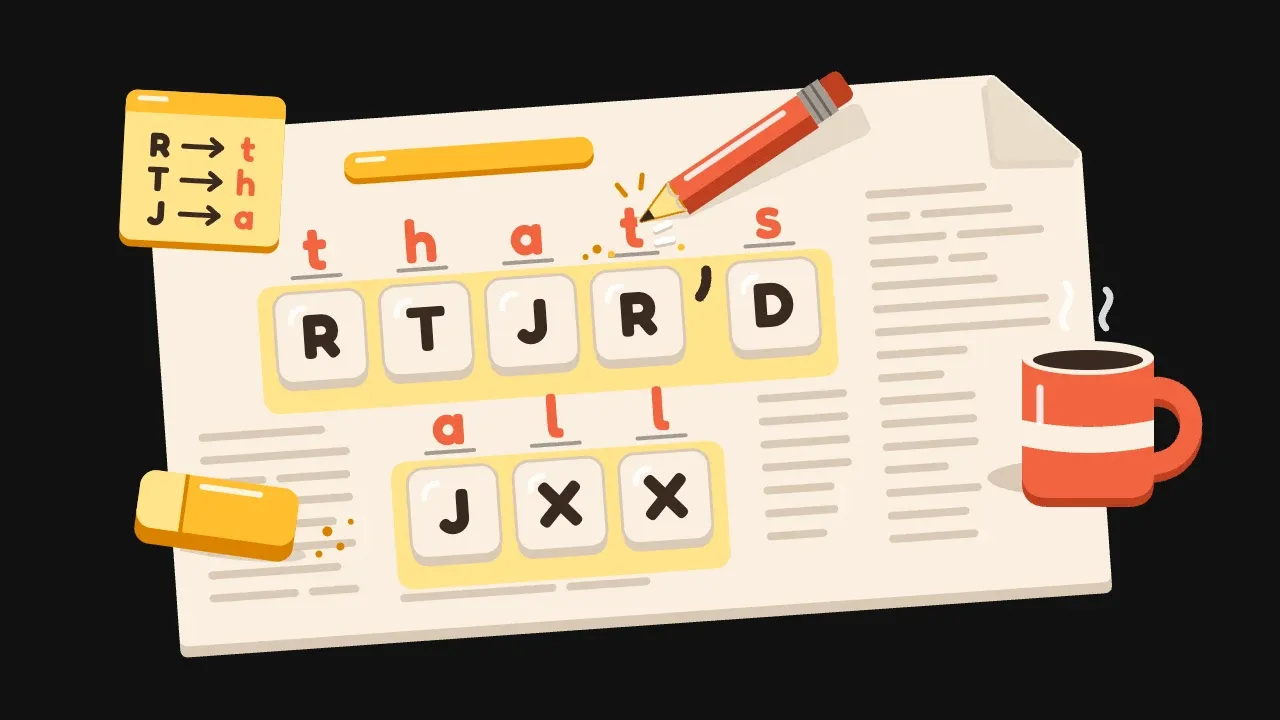
Rule: every letter of a sentence has been swapped for another letter, and the swap is always the same. Work out the swaps and you can read the sentence. That’s a substitution code.
Here’s the key: the keyboard read row by row, QWERTYUIOPASDFGHJKLZXCVBNM. A becomes Q, B becomes W, C becomes E, and so on. The coded line Q WOKR OF ZIT IQFR decodes to A BIRD IN THE HAND.
To solve it, start with the one-letter word. A one-letter word is A or I, and here Q is A. Next, ZIT at the start of a phrase is often THE, so I is H and T is E. Then IQFR fits HAND, using the letters you already know.
Best for: patient solvers who like codes. Difficulty: medium.
First step: find the one-letter words and any short word that appears more than once.
Try it: the hint is Z = T. Decode ZIT WTLZ HSQF OL Q LODHST GFT.
Show the answer
THE BEST PLAN IS A SIMPLE ONE. The hint gives ZIT as THE and WTLZ as BEST. The rest follow from the same swaps.
4. Guessing games: find the hidden word
Rule: a word is hidden, you guess letters or whole words, and each guess teaches you something. There are two common shapes: hangman, where you guess one letter at a time and the wrong guesses are limited; and five-letter guessing games, where you guess a whole five-letter word and each letter gets a mark.
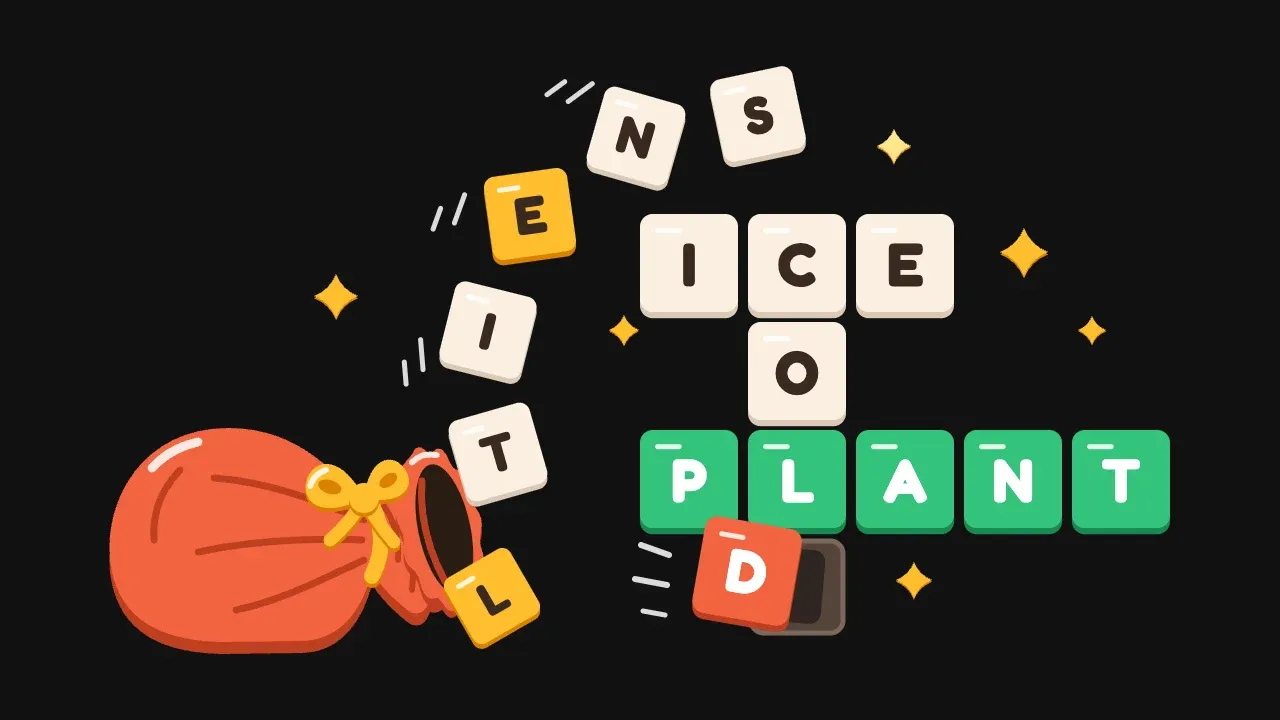
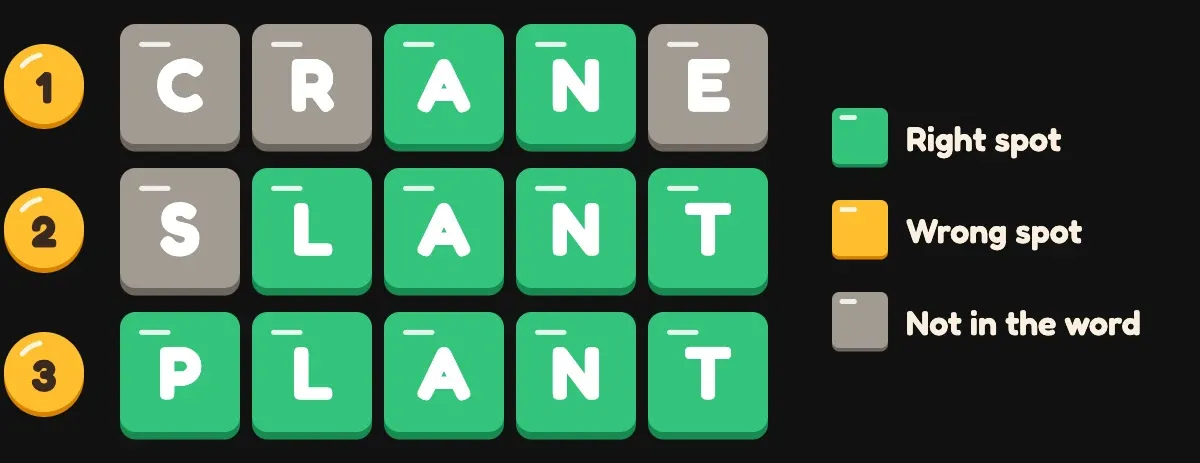
Say the hidden word is PLANT and your first guess is CRANE. C and R aren’t in the word, and neither is E. Which letters are in the right spots? A and N, third and fourth. So the pattern tells you the word has A and N there. Your next guess, SLANT, gets L, A, N and T in their right spots, and S isn’t in the word. One more guess, PLANT, gets all five right.
Best for: people who like deduction and short rounds. Difficulty: easy to medium.
First step: start with a word that has common, different letters. Which letters should you guess first in hangman? See hangman strategy.
5. Crosswords: fill a grid from clues
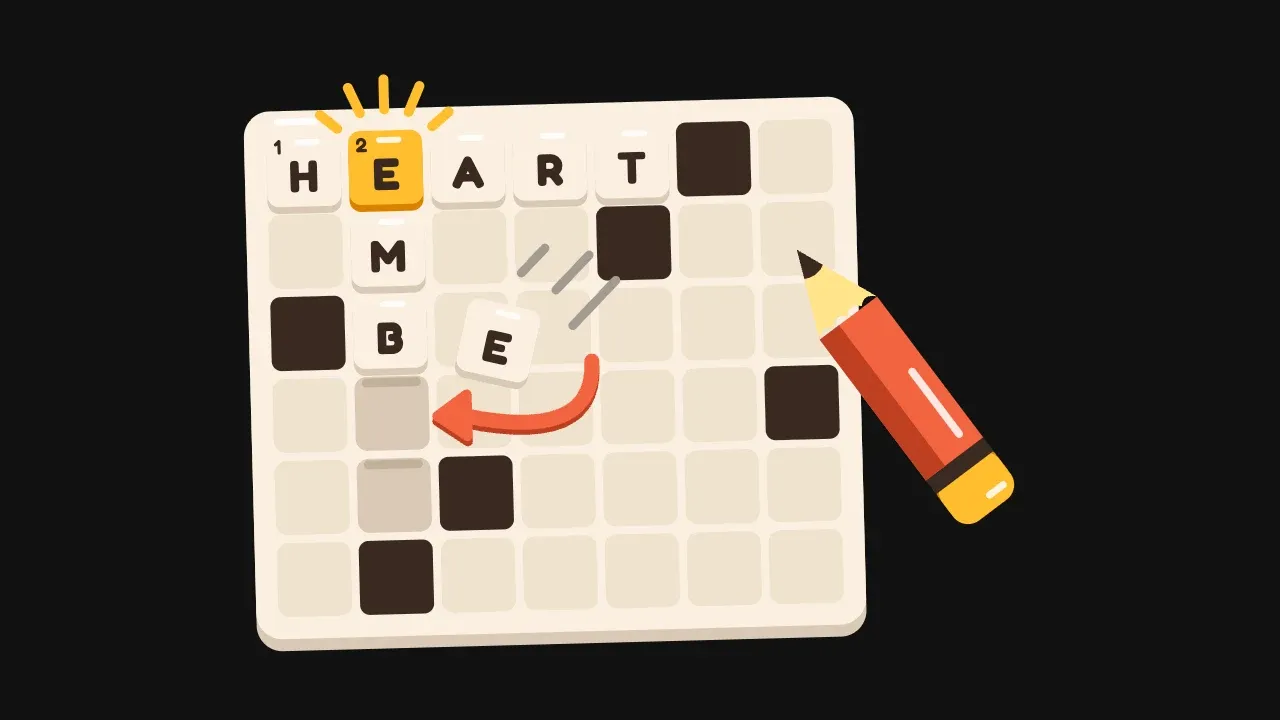
Rule: each clue has a number of letters. The answers cross, so a letter you know from one answer helps you with the other.
Take the clue “Frozen water (3)”. The answer? ICE. Its middle letter is C. If a down answer crosses at that C and starts there, you already know its first letter.
Best for: people who like general knowledge and wordplay, and have a bit of time. Difficulty: easy to hard, set by the puzzle.
First step: start with the short clues and the fill-in-the-blank ones. Want six beginner tips? See how to solve a crossword.
6. Hidden words: find them inside
Rule: two close cousins, both easy to start. A word search asks you to find listed words hidden in a grid of letters. Words in a word asks you to make as many small words as you can from the letters of one long word.
From CHOCOLATE you can make COCOA, COAT, CLOT and LATE, since each uses only letters CHOCOLATE has. TOTAL doesn’t fit. Why? CHOCOLATE has only one T.
Best for: young players and a group. Difficulty: easy.
First step: agree a time limit or a word count. Want a spelling game the whole family can play? See spelling bee at home.
Which of these types of word games should you start with?
- Like quick tricks: anagrams.
- Like a path to follow: word ladders.
- Like codes: cryptograms.
- Like deduction and short rounds: guessing games.
- Like clues and trivia: crosswords.
- Playing with children: hidden words.
| Type | Rule | Difficulty | Best for |
|---|---|---|---|
| Anagrams | Rearrange every letter into a new word | Easy to medium | Quick puzzles |
| Word ladders | Change one letter per step, each step a word | Easy to medium | Players who like a path |
| Cryptograms | Decode a sentence where each letter is swapped | Medium | Patient solvers who like codes |
| Guessing games | Find the hidden word from marks or blanks | Easy to medium | Deduction and short rounds |
| Crosswords | Fill a grid from clues that cross | Easy to hard | Clues, trivia and wordplay |
| Hidden words | Word search, or words made inside one long word | Easy | Young players and groups |
Put it into practice
Pick one type and try its tiny example today. Want the first full set of puzzles? Go to word ladder puzzles. Skipped the two anagram puzzles above? Try them now.