Learning how to solve a crossword is less about knowing big words than about knowing where to start. Most beginners look at 1 Across, find nothing, and give up. These six tips turn a blank grid into small, certain steps, and a tiny grid shows them working one answer at a time.
1. Start with the clues you’re sure of
Skim all the clues before you write anything. Fill in only the answers you are certain of. Don’t begin at 1 Across just because it comes first.
Start with the easy ones: fill-in-the-blank clues and short answers. “Take ___ (be brave)” is HEART, and a 3- or 4-letter answer has only a few words that fit.
The number in brackets after each clue is the answer’s length. Use it as your first filter: a clue marked (5) needs a five-letter word.
Write in pencil, or use the pencil mode in your app, so a wrong answer costs you nothing.
2. How to solve a crossword: let the crossing letters do the work
Every square belongs to two answers: one across and one down. A letter you already know from one answer is a free clue for the other. If you are stuck on an answer, switch to the answer that crosses it.
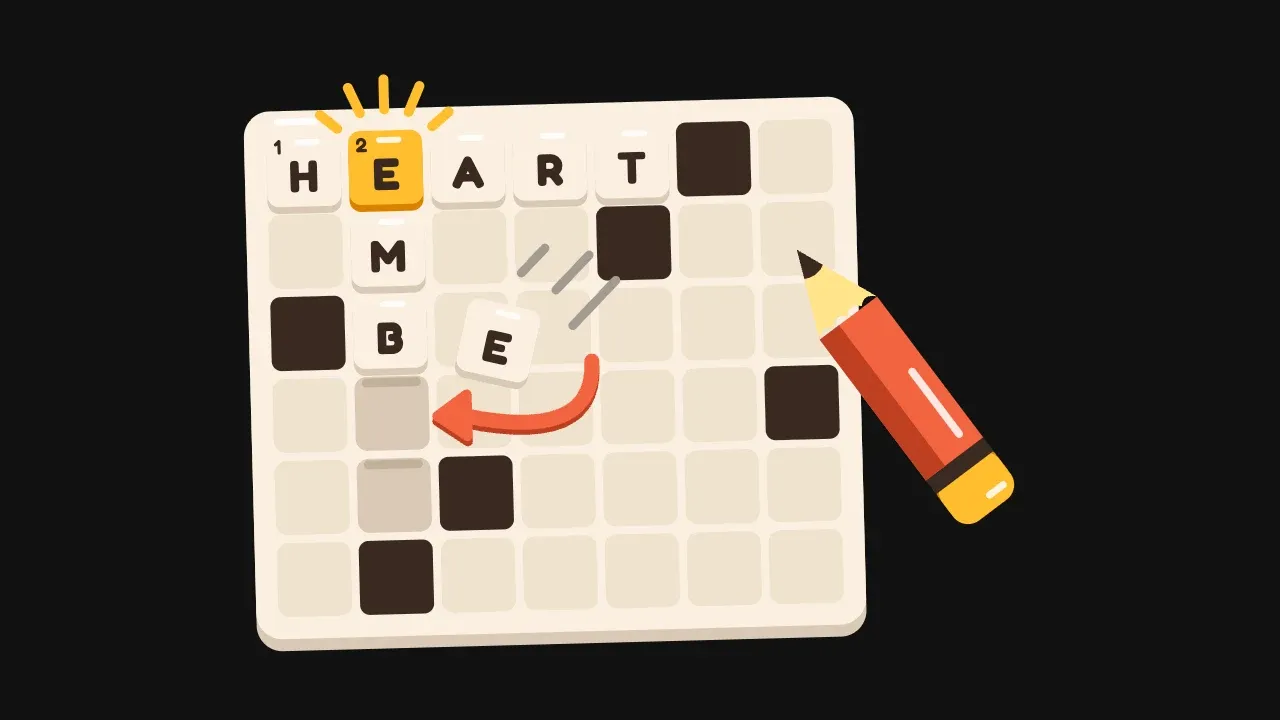
Here is a tiny crossword to see this in action. It is a 5x5 grid with no black squares, made for learning. The five across answers are the same five words as the five down answers, so you can check each word twice.
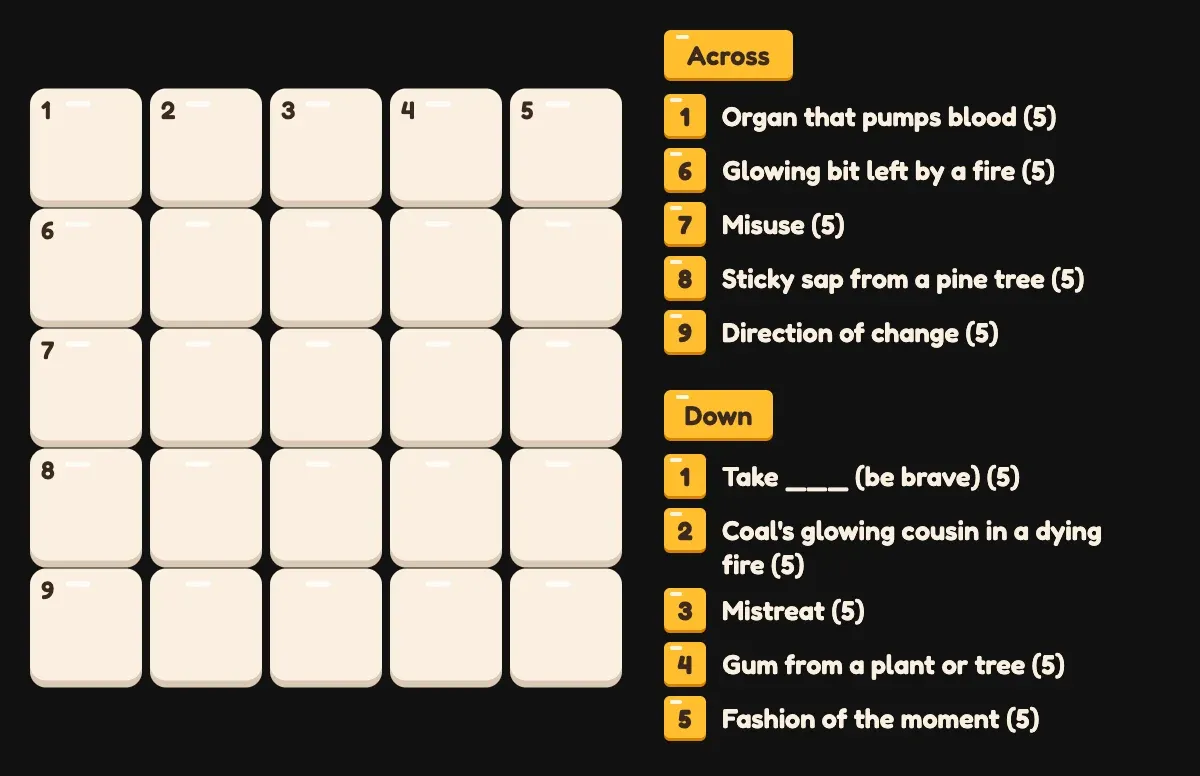
Each square that starts an answer has a number, and the clues are listed by number. Work through the grid in this order, one step at a time.
Step 1: Down 1, the fill-in-the-blank clue, is HEART. It gives the first letter of every across answer: H, E, A, R and T, down the first column.
Step 2: Across 7, “Misuse”, starts with A, the third letter of HEART. ABUSE is the obvious fit, so write it across row 3.
Step 3: Down 2, “Coal’s glowing cousin in a dying fire”, now reads _ _ B _ _. The B comes from ABUSE, which crosses it in row 3. That gives EMBER.
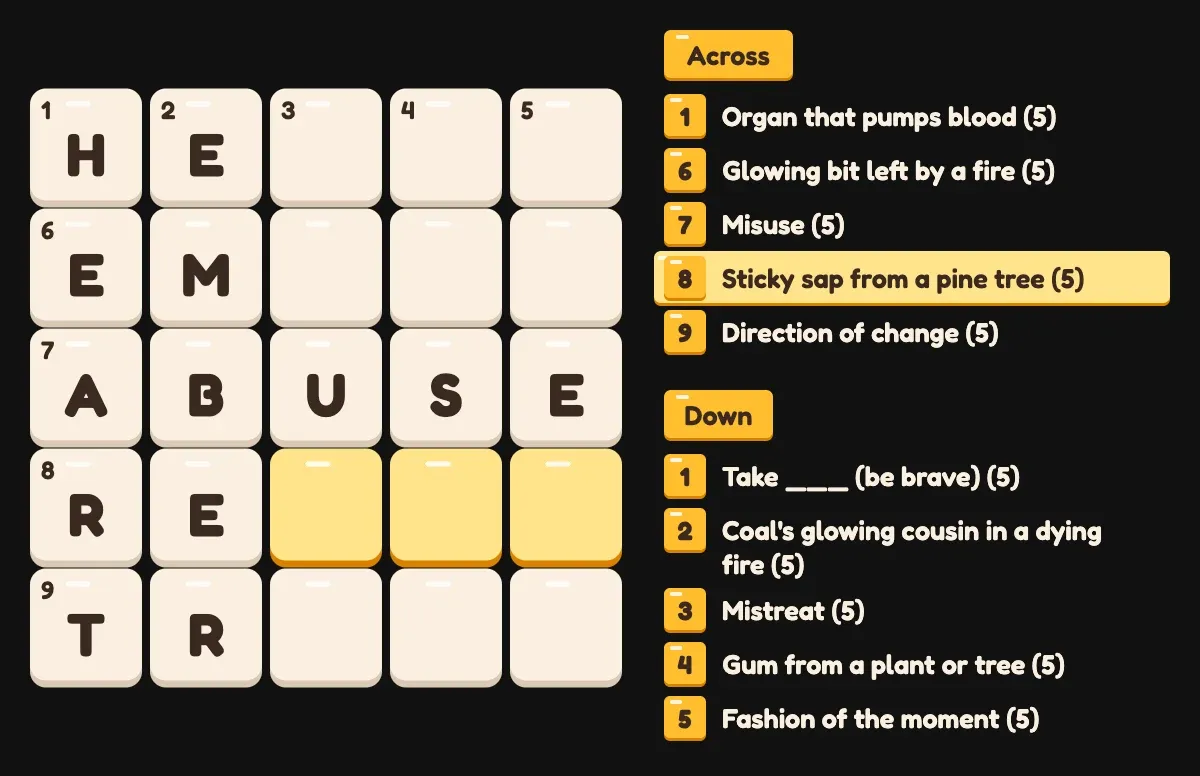
Step 4: Across 8, “Sticky sap from a pine tree”, now reads R E _ _ _. The R is from HEART and the E is from EMBER, in row 4. That gives RESIN, and tip 3 shows why it isn’t ROSIN.
Step 5: Across 9, “Direction of change”, reads T R _ _ _. The T is from HEART and the R from EMBER. That gives TREND.
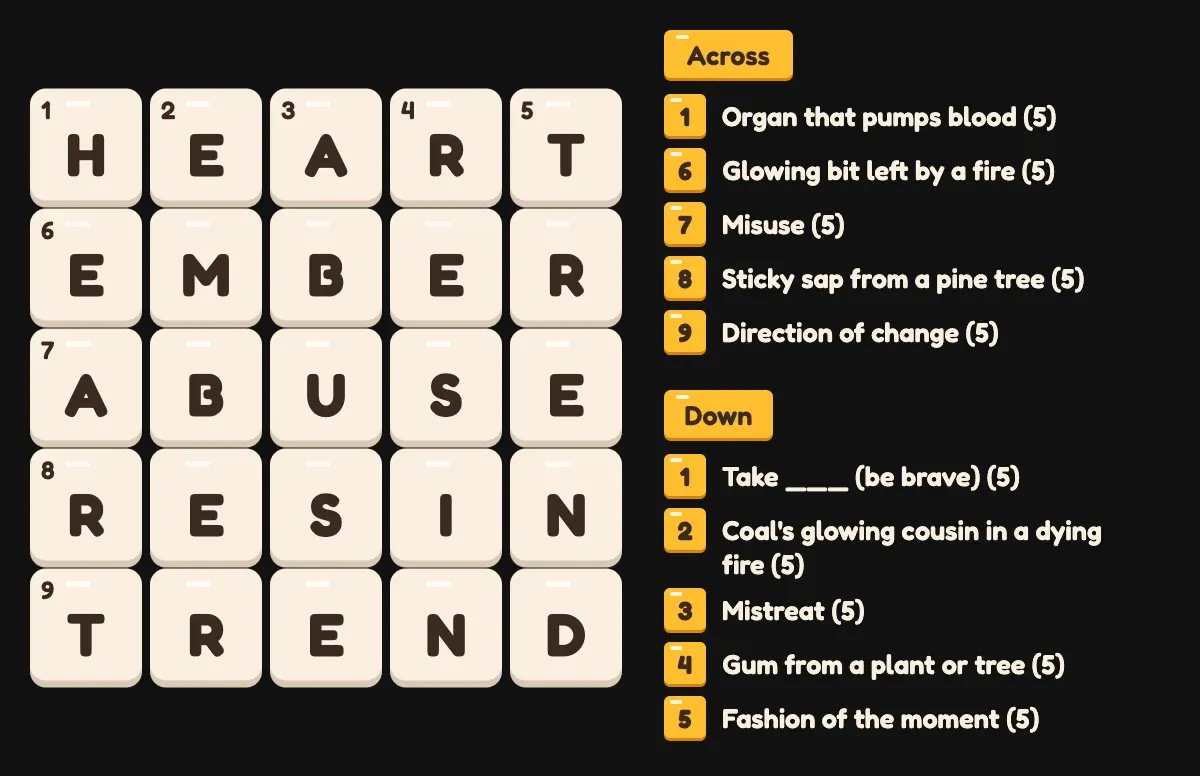
The last answers, Across 1 and 6 and Down 3 to 5, fill in from their crossings. Here is the finished grid.
3. Check every fit before you ink it
A word can fit the length and the first letters and still be wrong. Take “Sticky sap from a pine tree”, a five-letter answer that starts with R. RESIN and ROSIN both fit. The E from EMBER settles it, because RESIN has E as its second letter and ROSIN has O.
Another example: SPA_ (4 letters) could be SPAN, SPAR or SPAT. Don’t write any of them in yet. Wait for a crossing letter to pick one.
When two words fit, leave the squares blank, or pencil both in small, and solve the crossing answer first.
Read the whole answer against the clue, not just the pattern. If a crossing won’t make a word, look for a wrong answer nearby.
4. Match the clue’s form: tense, plural, abbreviation
The answer usually has the same form as its clue. “Wept” is past tense, so the answer ends in -ED: CRIED. “Walkers” is plural, so the answer usually ends in S.
These short signals tell you what kind of answer to look for:
- “briefly” or “for short” means an abbreviation: “Moment, briefly” is SEC.
- “in French” or “in Spanish” means the answer is that word in another language: “Yes, in Spain” is SI.
- A blank (___) means the answer completes a phrase: “Take ___” is HEART.
5. Watch for the question mark
A question mark means wordplay: the answer is not the plain meaning. “Banker?” (5) is RIVER, because a river has banks. The plain meaning, a person who works in a bank, points to a different answer.
What to do: read the clue as a joke first, then ask what else each word can mean.
6. Learn the words crosswords love
Crossword makers need short words with plenty of vowels to fit tight grids, so the same ones keep coming back. Learn this short list. After a few puzzles you will know them on sight, and that is a big part of why experienced solvers are fast.
| Answer | Typical clue |
|---|---|
| ERA | Period of history |
| ORE | Mine find |
| ARIA | Opera solo |
| ALOE | Soothing plant |
| EPEE | Fencing sword |
| ETA | Greek letter |
| ASEA | On the ocean |
| OLE | Bullfighter’s cheer |
| ANEW | Once more |
| ERR | Make a mistake |
Try it: four clues
Read each clue, fill in your answer, then open the answer to check it.
(a) “Once ___ a time” (4)
Show the answer
UPON. A fill-in-the-blank clue, so tip 1 applies: the phrase gives it straight away.
(b) “Wept” (5)
Show the answer
CRIED. The clue is past tense, so the answer ends in -ED (tip 4).
(c) “Moment, briefly” (3)
Show the answer
SEC. “Briefly” is an abbreviation signal, and SEC is short for second (tip 4).
(d) “Bloomer?” (6)
Show the answer
FLOWER. The question mark means a pun: a flower blooms (tip 5).
Pencil, crossing letters and patience beat knowing lots of words. For eight habits that help with any puzzle, read how to get better at logic puzzles. For another word puzzle, where you change one letter at a time, try word ladders.