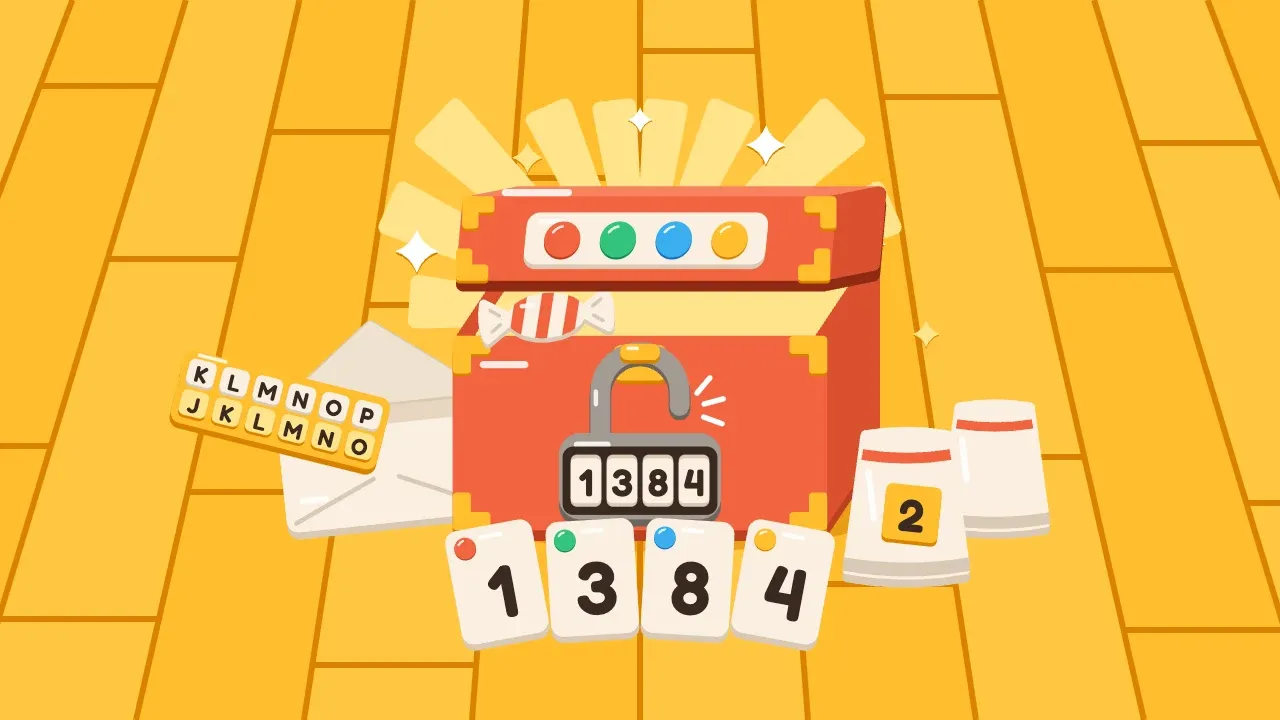
Want to know how to make an escape room at home for a rainy afternoon or a birthday? Most guides are loose lists of ideas, not a game you can set up tonight. Here’s one complete game of six puzzles, in order. Each answer tells you where the next clue is hidden, and the last answer opens a locked box. The answers stay hidden until you want them. You also get what to print, where to hide things, timing for different ages and a blank template to make your own.
How to make an escape room at home: what you need and how it works
An escape room at home is a chain. Solve a puzzle, and its answer tells you where the next one is hidden, until the last answer opens a locked box.
The rule that makes it work: every answer must point to the next hiding place (a place, a number or a colour), so nobody can skip ahead.
- Kit, all from home: paper, pencil, envelopes, a white wax crayon, watercolour paints, five paper cups, sticky notes, coloured dots or crayons, and a small box with a lock you already own. No lock? See the note in puzzle 6.
- Digit cards: each one has a coloured dot and one digit. Players collect them as they go and keep them until puzzle 6.
- Time: about 30 minutes to set up, and 30 to 45 minutes to play.
- Players: 2 to 5, in one team.
- Safety: every hiding place is low and ordinary. Nothing scary, no dark rooms, no climbing, and no closed windows or hot things used as a clue place.
The story and the plan at a glance
The story, in one line: a snack or small prize is locked in a box, and clues left by the “puzzle fairy” lead to a four-digit code.
| Puzzle | Kind of puzzle | What the player does |
|---|---|---|
| 1. The riddle at the door | Riddle | Solves the riddle and says the answer aloud |
| 2. The one-step letter code | Letter code | Steps each letter back one place |
| 3. The invisible message | Hidden writing | Paints over the crayon to reveal the words |
| 4. The countdown cups | Number pattern | Finds the missing number and lifts the right cup |
| 5. The scrambled word | Anagram | Unscrambles five letters into a word |
| 6. The colour code on the box | Colour to digit | Turns four coloured dots into a four-digit lock code |
The places are examples: swap in rooms and furniture from your own home.
Puzzle 1: The riddle at the door
Print or write this riddle on a card, and put it in an envelope on the front door:
I have a face and two hands, but no arms or legs. What am I?
Age 6? Read it aloud or point to the room. Older players? Keep it as written: it’s the warm-up.
Show the answer
A clock. Hide the next envelope under a clock or watch on a low table or shelf. It holds the puzzle 2 card and the decoder strip, plus a yellow digit card with a big 4 on it.
Puzzle 2: The one-step letter code
Write this on the card. Each letter has been moved one step forward in the alphabet:
DIFDL UIF CPPLTIFMG
Add a decoder strip to the card. It’s the alphabet written twice, with the second row shifted one place, so each code letter sits above the letter one step before it.
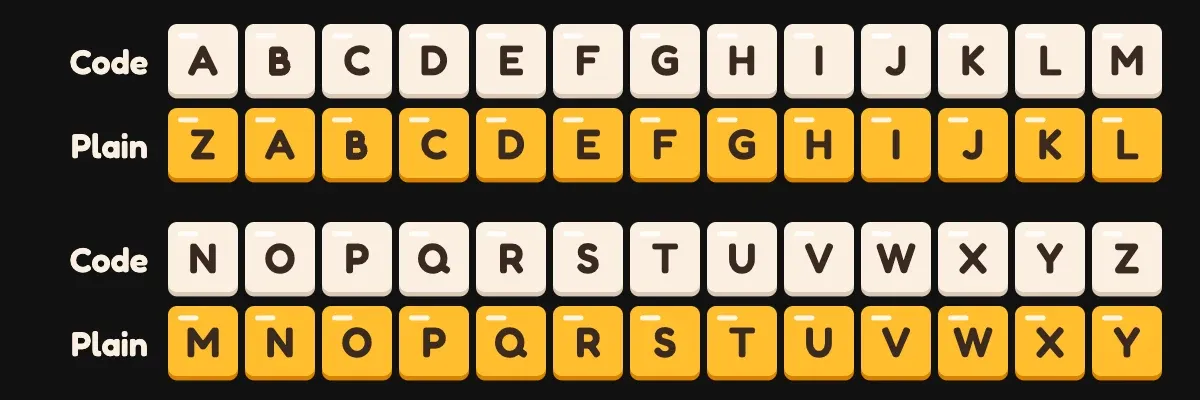
For age 6, use numbers instead: a key on the card says A=1, B=2 and so on. The word SOCK then reads 19-15-3-11. Teens can get a shift of 3, or no strip at all.
Keep the message under five words, and write it in capitals.
Show the answer
CHECK THE BOOKSHELF. Each code letter steps back one place to give the plain letter. Hide the paper for puzzle 3 on the bookshelf, with a red digit card with a 1 on it.
Puzzle 3: The invisible message
Before the game, write a short message on white paper with a white wax crayon, pressing hard. Players paint over it with watercolour, and the words show up. Test it yourself first, so you know how much paint to use.
For age 6, draw a big picture of a sock instead of words. For teens, keep the words, and hide the paper inside a book on the shelf.
Show the answer
LOOK IN THE SOCK DRAWER. The sock drawer holds the puzzle 4 card, the number pattern.
Puzzle 4: The countdown cups
Set five paper cups upside down, numbered 1 to 5 with sticky notes. The card from the sock drawer shows a pattern:
10, 8, 6, 4, ?
Age 6? Use 5, 4, 3, ?. Teens? Use 32, 16, 8, 4, ?, where each number is half the one before. Why must the missing number be between 1 and 5? So it fits a cup.
Show the answer
2. Every version above has the answer 2, so the cups stay the same. Under cup 2, put a green digit card with a 3 on it, and the puzzle 5 card. The other cups hide nothing, or a joke note.
Puzzle 5: The scrambled word
Write the letters on the card, with a hint underneath:
OCUHC
Hint: you sit on it to watch TV.
For age 6, lay the letters on separate cards and put the first one in the right place. For teens, leave out the hint line.
Show the answer
COUCH. Hide the locked box under or behind the couch, or on its seat, with a blue digit card with an 8 on it. Keep the box in an easy spot to reach.
Puzzle 6: The colour code on the box
Stick a card on the box that shows four coloured dots in a row:

Players look up the digit card for each colour, then put the four digits in the same order as the dots. Set the lock to that code.
The box holds the treasure: a snack, a small prize, or a note saying who gets to hide the clues next time. No lock? The team says the code aloud to the host, and the host opens the box once they get it right.
Show the answer
1384. Red is 1, green is 3, blue is 8 and yellow is 4, so the dots read 1, 3, 8, 4.
How long it takes and how to set the level
Use this table to choose the level:
| Age | How the game runs | Hints |
|---|---|---|
| 6 | A grown-up reads the clues, with big pictures instead of words | Free, any time |
| 9 | The game as written | On request |
| Teens | Shift codes and harder patterns, with a 30-minute timer | On request |
Each puzzle takes about 5 to 8 minutes, so the whole game runs about 30 to 45 minutes.
The main difficulty dial is how hard the hiding places are. Put them low and in plain sight for little ones. For older players, put them behind or under things.
Mixed ages? Give the youngest the digit cards and the colour-dot job, so each age has a role.
Hints, safety and a reset checklist
Give each team three hint cards. Each card gives a hint for one puzzle. Or the host offers a nudge after three minutes of being stuck. Never let a player stay stuck for long.
Reset checklist: put the digit cards back in their envelopes in order, set the cups back upside down, re-hide the box, set the lock back to its code, and keep the decoder strip with the puzzle 2 card.
To play again, swap the places and the code. The same puzzles then make a new game.
Make your own: a fill-in template
Copy this table and fill it in.
| Puzzle type | Question or message | Answer | Hide next clue here | Digit card (colour and number) |
|---|---|---|---|---|
Fill it in backwards: start with the box and its code, then the last puzzle, and work back to the first. Puzzle types to swap in: riddle, shift or number code, invisible ink, number pattern with numbered cups, scrambled word, and picture or colour order.
Before game day, solve every puzzle yourself and check that each answer leads to the right place. Then have someone else try the first two.
For more to solve, try lateral thinking puzzles or brain teasers for a 5-minute break.