Lateral thinking puzzles with answers look strange at first. A man asks a café waiter for a glass of water, the waiter claps loudly right behind him, and the man says thank you and leaves. Thinking about it alone won’t get you there, but asking the right questions will. Below: what they are, a method for solving them, eight gentle puzzles, and how to run them as a group game.
What are lateral thinking puzzles?
One person, the host, knows the full story. The others, the solvers, get only a short, odd setup, and they work out what happened by asking questions.
The host may answer only yes, no or irrelevant. Some groups also allow “it depends” or “be more specific”. The puzzle is solved when a solver can tell the whole story, including the odd part of the setup.
These puzzles also go by the names situation puzzles, yes/no riddles and minute mysteries. A riddle usually has a quick answer you can guess. With these, you have to question your way to it. For quick-answer puzzles, try the 10 brain teasers for a 5-minute break.
Every puzzle here is gentle: nobody is hurt, so they suit all ages.
How to solve lateral thinking puzzles: 5 habits
-
Start broad. Is it an everyday place or an unusual one? Was it an accident or on purpose? Is one person involved, or more? Does a word in the setup mean two things?
-
Test your assumptions. The setup hides an assumption on purpose, such as a word with two meanings or a detail you picture wrongly. Ask yourself, “Is the thing I picture really what it seems?”
-
Switch angle after three related no’s. Three no’s in a row about the same idea mean that idea is out. Drop the whole category, illness for example, and try a new one: surprise, size, time, an object.
-
Keep going after a first plausible answer. A good guess often explains half the story. Before you announce it, ask, “Does that explain the odd part too?”
-
Ask questions a yes or no can answer. “Was it because of something the man was wearing?” works. “Why did he leave?” doesn’t. It’s the halving idea from the 20 questions strategy.
A worked example, question by question
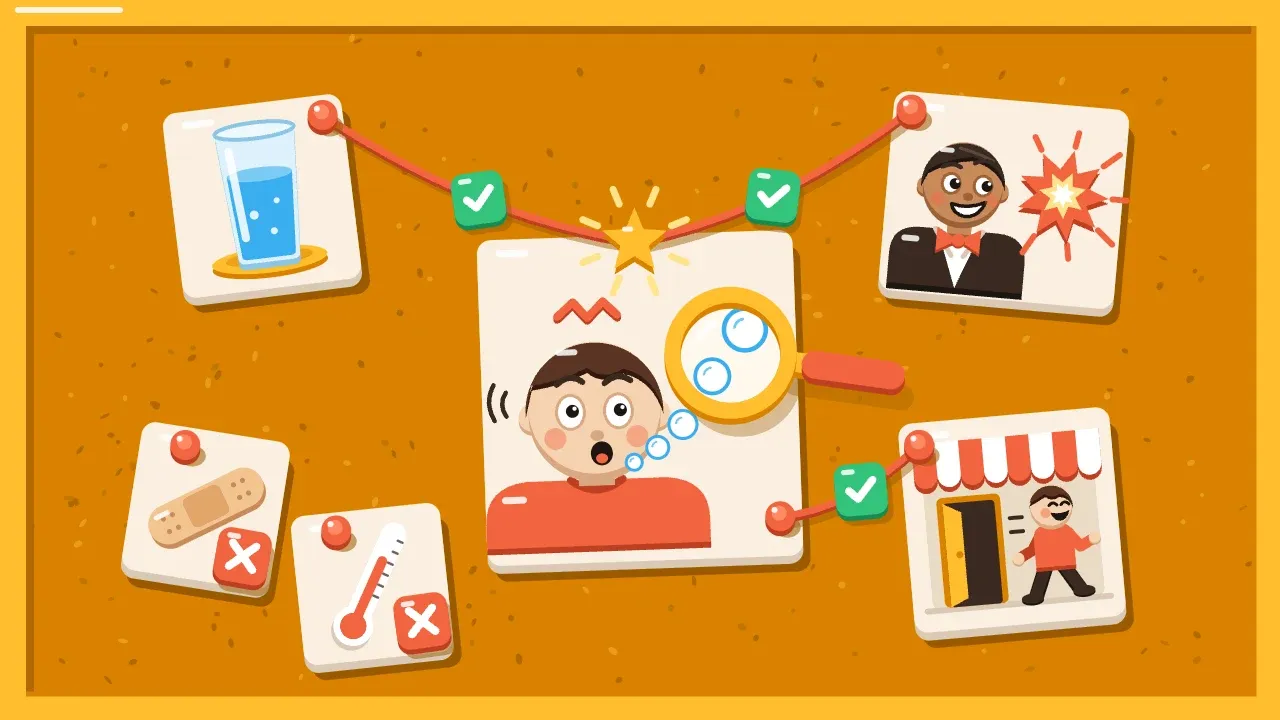
Setup: A man asks a café waiter for a glass of water. The waiter suddenly claps loudly right behind him. The man says “thank you” and leaves. Why?
Here’s how a solver might question the host:
- Q1: Is the man in danger? No.
- Q2: Did the waiter mean to help him? Yes.
- Q3: Did the man want the water because he was thirsty? No.
- Q4: Was he hurt? No. Q5: Was he ill? No. Q6: Was he in pain? No.
- Q7: Was it something small that bothers people but passes by itself? Yes.
- Q8: Is it something a person’s body does without being asked? Yes.
- Q9: Was it hiccups? Yes.
Q4 to Q6 are three related no’s in a row, all about harm to the man’s body: time to switch angle. Q7 does that.
Show the answer
The man had hiccups. He asked for water to cure them, and the waiter, noticing, tried a different cure: a sudden fright. It worked, so the man thanked the waiter.
This story isn’t one of the eight puzzles below. The switch at Q7 is what cracked it.
8 lateral thinking puzzles with answers
Try each one before you open its answer. Play alone, or with a friend as host: they know the answer and reply only yes, no or irrelevant.
1. The slow race
Lily finishes last in a bicycle race, yet she’s given the gold medal. How?
Show the answer
It was a slow race, and the winner is the last rider to cross the line without putting a foot down. Lily kept both feet on the pedals all the way, so the medal goes to Lily.
2. The trick candles
Mia blows out every candle on her birthday cake. The flames come back, but nobody’s worried. Everyone laughs. Why?
Show the answer
They are trick candles that relight themselves. The flames go out for a moment, then come back on their own.
3. The brothers who are not twins
Two boys have the same parents. They were born on the same day in the same year, yet they aren’t twins. How?
Show the answer
They are two of triplets (or more). Twins are only two babies born together, and a third baby makes it triplets.
4. Friday
A traveller rides into town on Friday, stays three nights and rides out on Friday. How?
Show the answer
Friday is the name of the traveller’s horse. They rode in on the horse, Friday, and rode out on it.
5. The very old grandfather
Grandpa Leo is 80, but he says he’s had only 20 birthdays. How can that be?
Show the answer
Leo was born on 29 February. That birthday comes only in leap years, every four years. Born in 1944, Leo has had real birthdays in 1948, 1952 and each leap year up to 2024, when he turned 80: 20 in all.
6. The stuck lorry
A tall lorry has driven under a low bridge and is wedged there. Engineers argue about cutting the bridge or the roof. Then a child asks one question, and the lorry is soon free. What did the child ask?
Show the answer
“Why not let some air out of the tyres?” With less air, the lorry sinks lower, low enough to drive out from under the bridge.
7. The lift
A man lives on the tenth floor. Each morning he rides the lift down to the ground floor. Coming home, he rides only to the seventh floor and walks the rest, except on rainy days, when he rides all the way up. Why?
Show the answer
He is too short to reach the button for the tenth floor, but he can reach the one for the seventh. On rainy days he carries an umbrella and uses it to press the button for ten.
8. The blank page
A student hands in a completely blank sheet of white paper and gets full marks. Why?
Show the answer
The task was to draw something white on a white background, such as a polar bear in a snowstorm. Other answers can fit too.
How to play lateral thinking puzzles as a group game
- Pick a host. The host reads the answer in private before the game. They answer only yes, no or irrelevant, and they never lie. When a question is close, they can say “you are getting warm”, but they must not give the answer away.
- Take turns. Go round the table with one question each, or let anyone ask with a hand up. A solver may guess the whole story at any time, and a wrong guess costs nothing.
- Limit the hints. The host may give up to three hints per puzzle, such as the key word of the setup.
- Keep score, or don’t. No score is fine. Otherwise, a point goes to whoever asks the question that cracks it, and one to the host if hints were needed. Rotate the host after each puzzle.
- For children. Use puzzles 1 to 4. Let the group ask as a team, allow “is it about …?” questions, and always end with the answer, so nobody is left wondering.
Which puzzle did you solve first?
Pick one puzzle and play it with a friend tonight, then ask them which one they cracked fastest. For more, try the 10 brain teasers for a 5-minute break. To make your own, start from an ordinary event, such as a bus ride, and hide one odd detail.