The word chain game needs no props and starts in ten seconds, in a car, a queue or a classroom. It falls apart the moment someone asks whether a name or a made-up word counts. Below: the rule, the rulings that settle those arguments, and four harder versions, each with an example chain.
How to play the word chain game
The first player says any word. The next player says a word that starts with the last letter of it, and play goes round the table while the chain keeps growing. Here’s a short chain, where each word starts with the last letter of the one before:
apple, elephant, tiger, rabbit, tent, table, egg, gold, door, rain
A round ends when someone can’t think of a word in time. That player is out, or takes a strike (see the scoring options below). Who wins? The last player left.
It suits players from about 6 up, two or more at a time. No props, no screens.
House rules that settle the arguments
The game has no official rulebook and sources differ, so agree these before the first word. Each row gives a recommended default.
| Question | Recommended default | Why |
|---|---|---|
| Can a word come up twice? | No. For a big group, keep a list on paper; for a short game, trust memory. | Repeats let the chain go round the same few words. |
| Are names and places allowed? | No, except for little kids or when the group is stuck. | A name is easy to argue over, and a dictionary can’t settle it. |
| Do plurals and endings count, such as dogs or running? | Yes. The chain follows the last letter of the word as said. | They are real words, so the rule needs no exception. |
| Can a player use a made-up word? | No. Anyone can challenge it; if nobody knows it, check a dictionary or a phone. | A challenge should end in a quick check, not an argument. A wrong challenger takes a strike, or is out in the elimination game. |
| How long is each turn? | 5 seconds for adults, 10 for young children. Count aloud. | Counting aloud means everyone plays to the same clock. |
| What about words ending in x, q or z? | No penalty. The next player must start with that letter. | Few words start with x or z, so the next turn is hard. That is part of the game. |
| Can play start again after someone is out? | Yes. The next player begins a fresh chain with any word. | The game goes on for everyone still in. |
Scoring and elimination options
These are house options, not rules from a book. Pick one before you start.
- Elimination: miss a turn and you’re out. It’s the fastest option and suits groups of 2 to 4, but the early loser has to sit out.
- Three strikes: a stalled, repeated or invalid word is a strike. Three strikes and you’re out. It keeps everyone in the game longer. Plenty of groups play it this way.
- Longest chain: no loser at all. The group works together to build the longest chain it can in 2 minutes, then tries to beat that number. It’s good for classrooms and mixed ages.
4 harder versions, from easy to tough
Each version adds one rule to the basic game, and the last-letter link stays.
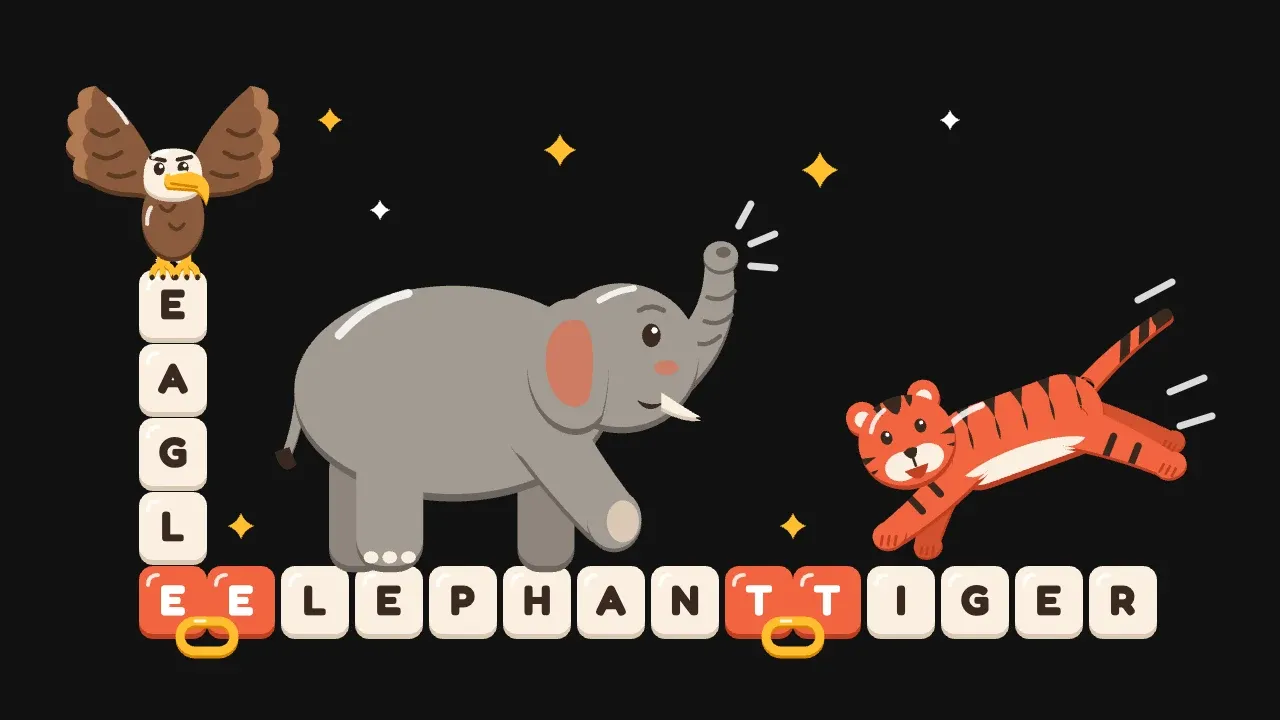
1. Theme chain (easy). Every word must belong to one category, such as animals.
zebra, antelope, eagle, elephant, tiger, rabbit, tortoise, eel, lion
2. Five letters or more (medium). Every word must have at least 5 letters, which rules out the easy short words.
planet, tiger, rabbit, tomato, orange, eagle, elephant, tulip
3. No vowel endings (medium-hard). No word may end in a vowel. Why does that matter? Every link then runs through a consonant, so every word after the first starts with one.
moon, nest, torch, hand, door, rain, nail, lamp, pen
4. Two-letter links (hard). The next word must start with the last two letters of the previous word. The links here are ot, er, se, ch, ir and on. Some endings have few good words, so allow one skip per round.
pilot, otter, erase, search, chair, iron, only
To make an even harder game, mix two rules, for example a theme plus five letters or more.
Shiritori: the Japanese version
In Japanese shiritori, each player links the next word to the last sound of the one before, written in kana. A word that ends in the sound “n” loses, because almost no Japanese word starts with it. Players often add rules such as nouns only or no repeats. English has nothing quite like that dead-end sound. So English groups usually make their own rules, like the ones above, and rules vary from group to group.
Playing it in a car, a queue or a classroom
- Car: no props. Pass the turn clockwise. The driver can play too. Longest-chain mode keeps everyone calm.
- Queue or waiting room: play with a theme chain to keep voices low.
- Classroom: use a category tied to the lesson, play for a team longest-chain score, and keep a 10-second limit.
Try the harder versions one rung at a time. Want nine more games to play at a table? Read 10 games to play at a restaurant. For a game on the road, read I spy for kids on a road trip.