Pen and paper games for adults can give you ten quiet minutes with no screen and no opponent. These six need one sheet of paper and a pen. Each has rules in a few lines and a worked example, and each works alone or with one other person. There’s no scoring: finishing is the win.
1. Word squares: a tiny crossword you build yourself
How to play
- Draw a 3 by 3 grid and fill it so the three rows are real words.
- The three columns must read the same three words, in the same order. Use a pencil, since you’ll want to rub out.
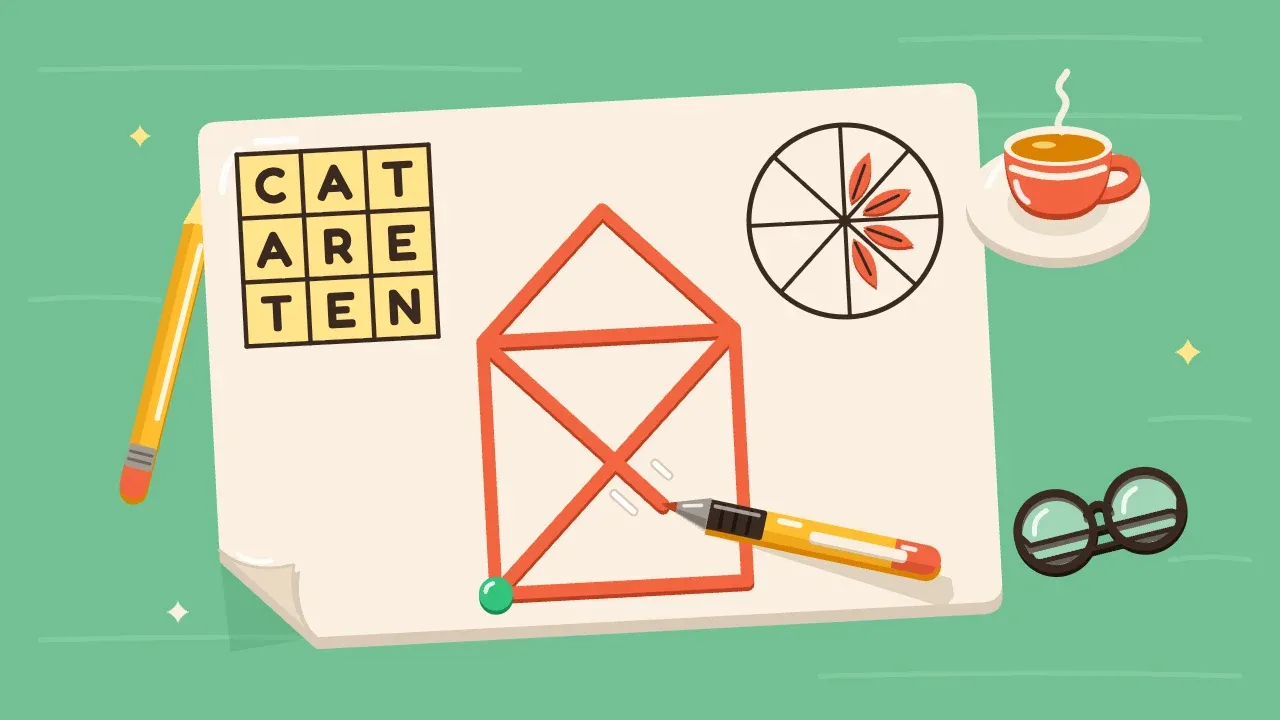
Example: the rows are CAT, ARE and TEN. Column 1 reads CAT, column 2 reads ARE and column 3 reads TEN.
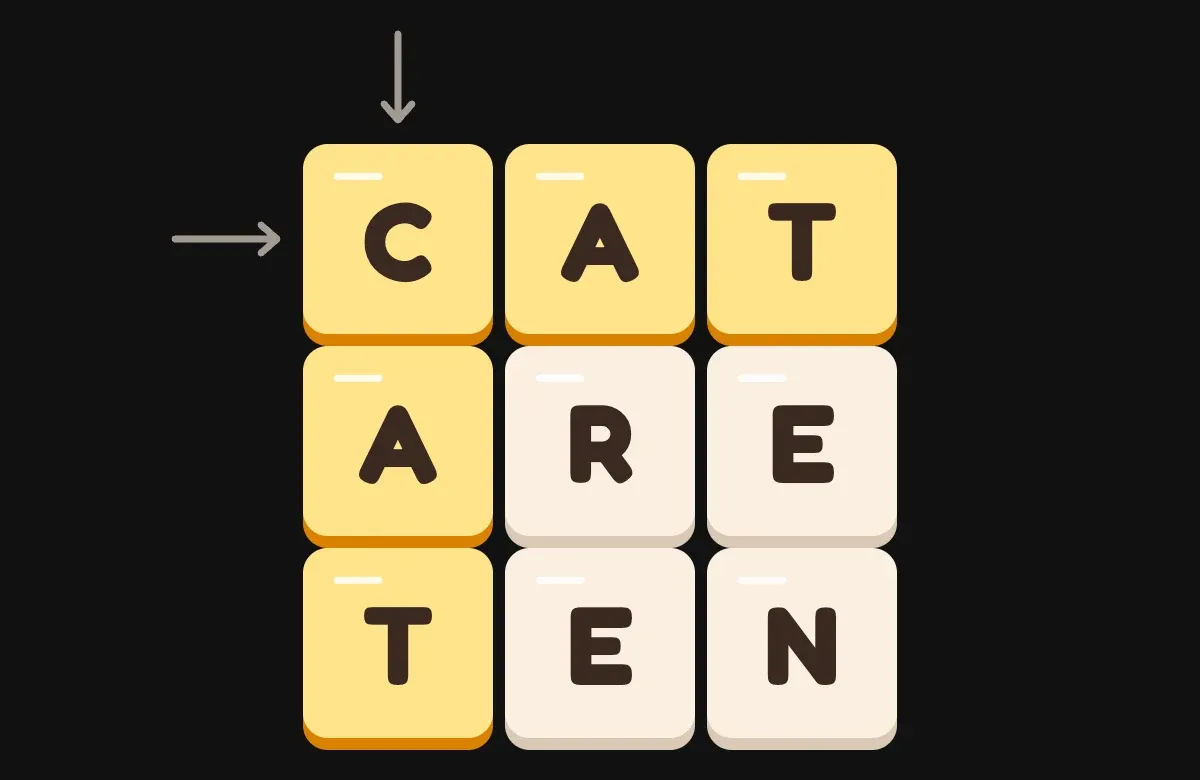
Want two more to try? The first row is your hint.
Square A: first row TAP
Show the answer
ARE and PEN. Column 1 must read TAP, so row 2 starts with A and row 3 starts with P.
Square B: first row SIT
Show the answer
ICE and TEA. Column 1 must read SIT, so row 2 starts with I and row 3 starts with T.
Want it harder? Use a 4 by 4 grid. Why is it calm? It’s small and slow, with no clock, and you can stop at any point.
2. Words inside a word: one long word, as many small ones as you find
How to play
- Write a long word across the top of the page.
- List every word you can make from its letters, using each letter no more times than it appears in the long word.
- Set no timer. Stop when your mind goes quiet.
Example: with CHOCOLATE you can make hat, cat, coat, late, tale, hotel, cheat, chalet, clothe, cloth, coach and cocoa. COCOA works because CHOCOLATE has two Cs and two Os. TOTAL doesn’t, because CHOCOLATE has only one T.
Want a mild challenge? Aim for ten words of four or more letters, as the list above has. Other long words to try are ADVENTURE, WATERMELON and MOUNTAIN.
Why is it calm? It’s a slow search, a bit like looking out of a window.
3. One-line drawings: can you draw it without lifting the pen?
How to play
- Draw a shape made of straight lines, and mark your start with a dot.
- Trace every line exactly once, without lifting the pen or going over a line twice.
Example: the envelope, a square with both diagonals and a roof (a point above the top edge, joined to the two top corners). Count the lines meeting at each point. Only the two bottom corners have an odd count (three each), so the drawing can be done. It must start at one bottom corner and finish at the other.
The route, from the bottom-left corner: bottom-left, bottom-right, top-right, top-left, bottom-left, top-right, roof point, top-left, bottom-right.
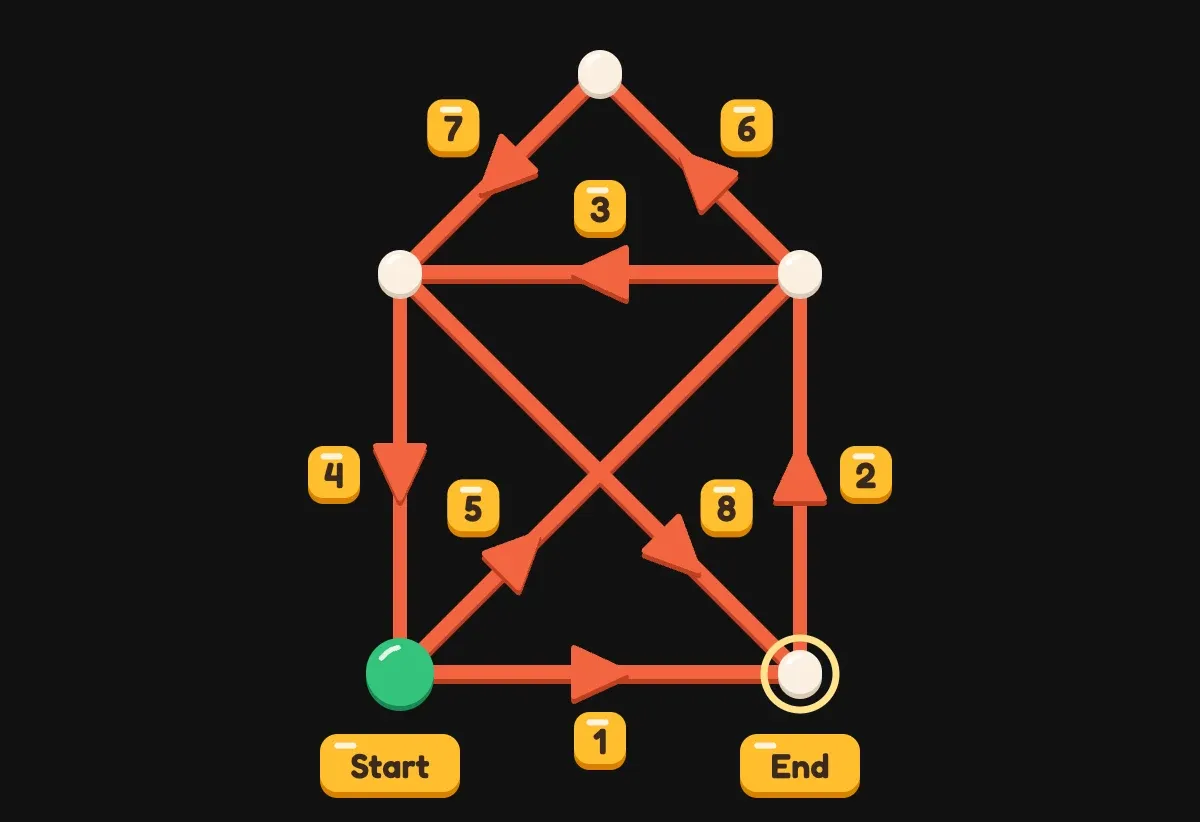
The rule behind it: a drawing in one piece can be done in one stroke if no point has an odd number of lines meeting there, or exactly two do. With two, you start on one and finish on the other. With four, it can’t be done. It’s a general rule for such drawings. Test it by adding one extra line to the envelope and counting again.
Why is it calm? Your hand keeps moving in one flowing line.
4. Draw your own maze, then walk it
How to make one
- Draw a square, then a winding path from one side to the opposite side, as a double line (two parallel strokes).
- Fill the rest of the square with walls and dead ends: short side branches that stop.
- Close the outside border, leaving one entrance and one exit.
Then leave it for an hour, or pass it to someone, and solve it with a pen of a different colour. A route that fools you is the sign of a good maze. A few long wrong turns that run nearly all the way to the exit work better than many short dead ends.
For the solving side, read how to solve a maze with the wall-follower rule.
Why is it calm? Building is slow, and solving a maze you drew yourself is gentle.
5. Pattern circle: one small shape, repeated eight times
How to draw it
- Draw a circle and divide it into eight slices: four lines through the centre.
- Draw one small, simple design in the first slice: a leaf, a wave or a row of dots.
- Copy it into the other slices, turning it round the circle.
Optional: add a second ring of a different shape. No two circles will match, and that’s the point.
What makes it calm? One small motion, repeated, with no right answer to get wrong.
6. The alphabet list: A to Z of one small subject
How to play
- Write the letters A to Z down the side of the page.
- Pick a topic, such as things in a kitchen, places to visit or foods.
- Write one answer for each letter. Skip the hard ones (X, Q) and come back to them, or allow yourself a cheat.
Example: the topic is things in the kitchen. Here are the first ten letters of the 26: A apron, B bowl, C colander, D dish, E egg timer, F fork, G grater, H honey, I ice tray, J jug.
Do the same topic again next week and see what’s changed.
Why is it calm? It’s a small list with no hurry, and the page itself is the reward.
Pen and paper games for adults to share: pass the page
Each game can be passed to one other person. Give a friend a word square with its first row filled in, trace a drawing they have drawn, solve a maze they have drawn, or take turns with a pattern circle or an alphabet list. No points, no scoring: you finish together.
Make it a quiet habit
Keep a sheet and a pen in a drawer. Pick one game, give it ten minutes, then put it away. For more quiet games, read memory games for adults at home.