These water sort puzzle tips start at a familiar moment. Every tube is nearly full and no pour fits. The level is dead. Below are six habits for any water sort or colour sort puzzle, each with its reason. Then one small puzzle, worked pour by pour, including the one move that ruins it.
How a water sort puzzle works (in 30 seconds)
- The goal: every tube holds one colour only, or is empty.
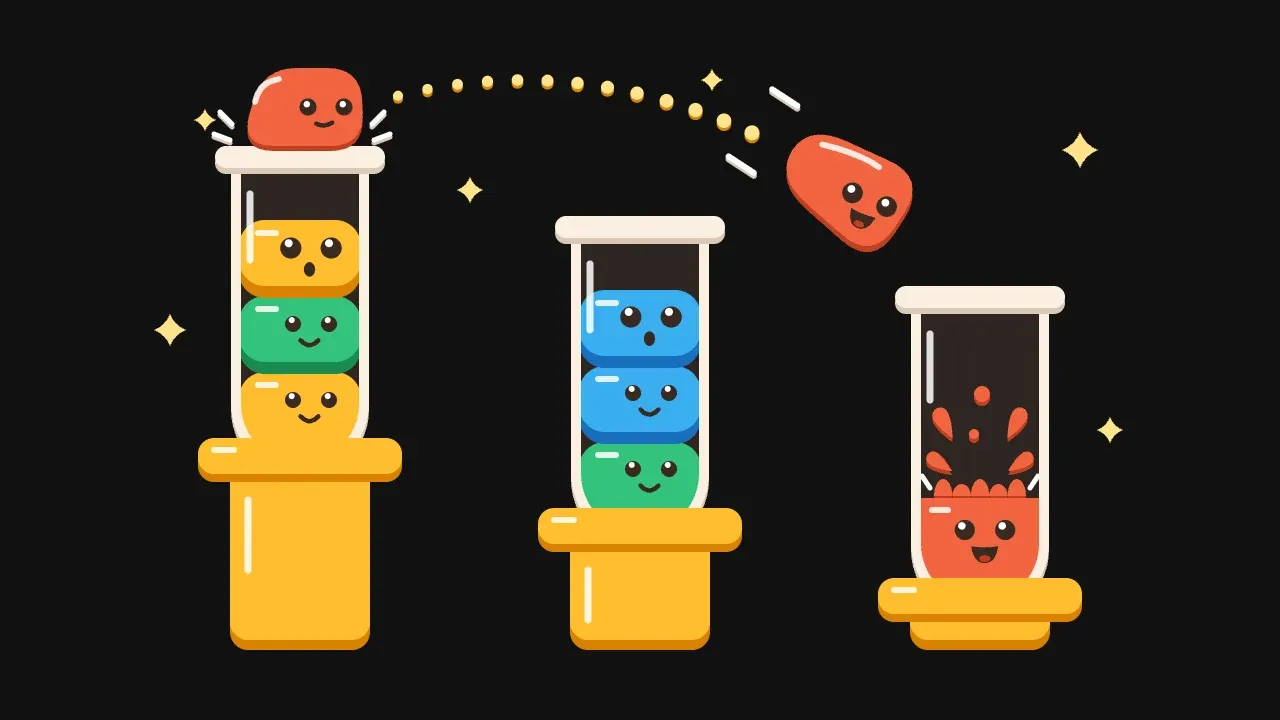
- The pour rule: you can pour the top colour of one tube onto another only if that tube is empty or its top colour matches, and there’s room. Tubes hold 4 units here. Your game may differ.
- The block: a pour moves the whole top block of that colour, as much as fits. Some games move one unit at a time, so check yours.
- The notation: tubes are numbered 1 to 5, left to right, with colours listed bottom to top.
- The lesson: a hard level is often lost to one early pour, not to one late mistake.
1. Keep one tube empty
The habit: treat the empty tube as working space, not as a place to park colours. Before you pour into it, ask what colour will live there and whether that colour will finish soon.
Why does it work? An empty tube is the one place a top colour can go without matching anything. Fill it with a mixed pile and you can no longer reach what’s underneath.
Common trap: pouring a colour into the empty tube when its other units are buried.
The worked puzzle below shows this exact move losing the level.
2. Pick an anchor colour and commit
The habit: choose one colour and finish it over the next few moves, rather than nudging many colours at once.
How do you choose? Prefer a colour that already sits on top in two or more tubes, so it can be gathered in two or three pours.
A finished tube is one fewer thing to track, and it often frees a place to pour. Switching colours every move scatters the units you need.
3. Look under the top colour before you pour
The habit: before any pour, look beneath the top colour in both tubes. What you uncover next often matters more than what you move now.
Example: pouring a blue onto a blue is allowed. But if the red you need next sits just under that blue, you have stacked more blue on top of it. Ask: what will be on top after this pour, and where will the next colour go?
The pour rule only looks at the top colour, so the layers underneath decide what’s possible later.
4. Plan three pours ahead
The habit: before you commit, play out three pours in your head: this one, the one it opens up, and the one after.
Why three? It catches many dead ends, such as a full tube with no matching top. And it’s still short enough to do in your head.
Check, in order: where’s the free space after the pour? Does any top colour now match another tube? Is the empty tube still empty?
The worked puzzle below takes 7 pours. Each one sets up the next.
5. Use undo to explore, not to panic
The habit: if your game has undo, use it to test an idea and step back. Don’t use it to rescue a board after ten careless moves.
Why it works: undo makes a pour free to try, so the sooner you find a dead end, the less you lose.
Not every game has undo. Yours doesn’t? Plan on paper or in your head.
6. Restart on the second dead end
The habit: if you’ve undone one bad line and then hit a second dead end, restart the level instead of digging further.
Why restart? Two dead ends in a row often mean the opening was the problem. A fresh start costs seconds; a tangled board costs far more.
Signs of a dead end: no tube is empty, and every mixed tube is either full or has a top colour that no other tube can take.
A worked puzzle: the pour that loses
The starting board has 5 tubes and 4 colours, 4 units each.
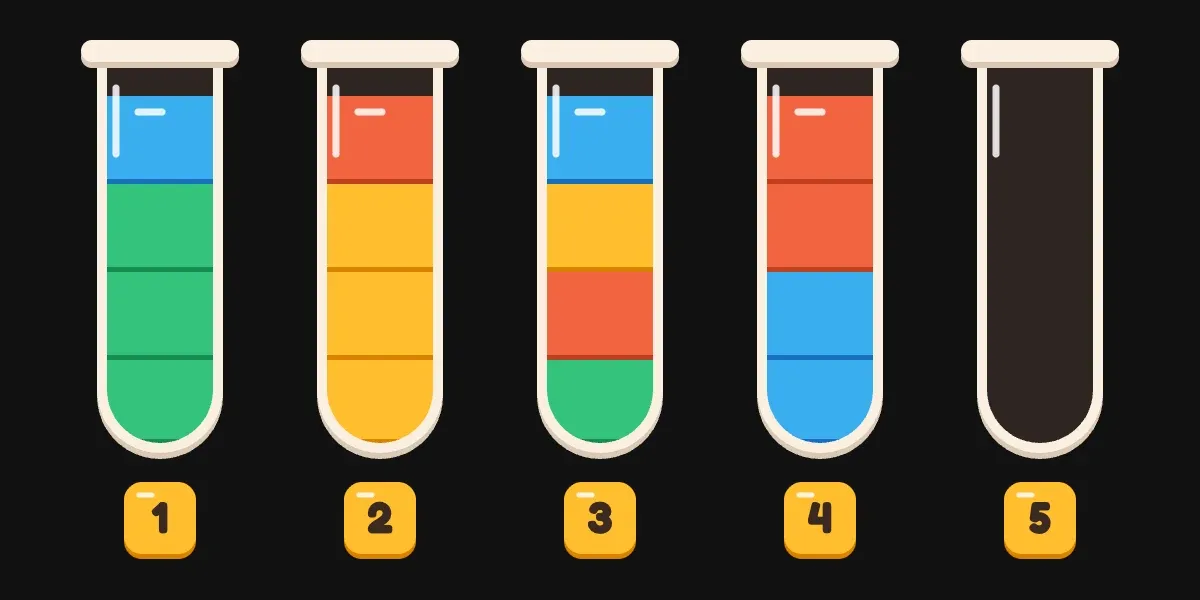
The losing first move: pour tube 1’s blue into the empty tube 5. It looks tidy: it uncovers three greens. But the empty tube is gone, and the reds on top of tubes 2 and 4 have nowhere to go.
From there, the only legal pour is tube 3’s blue onto tube 5. Then no pour is legal at all. Both reds sit on full tubes, so neither can move. Pouring tube 3’s blue first loses the same way.
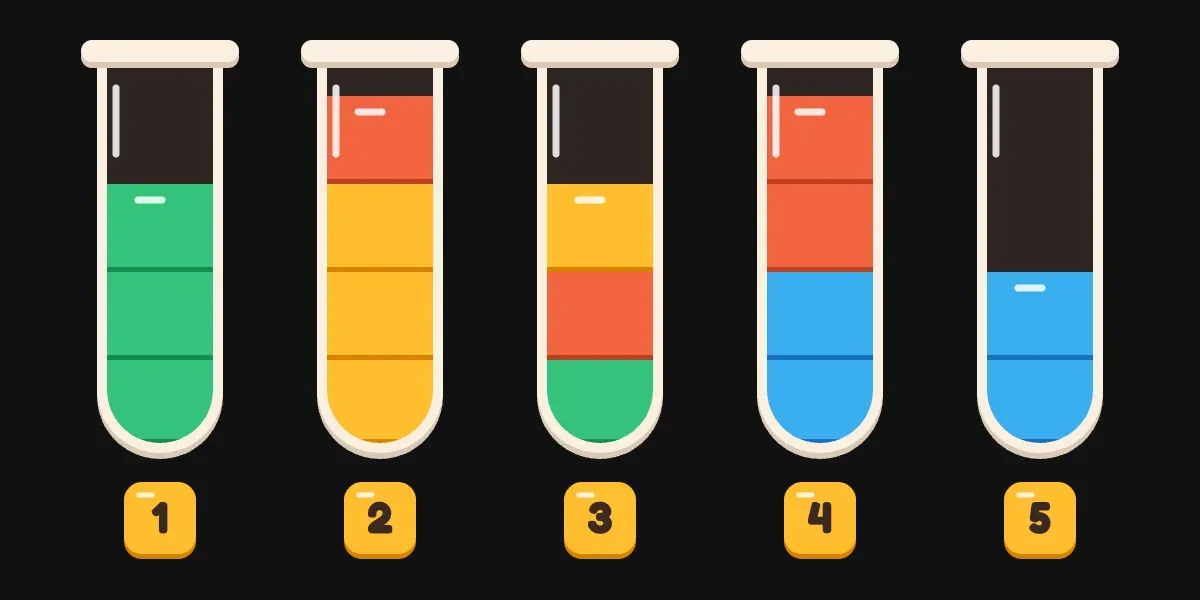
The winning line takes seven pours:
- Tube 2’s red goes onto the empty tube 5.
- Tube 4’s two reds go onto tube 5, which now holds three reds.
- Tube 1’s blue goes onto tube 4, which now holds three blues.
- Tube 3’s blue goes onto tube 4: four blues.
- Tube 3’s yellow goes onto tube 2: four yellows.
- Tube 3’s red goes onto tube 5: four reds.
- Tube 1’s three greens go onto tube 3, which holds one green: four greens.
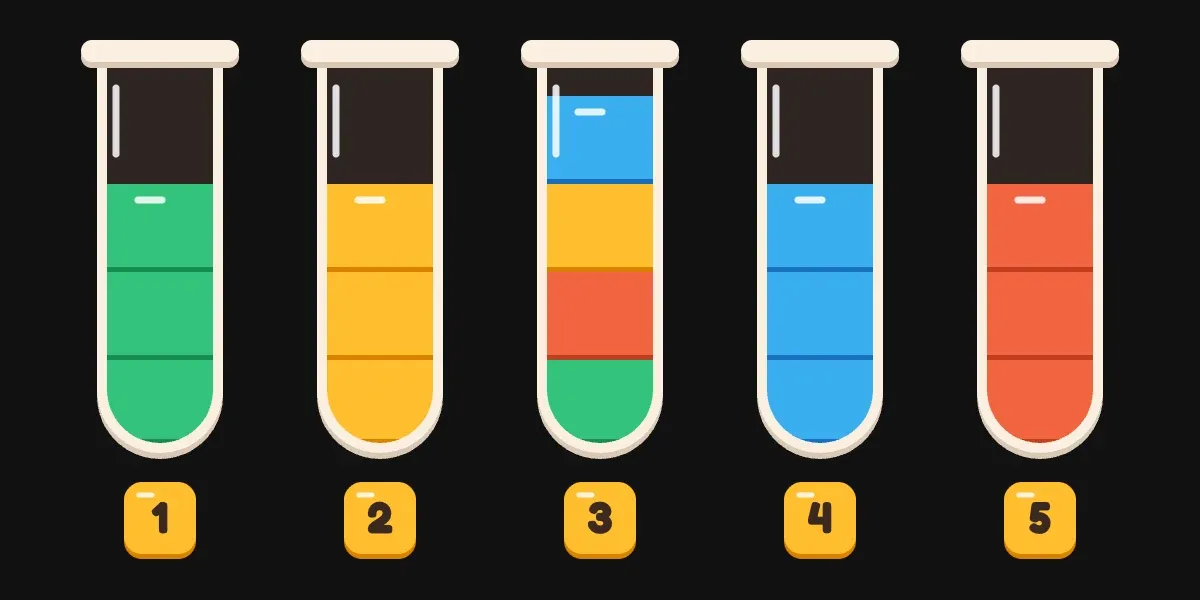
Which habits does it show? Red is the anchor (habit 2), and it goes into the empty tube because both red tops are about to join it (habit 1). You check the layers under each pour (habit 3), and each step is planned three pours deep (habit 4).
Try it yourself
Here’s a new puzzle.
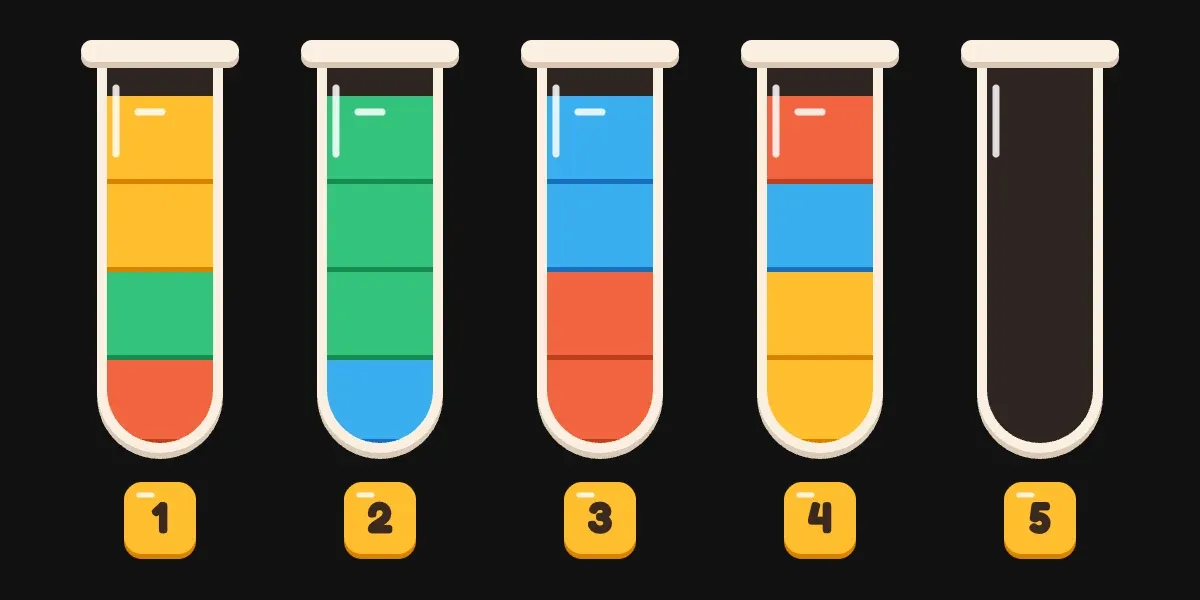
Hint: three of the four possible first pours lose. Only one wins: the green block from tube 2 into the empty tube 5.
Show the answer
Seven pours.
- Tube 2’s three greens go onto tube 5.
- Tube 3’s two blues go onto tube 2, which now holds three blues.
- Tube 4’s red goes onto tube 3, which now holds three reds.
- Tube 4’s blue goes onto tube 2: four blues.
- Tube 1’s two yellows go onto tube 4: four yellows.
- Tube 1’s green goes onto tube 5: four greens.
- Tube 1’s red goes onto tube 3: four reds.
Every tube is now one colour or empty.
Water sort puzzle tips: a quick checklist
- Keep one tube empty.
- Pick an anchor colour and commit.
- Look under the top colour before you pour.
- Plan three pours ahead.
- Use undo to explore, not to panic.
- Restart on the second dead end.
Puzzles with a different kind of stuck? Try how to get better at logic puzzles for habits that carry over, or merge game tips for another kind of game.