Mahjong solitaire tips start with one lesson: the pair that looks fine can be the pair that locks the board. You match a pair, then another, and suddenly no free tiles match, because the first pair was the mistake. Below: the rule, seven habits that keep the board open, and a tiny board where one careless match ends the game. This is the solo tile-matching game, not the four-player mahjong with scoring.
How mahjong solitaire works
Mahjong solitaire is a solo game: tiles are stacked in a layout, and you remove two matching tiles at a time until the board is empty. Many sets match by picture or number, and flowers and seasons often match any tile in their group. Rules vary by version.
A tile is free when nothing lies on top of it and its left side or its right side is open. A tile with a neighbour on both sides, or a tile with another tile covering it, is blocked.
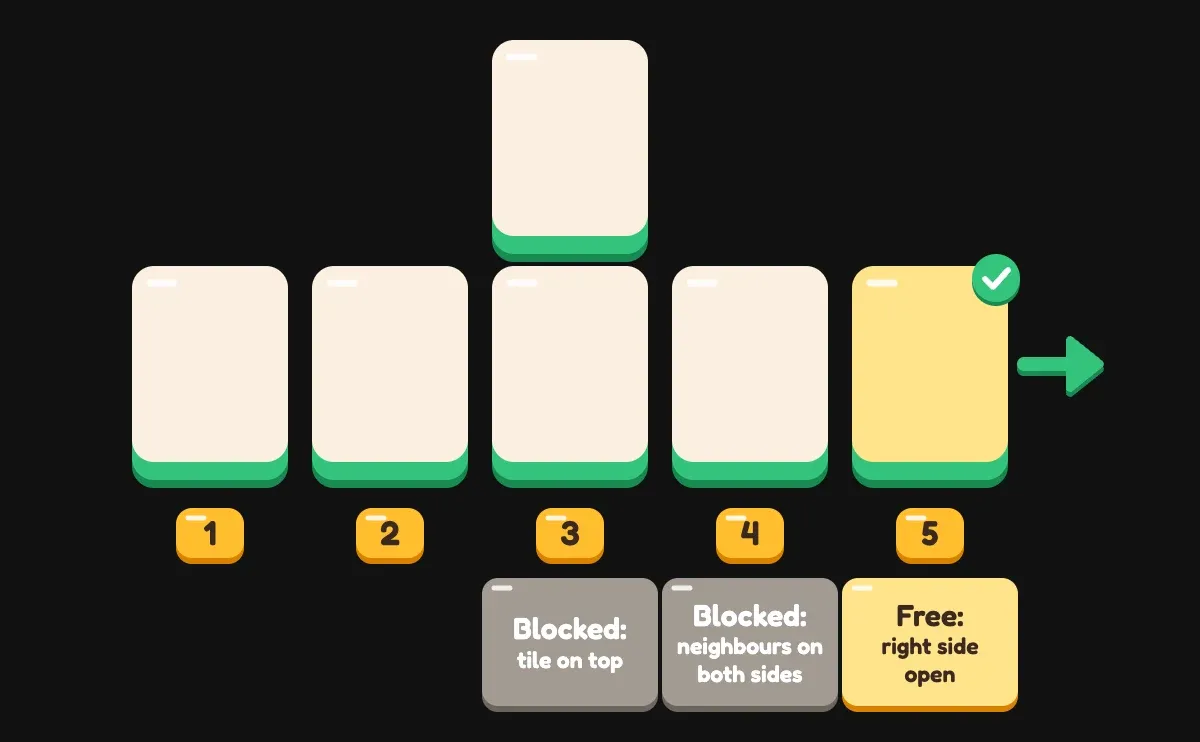
You win by clearing every tile. No two free tiles match? You’re stuck. Some deals can’t be won, so being stuck isn’t always your fault.
1. Scan the whole board before your first move
Beginners usually take the first pair they see. Before any move, find every free tile and note which of them match.
Look for kinds with four identical tiles. You’ll have a choice of which two to remove, and that choice matters (see habit 4).
Make it a ritual: look over the whole board for a few seconds before you start, and again every few moves.
2. Prefer matches that free new tiles
Ask of each possible pair: what does removing it open? Take the pair that uncovers a tile or opens a side, not a pair that opens nothing.
Removing the end tile of a row frees the next tile along. Take two tiles from the middle of a row, with their neighbours still in place, and you often free nothing.
3. Clear tall stacks and long rows early
A tile under a stack stays locked until everything above it is gone, so a deep stack hides many tiles. Work on tall stacks and long rows first, so the hidden tiles show up while you still have choices.
Short, open areas can wait. They stay available.
4. With four identical tiles, choose which pair to take
More than two matching tiles free? The pair you take matters. Take the pair that opens the most new free tiles, and leave the others for later.
The worked board below shows this: three A tiles are free, and one of the three possible pairs ends the game at once.
5. Check that no tile sits on top of its only twin
If the last two tiles of a kind are stacked, one on top of the other, they can never be matched: the top one can only leave with its twin, which is under it. Spot this early, while other tiles can still move.
General version: before you remove a tile, ask whether it’s the only way to free its twin, or a tile that something else depends on.
6. Think one move ahead, and use undo
Before you confirm a pair, picture the board after it. Is there still a matching pair among the free tiles? If not, you’re stuck at once, so don’t take that pair. This only catches an immediate dead end, so treat it as a first test, not a full plan.
Many versions have undo, hint and shuffle buttons. Use undo to test an idea. The buttons differ from version to version.
7. Start with simple layouts and learn where tiles are
Easy layouts with few layers hide fewer tiles and show you the patterns. Winning them? Move up.
Keep a mental note of where each kind of tile sits. A buried tile can decide which free tile to keep (habit 4).
A worked board: how one match ends the game
The layout: six tiles in a row, positions 1 to 6 from left to right, with an A on top of positions 3 and 4. The bottom row is B, C, C, B, A, A: eight tiles in all.
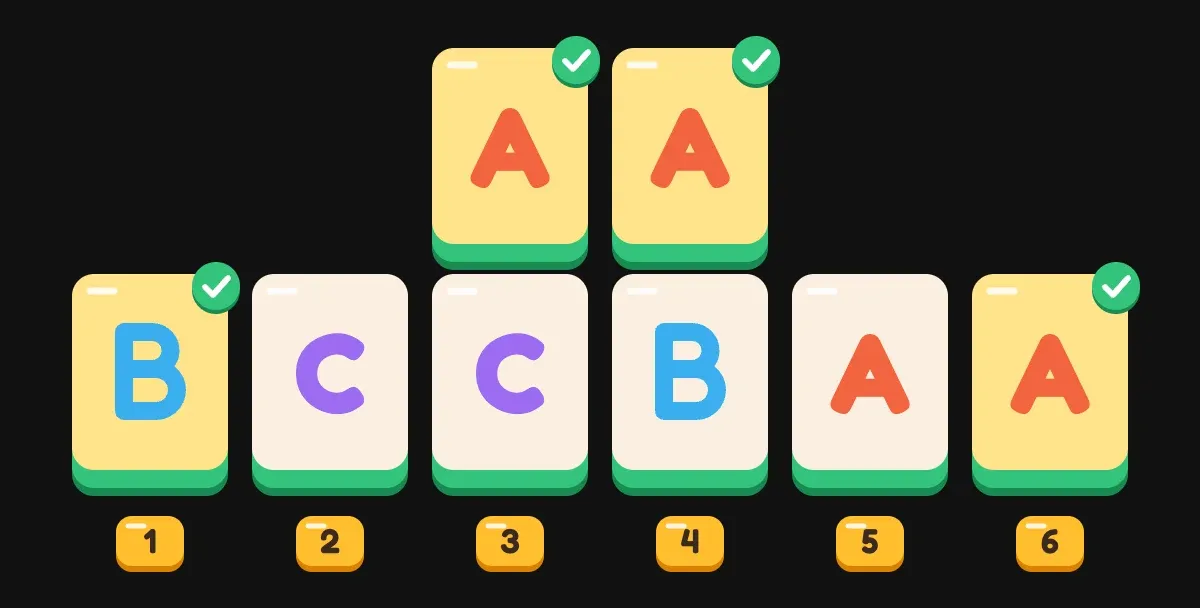
The free tiles are the B at position 1, the A at position 6 and the two top A’s. The only matches are among the three A’s: top 3 with top 4, top 3 with position 6, or top 4 with position 6.
The bad move is to take the two top A’s together. It looks right, since they’re the tallest part of the board. But does it open anything? No: the tiles under them have neighbours on both sides. The B at position 1 and the A at position 6 are left, and they don’t match: stuck after one move.
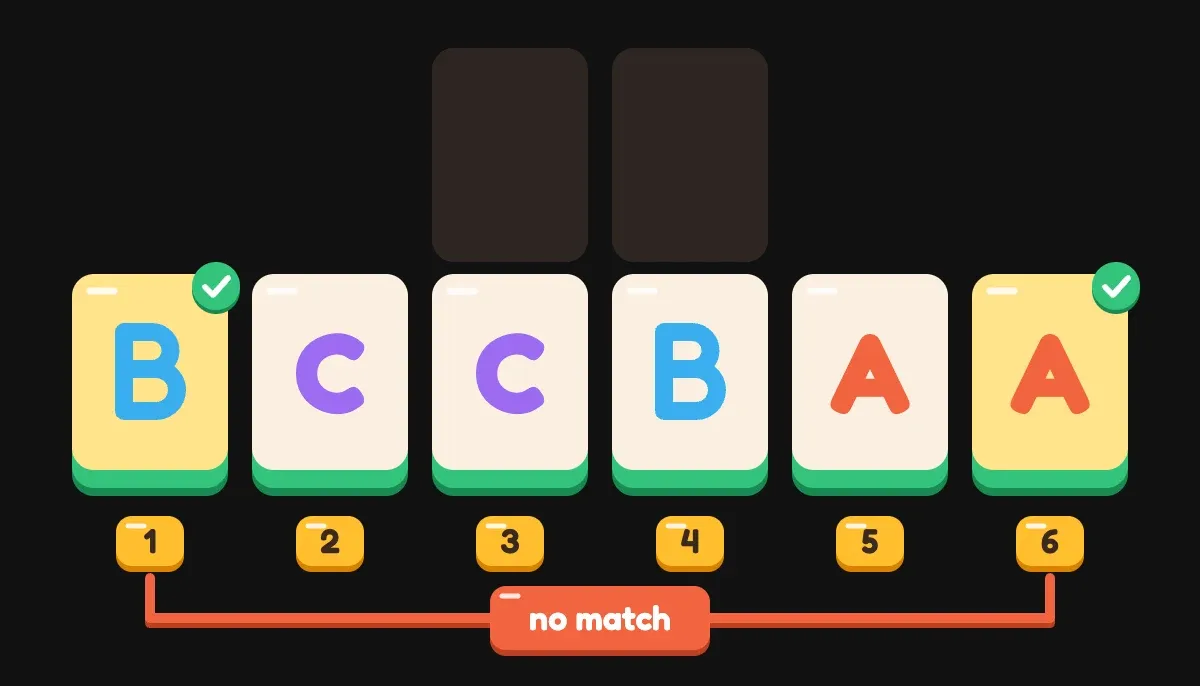
The good line starts with the top A at position 3 with the A at position 6. The A at position 5 now has an open right side, so it’s free.
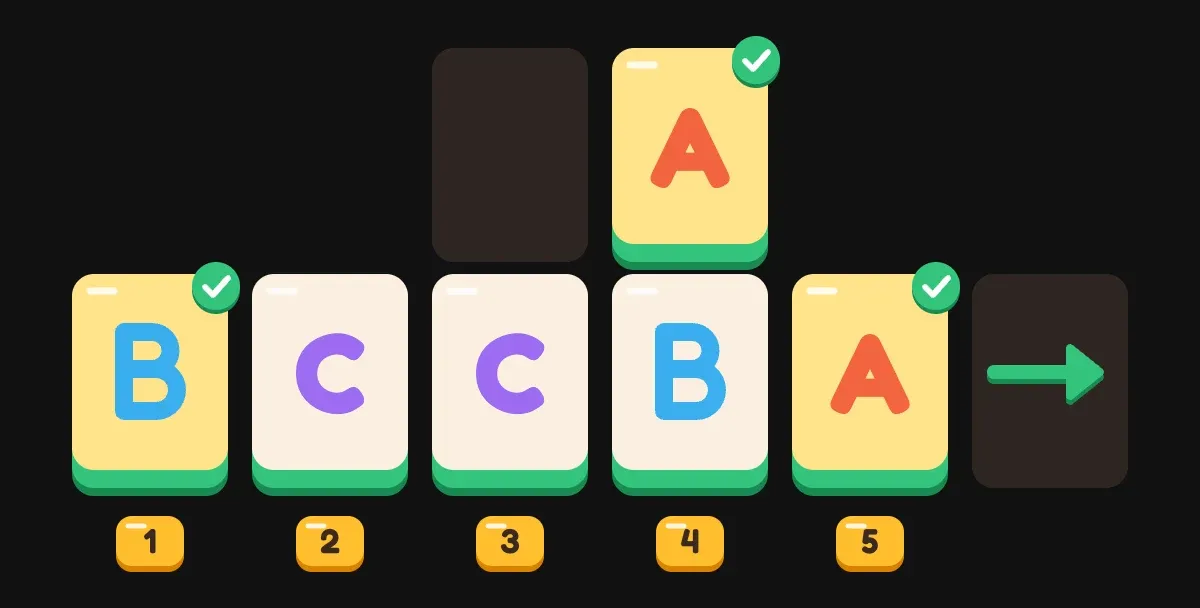
Next take the top A at position 4 with the A at position 5. The row is now B, C, C, B: take the two B’s, which are both free, then the two C’s. The board is cleared in four moves.
The obvious clear-the-stack pair was the trap. The end tile of the row was the key: take a free end tile when it opens the next one (habits 2 and 4).
Mahjong solitaire tips for when you’re stuck
First check that you haven’t missed a pair: re-scan every free tile.
Then undo a few moves and take a different pair of the same kind (habit 4).
No undo? Use the shuffle or hint if your version has one, or restart the deal. Some deals can’t be won, so a loss isn’t always your mistake.
Start with an easy layout and play one game using only habits 1 and 2. Then add one more habit per game.
Same thinking, other games: try how to get better at logic puzzles or water sort puzzle tips.