
Hidden object games tips matter most when you’re stuck on the last item: the list is down to one word, the picture is a blur, and the timer or your patience is running out. The last item is often the hardest one to spot, so it pays to have a plan for the whole scene rather than a lucky guess. Here are seven habits that work on almost any scene, a one-minute drill to practise them, and a checklist to copy.
1. Scan the scene in a grid
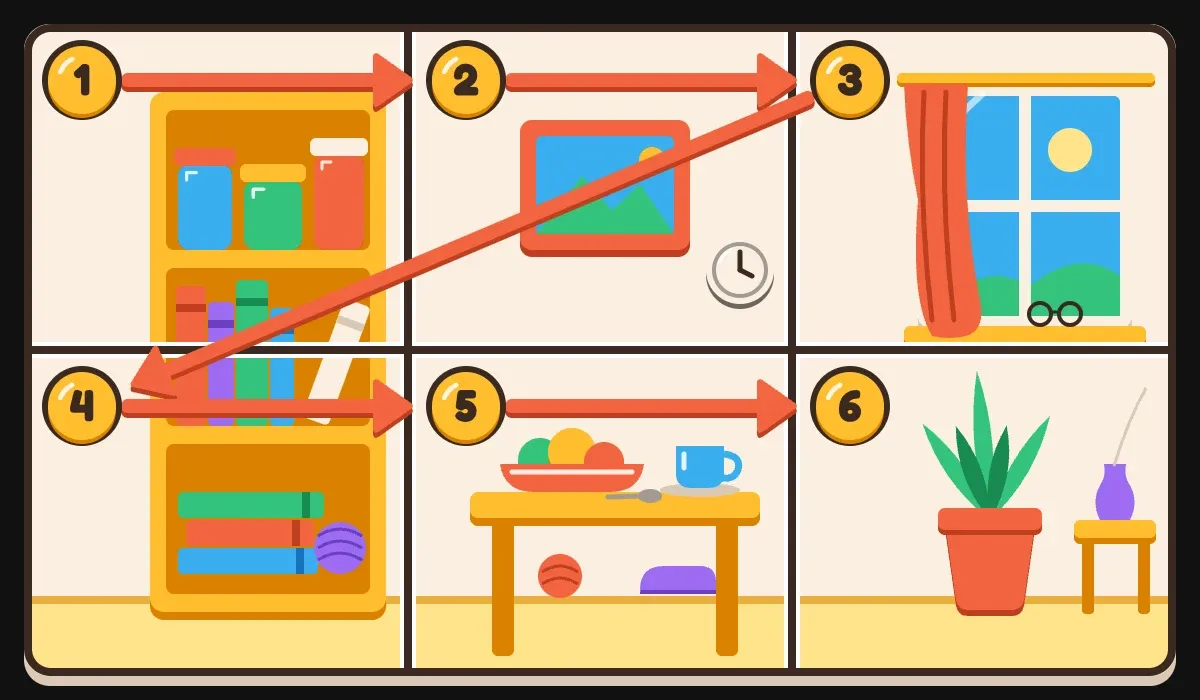
Don’t let your eyes jump around. In your mind, split the scene into six blocks: three across and two down. Then sweep one block at a time, left to right and top to bottom, like reading a page.
Why does a fixed order work? Random looking re-checks the same spots and skips others. Sweep every block in turn and you see each part once, so you know what’s left.
2. Search by shape first, then by colour
Before you look for “a key”, picture its outline: a small circle with a long stem. A shape still reads when an item is partly covered or in shadow. Colour often doesn’t, because the scene can fade or tint it.
Use colour as a quick second filter. Let your eye pass over the scene looking only for one colour, such as every bit of red.
Some shapes to start with:
- scissors: two loops and a V
- a spoon: an oval with a line
- a feather: a thin curve with a fringe
3. Read the list for patterns
Read the whole list before you start, not one word at a time. Group the items: round things, tools, animals, things that belong in a kitchen.
Items in a list are often tied to the scene’s theme, so a group tells you where to look first. Kitchen things go near the stove or the table. Look for anything that seems out of place, too.
4. Check the edges, shadows and clutter
Items hide at the borders: window frames, door edges, the rim of the screen. They also hide in dark corners, inside piles, behind other objects, and sometimes only part of them shows.
Do a slow pass of the outer edge of the scene, then the darkest area, then the busiest pile. Items can also be in plain sight at the wrong size: very small, or turned sideways or upside down. Look for tilted shapes.
5. Slow down and avoid mis-taps
Many games take away time or points for tapping empty spots, so guessing fast can cost more than looking longer. Check the rules of the game you play, because they differ.
Here’s a rule of thumb: tap only when you’re sure you see the item, not when you think it’s probably there. A steady pace wins over a fast one. Calm scanning gives you one clean pass instead of three rushed ones.
6. Use hints sparingly
Save hints for the last item or two, once you have done a full grid pass. What does a hint used early teach you? Nothing. Used at the end, it shows you where you missed.
When you do use one, note what the item looked like and where it was. Ask yourself why you skipped that block: was it too dark, too busy, or was the item turned sideways? That’s the real lesson. Hints that recharge over time are best kept for when you’re truly stuck.
7. Find the last hidden object: pause and rest your eyes
When the last item won’t show, stop staring. Look away at something far off for 20 to 30 seconds, then look back. Fresh eyes often see what tired ones skip.
Then change how you look. Re-run the grid in the opposite order, from bottom right to top left. Scan for a different shape, or tilt your head or your phone. Re-read the item’s name too: you may be picturing the wrong version. A “bat” might be an animal, while the scene shows a baseball bat, so think of every meaning of the word.
Still stuck? Take a longer break and come back with a clear head.
Practice drill: the one-minute room search
You don’t need a game for this. Pick a messy desk, a drawer or a shelf. Ask a friend or family member to hide one small, everyday thing in plain sight, such as a coin, a button or a paper clip, without moving anything else. Or list five things in the room yourself and find each one.
Read the list, group the items, sweep in the 3x2 grid, then check the edges. Time the whole thing for one minute.
To make it harder, pick tiny items or cut the time limit. Play in turns and swap roles, so each of you hides and searches.
Hidden object games tips: a quick checklist to copy
- Scan in a grid
- Shape, then colour
- Read the list for groups
- Edges, shadows, clutter
- Slow down, no blind taps
- Hints last
- Look away, then look back
Try the drill on your next scene. Want more step-by-step thinking? The logic puzzle habits post covers it too, and physics puzzle games tips shows how to plan a shot.