Here are eight matchstick puzzles with answers: fix a wrong sum by moving one stick, then make squares and triangles from a few sticks. You’ll need toothpicks, craft sticks or pencils, or just a pen to draw lines on paper. Every answer’s hidden under a fold, so you can try first and look after.
How matchstick puzzles work
In a matchstick puzzle you move, add or take away sticks to reach a goal, like a true equation or a set number of squares. Wikipedia describes several kinds:
- Equation puzzles, written with Roman numerals or with seven-segment digits like a calculator’s.
- Picture puzzles, where you rearrange a simple picture made of sticks.
- Lateral-thinking puzzles, where you see the sticks a new way, such as turning a number into a symbol.
- Construction puzzles, where you build a shape from a set number of sticks.
The rules aren’t the same everywhere. BrainBashers asks you to move exactly one stick, while LogicLike lets you move, add or remove one or more. Scientific American’s squares puzzle (more on it below) says every stick must be part of a square.
So here, each puzzle says what to do. Unless it says otherwise, play it like this: pick a stick up and put it down whole (no breaking), and every stick you end with has to belong to the figure, with no loose ends.
Matchstick equation puzzles (move one stick)
To fix an equation you take a stick from one symbol and put it on another, so the total stick count never changes. These puzzles use the standard seven-segment forms: each digit is built from up to seven sticks, named like this.
 aaa
f   b
f   b
 ggg
e   c
e   c
 ddd
The Wikipedia page on seven-segment displays lists which sticks make each digit. A 0 uses a, b, c, d, e and f. A 6 uses a, c, d, e, f and g (it’s got a tail). A 9 uses a, b, c, d, f and g. Some displays draw the 6 and 9 without the tail or give the 7 a fourth stick, so a puzzle set should say which forms it uses. A plus is two sticks (one flat, one upright), a minus is one, and an equals sign is two.
Every move below was checked by counting sticks and by running it through a short script. This table covers what you’ll use most, one stick at a time:
| Change | Digits |
|---|---|
| Move one stick inside the digit | 0 and 6, 0 and 9, 6 and 9, 2 and 3, 3 and 5 (both ways) |
| Add one stick | 0 to 8, 1 to 7, 3 to 9, 5 to 6, 5 to 9, 6 to 8, 9 to 8 |
| Take one stick away | 6 to 5, 7 to 1, 8 to 0, 8 to 6, 8 to 9, 9 to 3, 9 to 5 |
The digits 1, 4, 7 and 8 can’t change by moving a stick inside them, and 2 and 4 can’t gain or lose one and stay a digit. Like finding the rule in numbers? Then number sequence puzzles work the same muscle.
Puzzle 1: the one Wikipedia uses
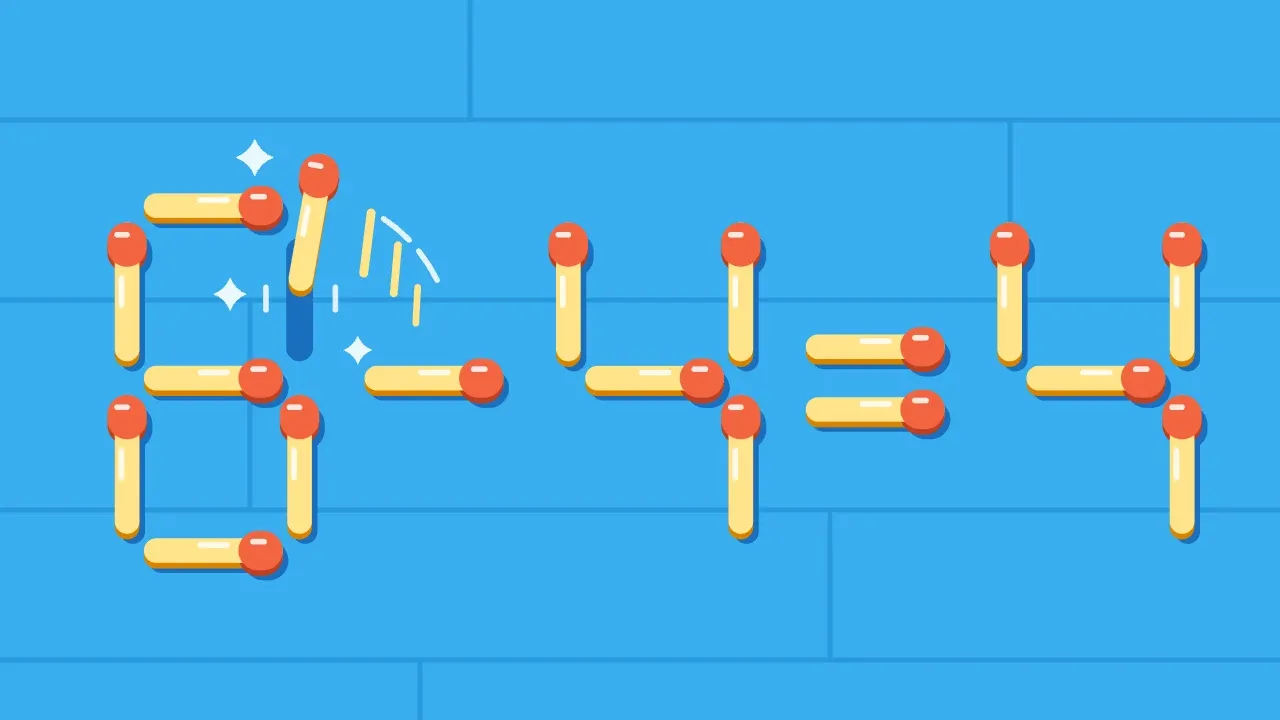
Move one stick to make this true: 6 + 4 = 4
Show the answer
It’s got two answers. The false sum uses 18 sticks, and both answers keep that count.
0 + 4 = 4: take the middle stick (g) of the 6 and put it in the empty top-right spot (b). That makes a 0.8 - 4 = 4: take the upright stick out of the plus, so it becomes a minus, and put it in the 6’s top-right spot. That makes an 8.
Puzzle 2: the plus gives one up
Move one stick to make this true: 5 + 7 = 2
Show the answer
9 - 7 = 2. Take the upright stick from the plus and put it on the 5’s top right (b). A 5 with that stick added becomes a 9, and the plus turns into a minus. There’s only one answer to this one.
Puzzle 3: a minus that wants to be a plus
Move one stick to make this true: 2 - 3 = 6
Show the answer
2 + 3 = 5. Take the bottom-left stick (e) off the 6, which turns it into a 5. Lay that stick across the minus to make a plus. There’s only one answer here too.
Matchstick shape puzzles: squares and triangles
Shape puzzles are all about sharing, since one stick can be the side of two squares at once. Puzzles 4 and 5 are easy to try on paper, and they’re even better with real sticks.
Puzzle 4: two squares from a grid
Twelve sticks make a 2 by 2 grid. It holds five squares: four small ones and one big one around the edge.
+---+---+
|   |   |
+---+---+
|   |   |
+---+---+
Take away 4 sticks and you’ll have exactly 2 squares left, with no loose sticks.
Show the answer
Keep two squares in opposite corners. Twelve sticks minus four leaves eight, and two separate squares take exactly 8. They’re only touching at the middle point.
+---+   +
|   |
+---+---+
    |   |
+   +---+
Keeping the other pair of opposite corners works too. It’s the mirror image.
Puzzle 5: five squares become four
Here’s a plus shape of five squares, made of 16 sticks.
+   +---+   +
    |   |
+---+---+---+
|   |   |   |
+---+---+---+
    |   |
+   +---+   +
Move 2 sticks to leave exactly 4 squares. Squares of any size count, and every stick must be part of a square.
Show the answer
Fill in a corner to make a big square. Pick up the two sticks on the top and left sides of the empty corner below the right arm. Lay them along that corner’s bottom and right sides.
+   +---+   +
    |   |
+---+---+---+
|   |   |   |
+---+---+   +
    |       |
+   +---+---+
Now you’ve got three small squares (top, left and middle) and one big 2 by 2 square. The count is 16 sticks both before and after.
This puzzle has three different answers, not counting turned or flipped copies. They all end with three small squares and one big one.
Puzzle 6: four triangles from six sticks
Make four triangles of the same size using six sticks, each stick the same length.
Show the answer
You can’t do it flat. Build a pyramid. Lay three sticks as a triangle, then stand the other three up from its corners so they meet at a point. The pyramid has four triangular faces and six edges, and each stick is an edge of two faces. Wikipedia’s matchstick puzzle page names the three-dimensional pyramid as the way to do this one.
Easy matchstick puzzles for kids
Both just need squares, and it’s fine for a child to count out loud with real sticks. Use flat toothpicks, craft sticks or lines on paper with young children: toothpicks are pointed, and real matches aren’t toys.
Puzzle 7: take away three
A row of three squares uses 10 sticks.
+---+---+---+
|   |   |   |
+---+---+---+
Take away 3 sticks so that 2 squares are left and every stick belongs to a square.
Show the answer
Remove the top, bottom and right sides of the last square. Seven sticks are left, and that’s exactly two squares sharing a middle stick. You could also clear the first square instead. It’s the same answer, flipped.
Puzzle 8: three squares from ten sticks
Make 3 squares using 10 sticks.
Show the answer
Let the squares share sides. Three separate squares need 12 sticks (3 x 4). In a row of three, the squares share two sides, and 12 - 2 = 10. An L shape of three squares shares two sides as well, so it’s an answer too.
Kids who’ve enjoyed these may like logic puzzles for kids, which have more to think through and no sticks at all.
Are matchstick puzzles good for them? No study of matchstick puzzles in particular turned up. A 2015 study of 847 children aged 4 to 7 found that those who played with puzzles, blocks and board games more than six times a week scored higher on a spatial task than those who played less. The Association for Psychological Science says that shows an association, and the researchers planned experiments to test cause. It wasn’t about matchsticks.
5 tricks for solving matchstick puzzles
- Count the sticks before you touch one. In a “move” puzzle the total never changes. In
6 + 4 = 4there are 18 sticks, and both fixed versions,0 + 4 = 4and8 - 4 = 4, have 18 too. Does the goal need a different count? Then you’re being asked to add or take away. - Try the symbols before the digits. A plus can give up its upright stick and become a minus (puzzles 1 and 2). A minus can take one and become a plus (puzzle 3). Digits don’t change easily, so the signs are a good place to look for a spare stick.
- Look for a stick that does double duty. Does a square seem to cost four sticks? Ask which sides it could share. It’s what puzzles 7 and 8 both turn on.
- Try a twist. Maybe the answer isn’t flat, as in puzzle 6, or maybe a number can become a symbol or a Roman numeral. It’s the same jump as in lateral thinking puzzles. Researchers have used matchstick arithmetic to study this: in Knoblich and colleagues’ 1999 experiments, the abstract says the authors tested, in four experiments, the idea that people get past a block by loosening the limits they assume on a solution and by breaking apart perceptual chunks, and the results were consistent with it.
- Work backwards from the finished figure. List the true equations near the false one, or picture the squares you want, and ask what’s missing. It’s one of the habits for logic puzzles too.
Don’t stop at the first answer. Look for a second. Scientific American’s matchstick squares puzzle, by Heinrich Hemme, has three solutions, and puzzle 1 above has two. Others, like puzzles 2 and 3, have just one, so a good setter says whether to find one answer or all of them.
A pocket puzzle that needs no screen
Matchstick puzzles don’t need any setup, and they’re easy to carry. They also ask for one skill: looking at the same figure in a new way. For more quick ones to share, try 10 brain teasers for a 5-minute break.
Want a screen puzzle with the same look-before-you-move habit? Try it with Loopaway, a free arrow puzzle in your browser where you work out which arrow can slide off first. How arrow puzzles work explains the idea behind it.
Frequently asked questions
How do you solve matchstick puzzles?
Count the sticks first, then work out which symbol or shape can lend a stick and which one needs it. Try the plus, minus and equals signs before the digits, and count the sticks again at the end to check.
How do you fix a matchstick equation by moving one stick?
Take one stick from a symbol and put it on another, so every symbol is still a valid digit or sign and the sum is true. In 6 + 4 = 4, taking the upright stick out of the plus and adding it to the 6 gives 8 - 4 = 4.
Can a matchstick puzzle have more than one answer?
Yes. 6 + 4 = 4 has two answers, and the plus-shaped square puzzle here has three, not counting turned or flipped copies. Others, like 5 + 7 = 2, have just one.
Are matchstick puzzles good for kids?
They're hands-on, need no screen, and a child can count and move one stick at a time. No study of matchstick puzzles in particular turned up for this post, so enjoy them as play.
Sources
- Matchstick puzzle (Wikipedia)
- Seven-segment display (Wikipedia)
- Matchstick Puzzles - BrainBashers
- Matchstick Puzzles with Answers (LogicLike)
- Math Puzzle: Make matchstick squares (Scientific American)
- Constraint Relaxation and Chunk Decomposition in Insight Problem Solving (CEU research portal)
- Playing With Puzzles and Blocks Could Build Children's Spatial Skills (Association for Psychological Science)