Logic puzzles for kids have one answer you can work out from the clues, with no guessing and no outside facts. Six easy ones run from about age 5 to about age 10, each with a hint and an answer you can keep hidden. Read the clue aloud, wait a minute before offering the hint, and only then open the answer.
What makes a puzzle a logic puzzle for kids
The answer comes from the clues, not from knowing something. If a child can reach it by thinking, it’s a logic puzzle. Good ones for kids have a few things in common: one clear answer, short clues, and only a few things to keep track of at once.
Children tend to reason best about things they can see or picture. In Piaget’s well-known stages, Simply Psychology describes logical thinking about physical, easy-to-picture things as starting at about age 7 to 11, and a college textbook gives the same range. So draw the puzzles, or act them out with toys, paper cut-outs or the kids themselves.
The ages below are a rough guide based on how hard each puzzle is, not a rule. Younger kids can enjoy the early ones with a grown-up reading aloud, and older kids may find them quick. If a puzzle stops being fun, put it away. It’ll keep until another day.
1. Who is first in line? (ages 5 to 7)
Three kids stand in line for the slide: Mia, Leo and Sam. Mia is behind Leo. Sam is in front of Leo. Who is first, who is in the middle and who is last?
Show a hint
Start with who you know. Leo has someone in front of him and someone behind him, so where does he stand?
Show the answer
Sam, Leo, Mia. Sam is in front of Leo, and Mia is behind Leo, so Leo has to be in the middle. Sam is first and Mia is last.
This kind of puzzle is about putting things in order. Simply Psychology calls the skill behind it transitive inference: if A is longer than B and B is longer than C, then A is longer than C, without comparing A and C. Three toy figures make it easy to try.
2. The three pets (ages 6 to 8)
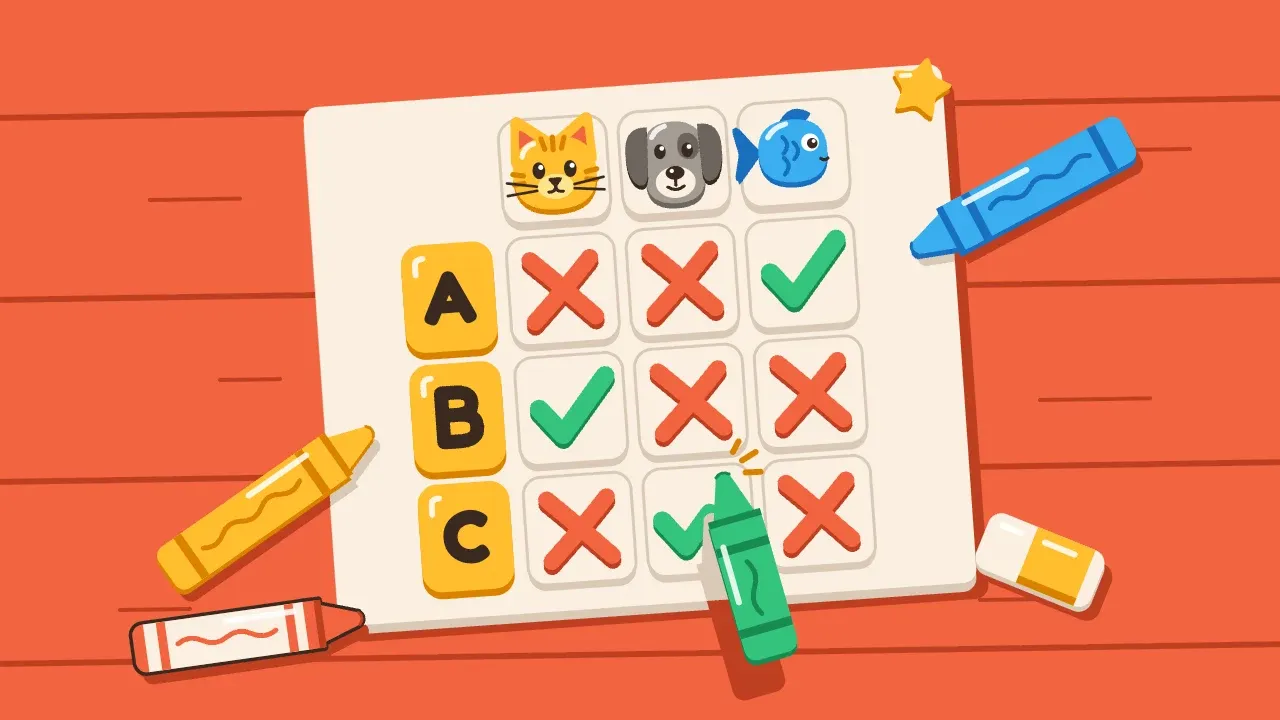
Ana, Ben and Cy each have one pet: a cat, a dog or a fish. Ana’s pet doesn’t have fur. Ben doesn’t have the dog. Who has which pet?
Here’s a grid to copy. Put an X where a pet can’t belong and a tick where it can.
| Cat | Dog | Fish | |
|---|---|---|---|
| Ana | |||
| Ben | |||
| Cy |
Show a hint
Which pets have fur? Use the first clue to cross out two boxes in Ana’s row.
Show the answer
Ana has the fish, Ben has the cat and Cy has the dog. Cats and dogs have fur, so Ana’s pet is the fish. That leaves the cat and the dog for Ben and Cy. Ben doesn’t have the dog, so Ben has the cat and Cy has the dog.
| Cat | Dog | Fish | |
|---|---|---|---|
| Ana | X | X | ✓ |
| Ben | ✓ | X | X |
| Cy | X | ✓ | X |
3. Which one does not belong? (ages 5 to 8)
In each set, one thing is different from the others. Which one, and why?
- Set A: triangle, square, pentagon, circle
- Set B: cat, dog, fish, cow
- Set C: 2, 4, 7, 8
Show a hint
Look for something the three have in common, then find the one that doesn’t have it.
Show the answers
- Set A: the circle. The triangle, square and pentagon have straight sides and corners. The circle has neither.
- Set B: the fish. The cat, dog and cow have legs and fur. The fish has neither. Another rule works too: the cow is the only one that isn’t a pet.
- Set C: 7. The others are even numbers, and 7 is odd.
More than one rule can work, and that’s fine. If a child picks a different answer and has a reason, listen to it. In Set A, for example, the triangle could be the odd one out because it has the fewest sides. The reason matters more than the “right” answer.
4. What comes next? (ages 6 to 9)
Find the pattern, then say what comes next.
- a. A A B A A B A A ?
- b. 5, 10, 15, 20, ?
- c. 1, 2, 4, 8, ?
Show a hint
For each one, say the pattern out loud as if you were clapping it. What repeats, or how does each step change?
Show the answers
- a. B. The pattern is A A B, over and over, so after two As comes a B.
- b. 25. You’re counting by 5s: each number is 5 more than the one before.
- c. 16. Each number is double the one before it: 1, 2, 4, 8, 16.
Counting by 2s (2, 4, 6, 8) works the same way as the 5s, if you want an easier warm-up. Ready for the next step up? Try number sequence puzzles.
5. The fox, the chicken and the corn (ages 7 to 10)
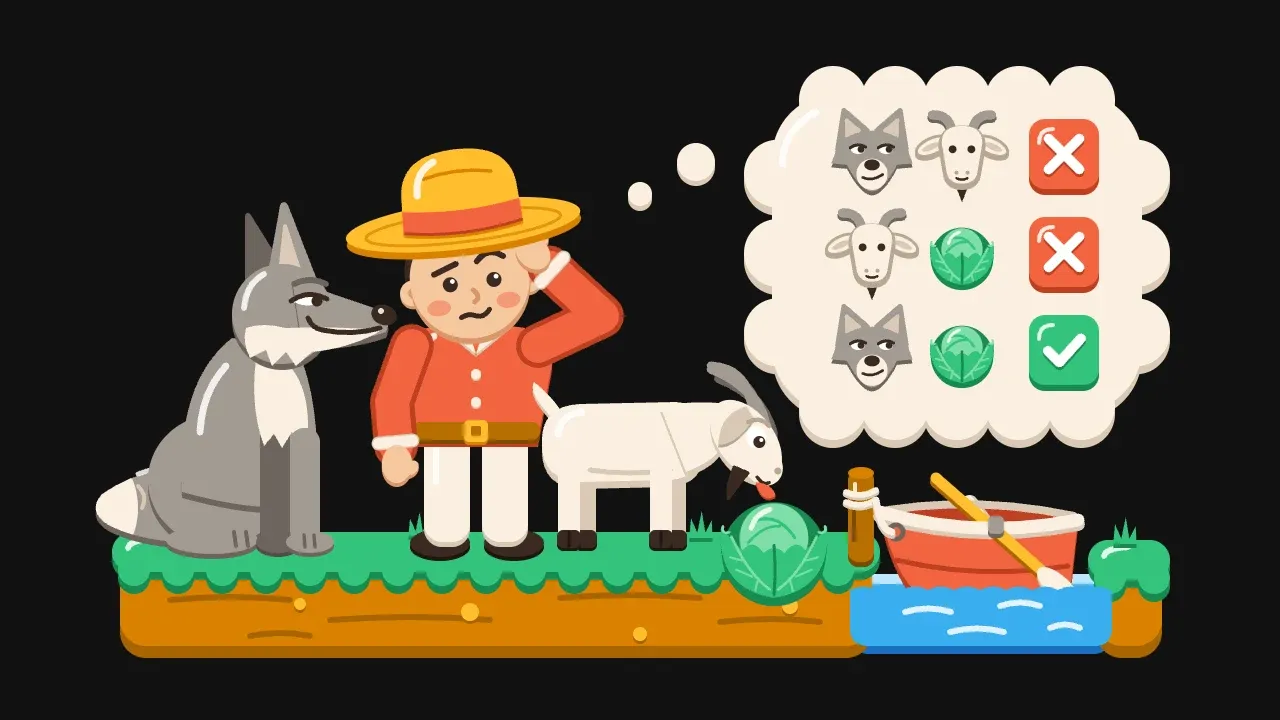
A farmer needs to take a fox, a chicken and a bag of corn across a river. The boat holds the farmer and one thing at a time. If the farmer leaves the fox alone with the chicken, the fox eats the chicken. And if the farmer leaves the chicken alone with the corn, the chicken eats the corn. How does everything get across?
Show a hint
Which one is in trouble with both of the others? Take that one first.
Show the answer
It takes 7 crossings, four forward and three back.
- Take the chicken across.
- Go back alone.
- Take the fox across.
- Bring the chicken back.
- Take the corn across.
- Go back alone.
- Take the chicken across.
You can swap the fox and the corn in steps 3 and 5, and it works just as well. The trick is step 4: bringing the chicken back feels like going backwards, but it’s what keeps everyone safe.
It’s an old puzzle. One of the oldest known versions, with a wolf, a goat and a cabbage, is Problem 18 in Propositiones ad Acuendos Juvenes (“Problems to Sharpen the Young”), a medieval Latin collection attributed to Alcuin of York, who died in 804. The Bosbury History Resource gives the same 7-crossing solution. Want harder versions? See river crossing puzzles with answers.
6. A four-friends grid (ages 8 to 10)
Amy, Ben, Cal and Dee each have one snack: an apple, a banana, a cookie or grapes. Use the clues to find out who has what.
- Amy has the cookie or the grapes.
- Ben has the apple or the banana.
- Cal doesn’t have the banana or the cookie.
- Dee doesn’t have the grapes or the banana.
- Amy doesn’t have the grapes.
Copy this grid and cross out as you go.
| Apple | Banana | Cookie | Grapes | |
|---|---|---|---|---|
| Amy | ||||
| Ben | ||||
| Cal | ||||
| Dee |
Show a hint
Put clues 1 and 5 together. They tell you one friend’s snack for sure.
Show the answer
Amy has the cookie, Ben has the banana, Cal has the grapes and Dee has the apple.
Clue 1 says Amy has the cookie or the grapes, and clue 5 says it isn’t the grapes, so Amy has the cookie. Dee can’t have the grapes or the banana, and the cookie is taken, so Dee has the apple. Cal can’t have the banana or the cookie, and the apple is taken, so Cal has the grapes. That leaves the banana for Ben, which fits clue 2.
| Apple | Banana | Cookie | Grapes | |
|---|---|---|---|---|
| Amy | X | X | ✓ | X |
| Ben | X | ✓ | X | X |
| Cal | X | X | X | ✓ |
| Dee | ✓ | X | X | X |
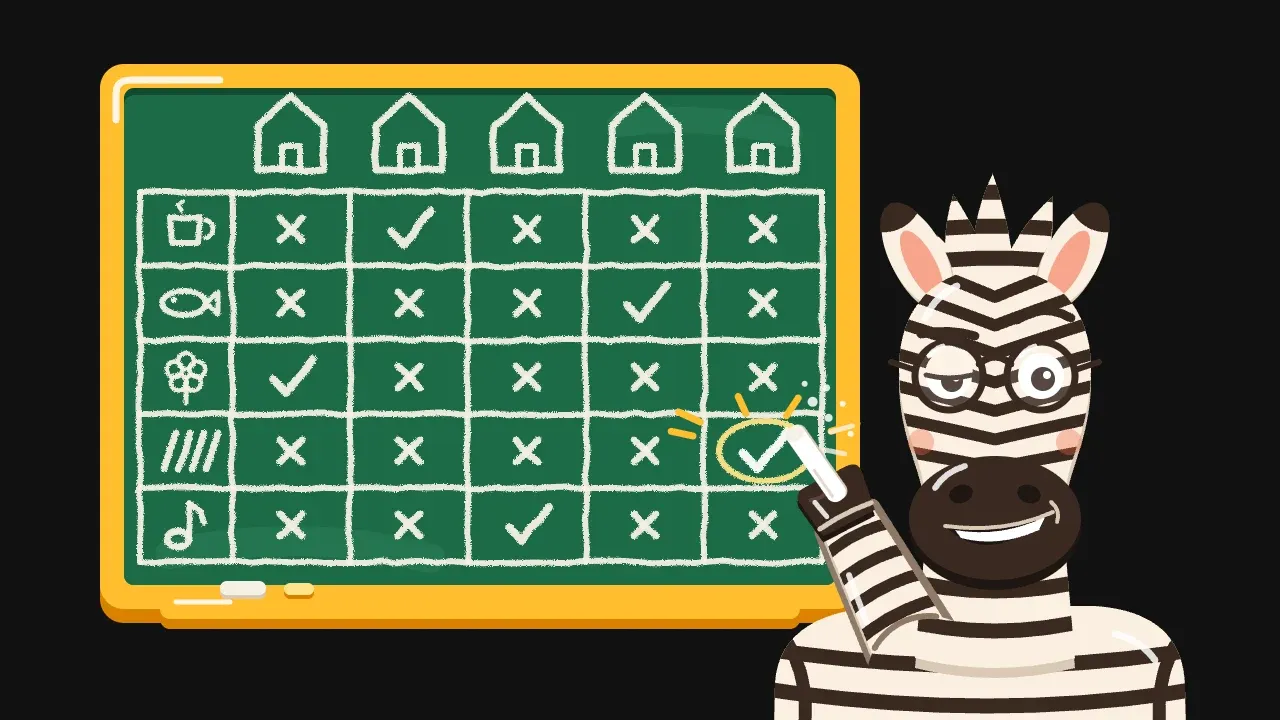
This is a small version of the grids in zebra puzzles. How to solve zebra puzzles teaches the full method, and zebra puzzles with answers has more to try once this one feels easy.
How to help a child who is stuck
Being stuck is normal, and the best help gives a nudge without giving the answer. NRICH, the University of Cambridge’s maths site, says being stuck “can, in fact, be a good thing”. Try these five moves in order:
- Read the clue again. Say it aloud, slowly. A small word like “doesn’t” is easy to miss.
- Find the clue with the fewest possibilities. In the pets puzzle, “doesn’t have fur” leaves only one pet. Start there.
- Draw it. Use a grid, a line of dots for the queue, or toys on the table. NRICH suggests drawing a diagram or making a model.
- Cross out what can’t be. Each X shrinks the puzzle, and sometimes only one option is left.
- Take a break. NRICH suggests sleeping on a problem and coming back to it later. Try a snack and a few minutes away, then come back.
While they work, let the child lead. Stanford’s DREME network gives tips for puzzle play with young children: guide with words and gestures instead of placing pieces yourself, and praise effort (“You worked hard on that”) rather than ability (“You’re so good at puzzles”). Want more habits that work at any age? See habits for getting better at logic puzzles.
Where to go from here
Are logic puzzles good for kids? They make fun practice for careful thinking, and that’s about as far as the evidence here goes. The one study found, Levine and colleagues’ 2012 paper, followed toddlers aged 26 to 46 months. Those who played with puzzles had better spatial skills at 54 months. But those were jigsaw-type puzzles, not logic puzzles. And the study couldn’t show that puzzle play caused the difference.
When these six feel easy, brain teasers with answers are a good next stop. For a screen puzzle, try it with Loopaway, a free arrow puzzle in your browser with no timer.
Its page lists no age rating, so play the first levels yourself to see if it fits. It’s one of several free puzzle games that need no download or account.
Frequently asked questions
What are logic puzzles for kids?
They're puzzles with one answer that you reach by reasoning from the clues, without needing any outside facts. For kids, the clues are short and there are only a few things to keep track of.
What age can kids start doing logic puzzles?
There's no fixed age. Piaget's well-known stages place logical thinking about things you can see or picture at about 7 to 11, and the first puzzles here suit about 5 to 7 with the clue read aloud and toys to move around. Try one and stop if it isn't fun.
How do you help a child who is stuck on a logic puzzle?
Read the clue again, find the clue with the fewest possibilities, draw it, cross out what can't be, and take a break. Let the child lead, guide with words instead of placing the pieces yourself, and praise effort.
Are logic puzzles good for kids?
They're a fun way to practise careful thinking. No study found for this post shows that logic puzzles improve reasoning: the one study, on toddlers' jigsaw-type puzzles, linked puzzle play to spatial skill but couldn't show cause.
Sources
- Concrete Operational Stage (Simply Psychology)
- 10.3: Piaget- Concrete Operational Stage (Social Sci LibreTexts)
- Early Puzzle Play: A predictor of preschoolers' spatial transformation skill (PMC)
- Propositiones ad Acuendos Juvenes (Wikipedia)
- Alcuin's River Puzzles (Bosbury History Resource)
- Puzzle Play: An Easy Way to Boost Early Spatial and Math Learning (Stanford DREME)
- Getting Started With Solving Rich Tasks (NRICH, University of Cambridge)