Knights and knaves puzzles feel impossible until you know the trick. On an island, some people always tell the truth and the rest always lie, and you have to work out who is who from what they say. Below is one simple method, then five knights and knaves puzzles with answers, from easy to tricky. Each full solution is hidden until you click, so have a go before you look.
The island of knights and knaves: the rules
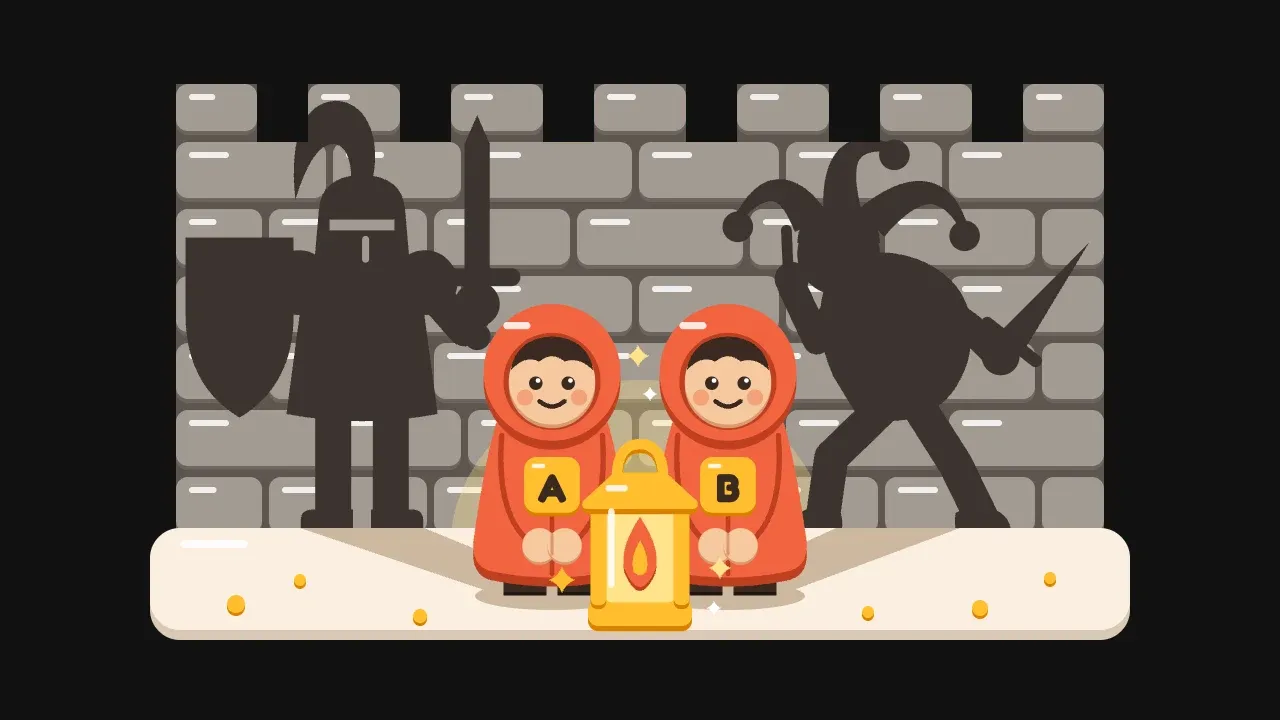
The rules fit on two lines. A knight always tells the truth. A knave always lies. Every islander is one or the other, with nothing in between. Can you tell which by looking? No.
Your goal is to work out, from what the islanders say, who is a knight and who is a knave.
The setup was made famous by the logician and puzzle writer Raymond Smullyan, in What Is the Name of This Book? (1978). That’s all the history you need.
Two short facts make most of these puzzles work. A knight can never say something false, and a knave can never say something true. So nobody on the island can say “I am a knave”. Why? A knight would be lying, and a knave would be telling the truth.
How to solve knights and knaves puzzles: assume, follow, check
The method has three steps:
- Pick one islander and assume they are a knight (or assume they are a knave).
- Follow what that forces. A knight’s words must be true, and a knave’s words must be false.
- If you reach a contradiction, the assumption was wrong, so the other type is right.
Start with the islander whose statement says something about themselves, or with the statement that says the most. Here’s a way to see it: a statement can only be true if its speaker is a knight. So check each statement against its speaker’s type, one at a time.
Worked example: “We are both knaves”
Puzzle: A and B live on the island. A says, “We are both knaves.” B says nothing. What are A and B?
Walk through the method. Assume A is a knight. Then the statement must be true, which makes A a knave too. That’s a contradiction, so the assumption fails: A is a knave.
Since A is a knave, the statement is false. So they are not both knaves, and B must be a knight.
Result: A is a knave and B is a knight. Check it: A’s false claim fits a knave, and B says nothing.
That’s the whole method. The puzzles below use it again, each with a little more to track.
Puzzle 1: “B is a knave” (easy)
A says, “B is a knave.” B says, “A and I are the same type.” Who is who?
Show the answer
A is a knight, B is a knave.
- Assume A is a knight. Then B is a knave. B’s statement, “we are the same type”, is false, because a knight and a knave differ. That fits a knave, so there’s no contradiction.
- Now assume A is a knave. Then B is a knight, and B’s statement must be true, so they would have to be the same type. A and B aren’t, so this is a contradiction.
- So A is the knight, and B is the knave.
Puzzle 2: “B is a knight” (easy)
A says, “B is a knight.” B says, “We are of opposite types.” Who is who?
Show the answer
Both are knaves.
- Assume A is a knight. Then B is a knight too, so B’s statement, “we are of opposite types”, must be true. But both are knights, so it’s false. Contradiction.
- So A is a knave, and A’s statement is false: B is not a knight. B is a knave.
- Check B: a knave says “opposite types”, which is false because both are knaves. That’s a lie, which is what a knave should say.
Puzzle 3: “At least one of us is a knave” (medium)
A says, “At least one of us two is a knave.” B says nothing. Who is who?
Show the answer
A is a knight, B is a knave.
- Assume A is a knave. Then “at least one of us is a knave” is true, because A is one. But a knave can’t say something true. Contradiction.
- So A is a knight, and A’s statement is true. A isn’t a knave, so the knave in the statement must be B.
The lesson: a statement can be true because of its speaker, so look at the speaker first.
Puzzle 4: a chain of three (medium)
A says, “B is a knave.” B says, “C is a knave.” C says, “A and B are both knights.” Who is who?
Show the answer
A is a knave, B is a knight, C is a knave.
- Start with C, whose statement says the most. Assume C is a knight. Then A and B are both knights. But A, as a knight, says B is a knave, which would be false. Contradiction, so C is a knave.
- C’s statement is false, so A and B aren’t both knights. B says “C is a knave”, which is true, so B is a knight.
- A says “B is a knave”, which is false, so A is a knave.
The lesson: in a chain, start where the chain can break.
Puzzle 5: counting knights (tricky)
Three islanders: A, B and C. A says, “We are all knaves.” B says, “Exactly one of us is a knight.” C says, “Exactly two of us are knights.” Who is who?
Show the answer
A is a knave, B is a knight, C is a knave.
- A can’t be a knight. If A were, their statement would be true, which would make A a knave. So A is a knave, and A’s statement is false: at least one of the three is a knight.
- Assume C is a knight. Then exactly two are knights. A is a knave, so B and C are the two knights. But B, as a knight, says exactly one is a knight, which is false. Contradiction, so C is a knave.
- A and C are knaves, so the knight from step 1 must be B. B’s statement, “exactly one of us is a knight”, is then true.
- Check all three: A lies, B tells the truth, C lies.
Quick-check: tips for any knights and knaves puzzle
Five habits to keep handy:
- Write each statement next to its speaker.
- Assume one islander at a time.
- Start with the islander who talks about themselves or who counts the knights.
- A contradiction means the other type is right.
- Finish by checking every statement against its speaker.
Some puzzles have more than one answer, or none. If both assumptions work, or both fail, read the statements again before you trust your answer.
Want a grid method for bigger puzzles? Read how to solve zebra puzzles. For the habits behind every kind of logic puzzle, read how to get better at logic puzzles.
Then try it on a friend. Write your own two-person puzzle, with a knight, a knave and a statement each. Check with the method above that it has exactly one answer, then see whether they can crack it.