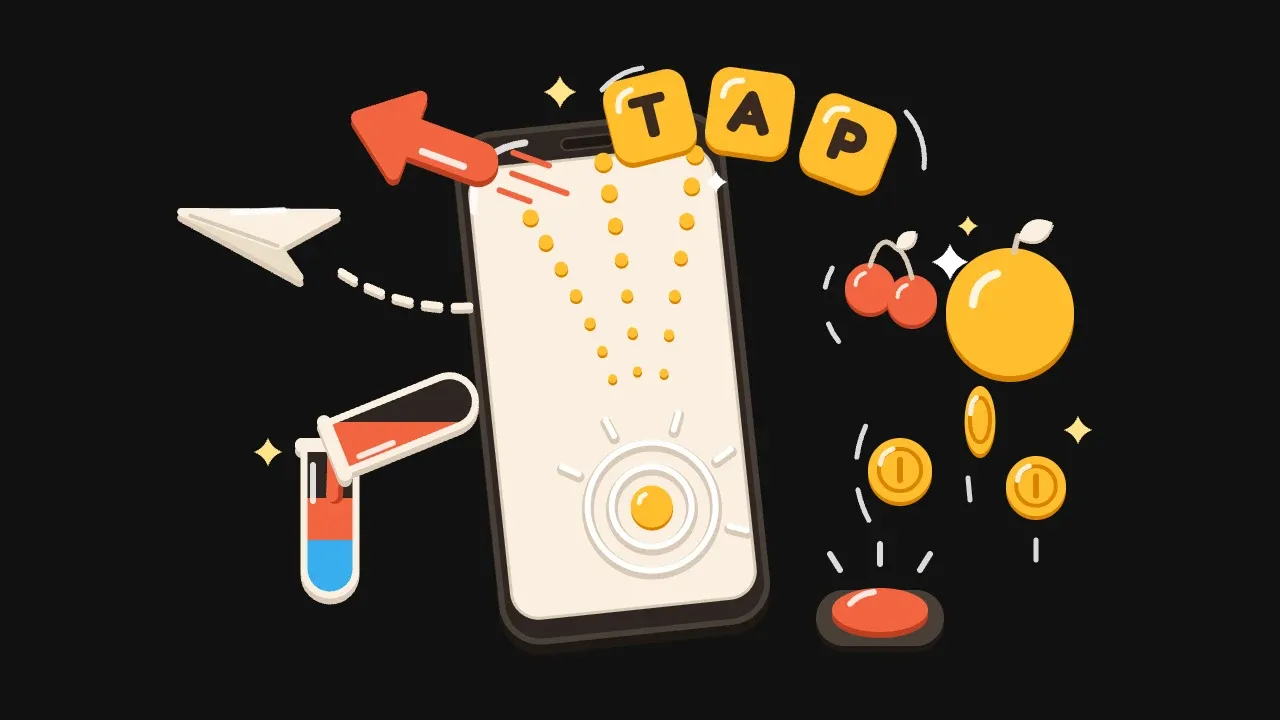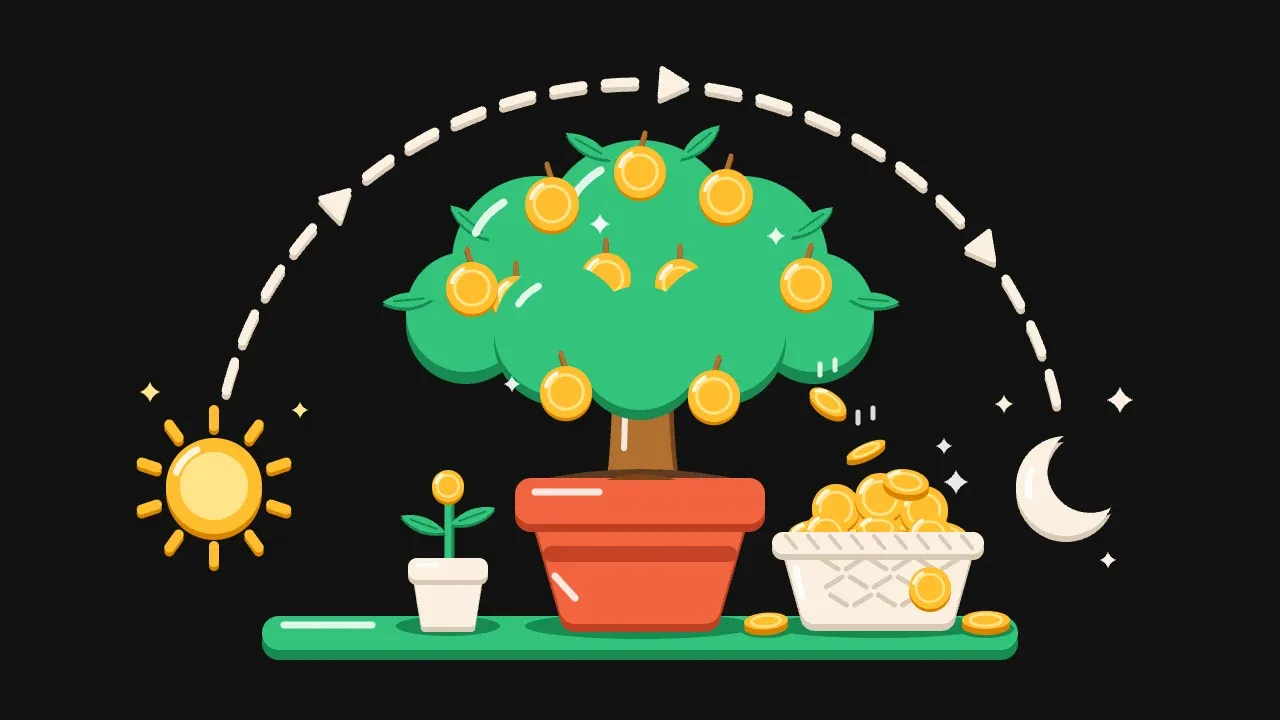
What is an idle game? It’s the kind where you tap a few times, and the numbers keep climbing even with the app closed. You buy helpers that earn for you, so progress carries on while you’re away. Below: how the loop works, one small example with real numbers, how idle differs from incremental, who it suits, and a way to play in two-minute check-ins.
What is an idle game?
An idle game is a game where you do a little at the start, then buy helpers that earn for you, so the numbers grow while you do something else. The genre is also called incremental or clicker games. They share one idea: a number that keeps growing, and things you spend it on.
It isn’t a game of levels to fail, lives or quick reflexes. You can’t lose it. You only play it faster or slower.
Writers describe the genre in slightly different words, so the plain version is the one used here.
1. How idle games work: the three-step loop
The loop has three steps. Then it repeats.
- Step 1, act. You tap or click and earn a first small amount of a currency, such as coins.
- Step 2, automate. You spend coins on a generator, a helper that earns coins by itself every second.
- Step 3, collect. The helpers keep earning, often while the app is closed. You come back to collect, then buy more. How much time away counts varies by game, and some games cap it.
Each round repeats with bigger numbers. What’s the fun? Choosing what to buy next.
2. A worked example with real numbers
The example is invented. One tap gives 1 coin. A generator earns 1 coin per second, and the first one costs 10 coins. Each generator you own makes the next one 15 percent dearer, worked out from the unrounded price and rounded up to a whole coin. The first eight prices are 10, 12, 14, 16, 18, 21, 24 and 27 coins.
Tap 10 times, then buy generator 1 for 10 coins, which leaves you with 0. Then stop tapping and just wait. With no tapping, and spare coins carried over, the timeline runs like this:
- At 12 seconds you buy generator 2 for 12 coins. You have 0 left.
- At 19 seconds you buy generator 3 for 14 coins.
- At 25 seconds you buy generator 4 for 16 coins, with 2 coins spare.
- At 29 seconds you buy generator 5 for 18 coins.
- At 34 seconds you buy generator 6 for 21 coins, with 4 coins spare.
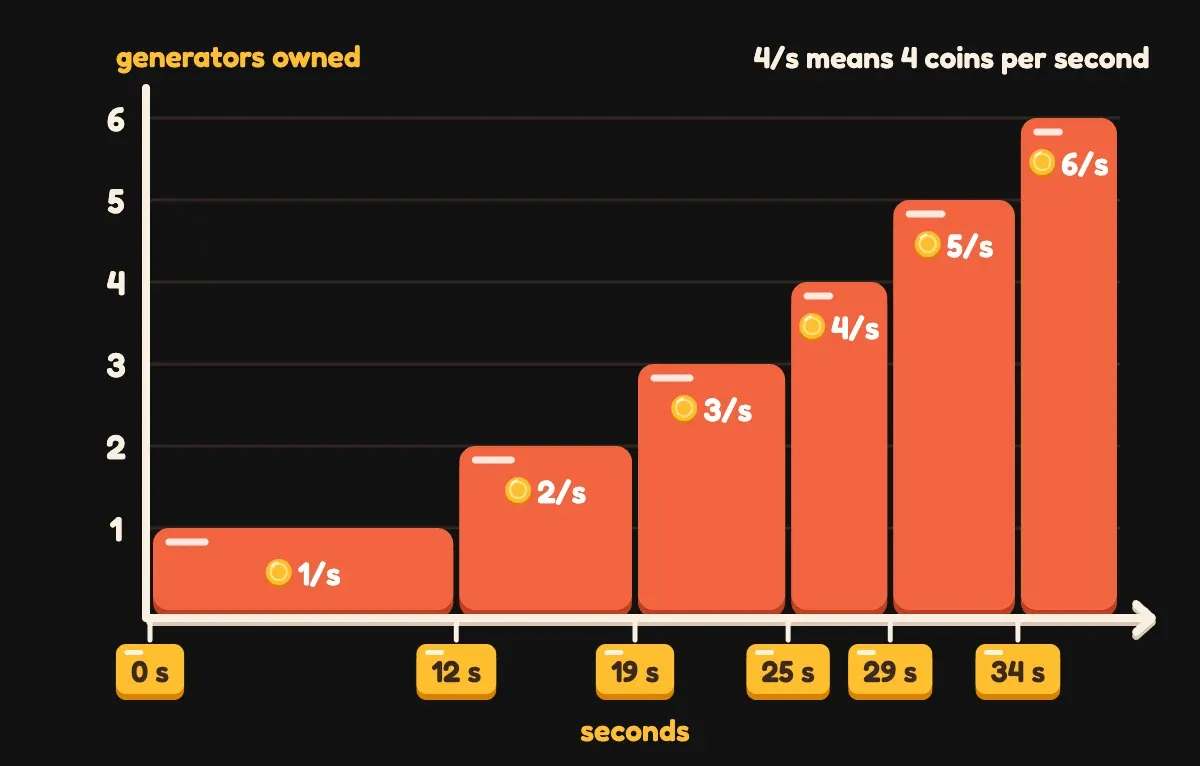
Each helper pays itself back. Early on, income climbs faster than the prices do. Keep going with the same rules and the 20th generator costs 143 coins. Prices outrun income, so growth slows. Many games answer this by adding new kinds of helpers.
If time away counted in full, 6 generators at 6 coins per second for 8 hours would give 172,800 coins (6 × 3,600 × 8). Games differ, so treat that as arithmetic, not a promise.
3. Buy now or save up?
Every idle game raises one main question: spend as soon as you can, or save for something bigger? A simple rule helps. When a purchase pays itself back quickly, compared with how long you’ll be away, buy it. In the example, generator 2 returns its 12 coins in 12 seconds, so buying it early beats saving up.
In real games the best buy changes as you go. The skill is comparing each price with what it adds. No maths beyond that.
Idle game vs incremental game
Most people use the two words for the same kind of game.
The finer version, as players and writers describe it: incremental is the wider family, any game built around growing numbers. Idle is the narrower part, where progress continues while you are away and playing is optional. An incremental game without that keeps you choosing and clicking. Players argue over the labels too. Treat this as community habit, not a rule.
A quick comparison:
- What you do: in an incremental game you keep choosing and clicking; in an idle game you set helpers up, and the numbers grow on their own.
- While you are away: an idle game keeps earning; an incremental game without that waits for you to play again.
- How often you check in: an idle game suits short check-ins; the other kind asks for more of your time.
Who enjoys idle games (and are they worth playing?)
Are idle games worth playing? It depends on what you want from a game.
They suit people with a few spare minutes who like watching numbers grow or planning small upgrades, or who want a calm game in the background. They may not suit people who want a challenge, a story or quick reflexes.
Some players call the genre relaxing. Others find it dull.
How to play in 2-minute check-ins
- Open it, collect, spend everything useful, and close it.
- Buy the cheapest thing that adds the most.
- Plan what to buy before a longer break, such as lunch or bedtime.
- Don’t chase the numbers all day.
- Treat any timers as optional.
The whole routine fits in three lines you can copy:
Collect.
Buy.
Close.
Try it on paper
Check it with a pen. Use the same rules as the example: tap 10 times, buy generator 1 for 10 coins, then stop tapping. Generators 1 to 5 cost 10, 12, 14, 16 and 18 coins. When does generator 4 arrive, with no more tapping?
Show the answer
25 seconds, with 2 coins spare. Generator 3 arrives at 19 seconds, so from then you earn 3 coins a second. By 25 seconds you have 18 coins: generator 4 costs 16, which leaves 2.
Want another kind of casual game? Read the merge game tips, or try the hidden object game tips.