Want to know how to play Sprouts? It’s a pencil and paper game for two. It sounds as if it could go on forever, because you only add spots and draw lines, but every game ends within a few moves.
Below: the rules, a whole game drawn move by move, the simple reason it must end, a few tips for a first win, and a twist where the result is fixed in advance.
1. How to play Sprouts: the rules in one minute
You need two players, one sheet of paper and a pencil. Start with 2 spots. Once that feels easy, try 3 or 4.
On your turn, do two things:
- Draw a line, straight or curved, from a spot to another spot, or from a spot back to itself (a loop).
- Put a new spot anywhere on that line.
Three rules govern the lines:
- A line may never cross or touch another line, or itself, or pass through a spot.
- No spot may end up with more than 3 lines. A loop counts as 2 lines on its spot.
- A new spot already has 2 lines (the two halves of its line), so it can take only 1 more.
The player who can’t move on their turn loses. Some players agree on misère instead, where the last mover loses. Agree on which one you’re playing before you start.
Sprouts was invented by John Conway and Michael Paterson, mathematicians at Cambridge University, in the 1960s.
2. A whole game, move by move
Here’s a full two-spot game, with spots A and B. Player 1 goes first. Each spot has 3 lives, one for each line it can still take. A spot with no lives left is dead.
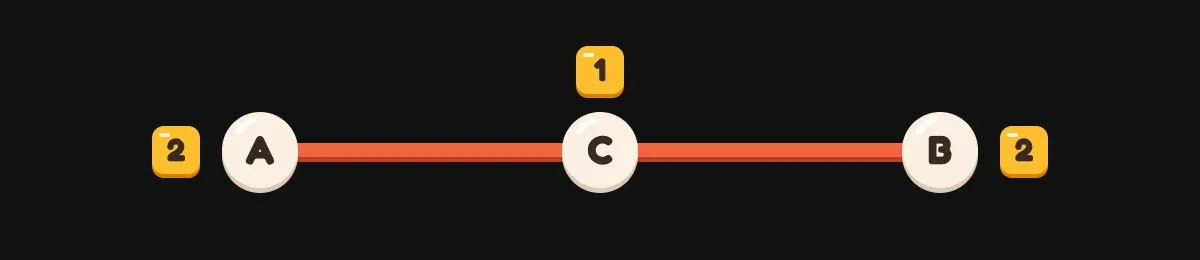
Move 1 (Player 1): Draw a line from A to B and put a new spot C in its middle. Lives left: A 2, B 2, C 1.
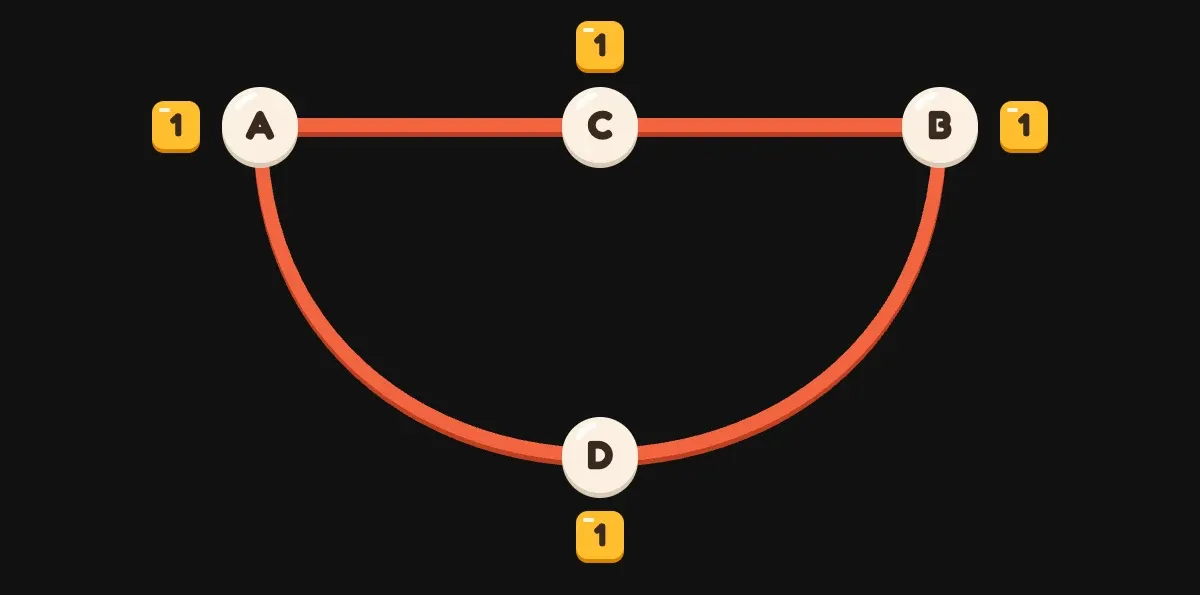
Move 2 (Player 2): Draw a second line from A to B, curving round the other side, and put a new spot D on it. A, B, C and D now form a ring, each with 1 life left. The ring splits the paper into an inside and an outside.
Move 3 (Player 1): Inside the ring, draw a line from C to D and put a new spot E on it. C and D are now dead. This line cuts the inside in two: A touches one half, and B touches the other. Lives left: A 1, B 1, E 1.
Move 4 (Player 2): Inside A’s half, draw a line from E to A and put a new spot F on it. E and A are now dead. B and F each have 1 life, but no line can join them: B lies on the other side of the line C-E-D, and F, with one life, can’t loop back to itself. Player 1 has no move, so Player 2 wins.
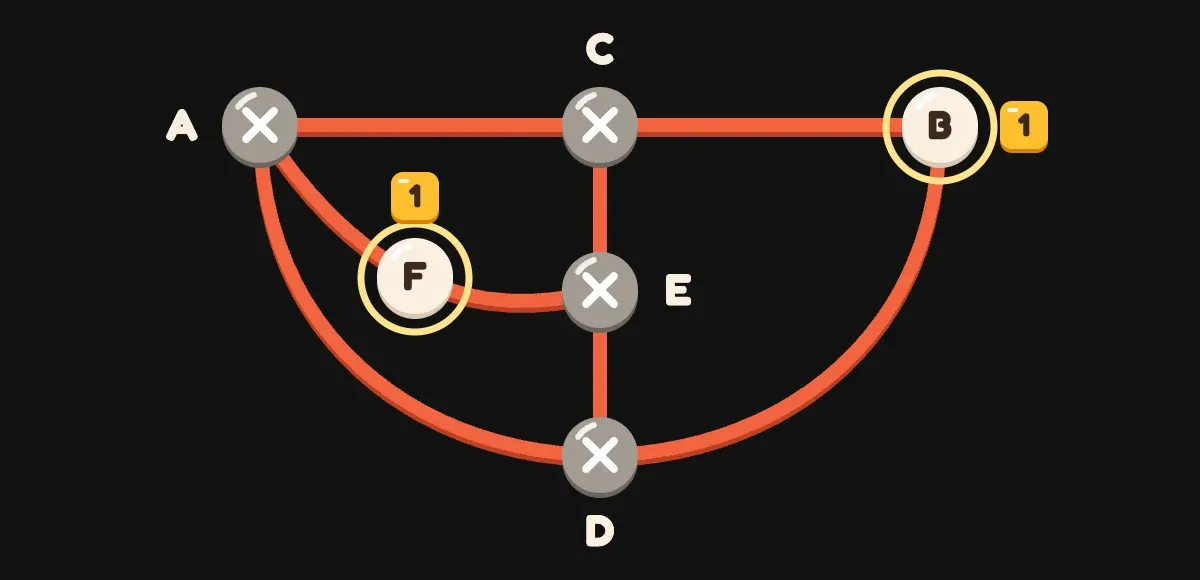
This game lasted 4 moves. Could a two-spot game last longer? Yes, but at most 5, as section 3 shows.
3. Why Sprouts always ends
Each spot starts with 3 lives, so a two-spot game starts with 6.
Every move uses 2 lives (one at each end of its line, or two on one spot for a loop), and the new spot brings in 1 life. So what does each move cost? Exactly 1 life in total. In the game above, the total went 6, 5, 4, 3, 2.
A move needs 2 lives. Only 1 left? Nobody can move. A two-spot game therefore lasts at most 5 moves. In general, n starting spots give at most 3n - 1 moves. The game can’t end too soon either: it always lasts at least 2n moves. That’s a known result, and it isn’t proved here.
The game can look endless, but the lives run out. Counting them tells you the most moves still possible.
4. How to win at Sprouts
The last mover wins, so you’re playing for whether the number of moves left is odd or even. Before each move, count the lives left.
- Keep spots reachable. Joining two different spots keeps more options open for both players.
- Check what a line walls off. A line that cuts a spot off from every other spot with a life leaves that life unused. Move 3 did this: it walled B off from A’s half, so B could never meet F.
- If you lose as first player on 2 spots, try 3. With perfect play, the second player wins the 2-spot game. For 3, 4 or 5 starting spots (and again every 6 after that), the first player wins. This pattern comes from computer searches. It isn’t proven for every size.
- Play a few games. Note who made the last move each time. The count gets easier to feel.
5. Brussels Sprouts: the version where the result is fixed
Brussels Sprouts is a close cousin, played with crosses (plus signs), each with 4 free ends. A move joins any two free ends with a curved line that crosses no other line, then draws a short stroke across its middle. The stroke makes a new cross, with 4 arms, 2 of them free.
The last mover still wins, but the number of moves is fixed before anyone plays. A game that starts with n crosses always lasts exactly 5n - 2 moves: 3 for one cross, 8 for two. Odd number of crosses? The first player always wins. Even? The second player always does. No choice you make can change that: it’s a one-player game in disguise.
Try a 2-cross game and count the moves. You should get 8.
6. Try it with a friend
Play the two-spot game from section 2, then a three-spot game, swapping who goes first each time.
Can you find a two-spot game that lasts 5 moves? Try it and see.
Want more counting? Try dots and boxes, or the classic tic-tac-toe.